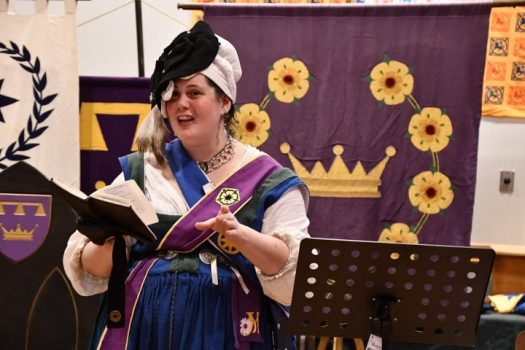
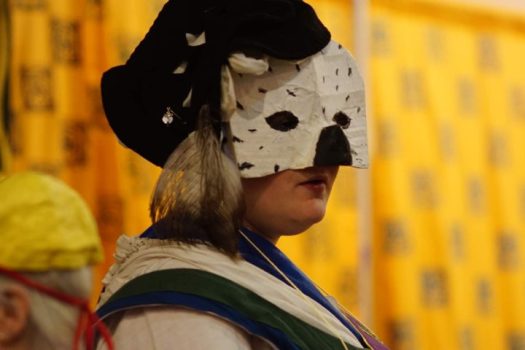
Crown Bardic

Delaware is far! I live in Maine, currently. In order for me to get to Delaware alone I need to fly. I don’t really feel like driving 7-8 hours *without stopping* alone so an airplane it is! Shoot, this is school vacation week as well… Cheapest plane ticket round trip is $300 (still cheaper than driving based on gas, tolls, oil change, wear and tear on tires etc). Oh well. Worth it. Usually tickets are around $150 round trip. Oh man! It’s also my Birthday. Welp, what a better way to spend your Birthday than around friends making music. NAILED IT.
I flew down to spend some time with my Laurel 2 nights before. Her advice and mentorship are always invaluable.
I had spent most of the day when I had silence in the house rehearsing my pieces. It was a luxury to have high ceilings versus my small apartment where I can’t even sing out due to this thing called neighbors. I also hadn’t had much time to practice in front of peers except for at 12th night. I ended up skyping with a few of my trusted friends and fellow performers for feedback. Not only on the performance itself but on my intros. Performance is not just the piece itself; it’s about setting the scene. You want everything to flow and be connected.
The night prior to competition I was surrounded by fellow competitors… no.. friends. That is a better word. Sure, we were in competition with one another, but one of the best things I love about my community is the love and support we share for one another. We all possess several special talents and none of us are the same. It’s a gift that we have such a variety of folks to learn from.

mlady
Day of. Up and at em! A hearty breakfast of nothing but protein to make sure nothing would go awry in my stomach. I made to hydrate well. You should always begin hydrating the night before or you will be playing catch up all day. Your bladder may also decide it needs tango lessons. I was greeted by familiar and nervous faces. Stage fright/competition fright never goes away. It’s something we all still cope with from time to time. It’s not even that we are afraid. It’s that we want something immensely and if something doesn’t go perfectly, you may be upset with yourself. I do try to point out to anyone that art should not be perfect. It should never be the same each time. It should never feel the same each time. I always try to find something new in a piece every time I perform it as well.
Anyways, Birthday wishes rolled in and it was time to begin. My first piece I chose was brand new repertoire to me. No one except for those I rehearsed in front of had every heard me sing it. IN fact, although it was a late period piece, most people had never heard of it.
Here is round 1:

Francis Pilkington (ca. 1570–1638) (The First Book of Songs or Ayres of Four Parts, 1605). This was originally set as a Madrigal. Each verse of text consists of the entire musical work, which then repeats back to the beginning with each consecutive stanza. Internal repetition starts with the nonsense syllables “Lulla, lullaby” to create an unbalanced binary (ABB) form. As such, the rhyme scheme, ababcddc, is divided at the “fa-la chorus,” splitting each octave into two quartets. Pilkington also altered meter between these quartets to create melodic and rhythmic variation

https://drive.google.com/open?id=1PhNWh6t2eObdYBc9C2S-TxtNp3VoG3sH
Rest, sweet nymphs, let golden sleep
charm thy star brighter eyes
Whilst my lute the watch doth keep
in pleasing sympathies.
Lulla lullabye, lulla lullabye,
Sleep sweetly, sleep sweetly,
let nothing afright ye,
in calm contentments lie.
Dream, fair virgins, of delight
and blest Elysian groves
while the wandering shades of night
resemble your true loves.
Lulla lullabye, lulla lullabye,
Your kisses, your blisses
send them by your wishes
although they be not nigh.
Thus, dear damsels, I do give goodnight,
and so am gone;
With your hearts’ desires long live,
Still joy, and never mourn.
Lulla lullabye, lulla lullabye,
Hath pleased you and eased you,
and sweet slumber seized you —
And now to bed I hie.
Lulla lullabye, lulla lullabye,
Sleep sweetly, sleep sweetly,
let nothing afright ye,
in calm contentments lie.

Brief biographical sketch of Francis Pilkington in the Grove Concise Dictionary of Music, 1994, Oxford University Press.


I never expect anything regarding moving on. You never know what the judges and the royalty are looking for in their champions. Everyone has a different taste to what they like and they don’t like. The first round was over and I swallowed hard waiting to find out if I had made it to round 2. I did in fact make it to round 2.
I chose a new strategy this. I chose pieces that made me happy and highlighted what I liked to sing. I chose a Dowland piece. If you know anything about me, I love to sing dark pieces. I like to make people feel. I chose Flow, my tears.

Here is round 2:
Flow, my tears” is a lute song (specifically, an “ayre”) by the accomplished lutenist and composer John Dowland (1563–1626). Originally composed as an instrumental under the name “Lachrimae pavane” in 1596, it is Dowland’s most famous ayre,[1] and became his signature song, literally as well as metaphorically: he would occasionally sign his name “Jo. Dolandi de Lachrimae”.Like others of Dowland’s lute songs, the piece’s musical form and style are based on a dance, in this case the pavan. It was first published in The Second Booke of Songs or Ayres of 2, 4 and 5 parts.

https://drive.google.com/open?id=1PfSHXUg3tdK9qSFg_paP3opxdZHmDlYl

Flow, my tears, fall from your springs!
Exiled for ever, let me mourn;
Where night’s black bird her sad infamy sings,
There let me live forlorn.

Down vain lights, shine you no more!
No nights are dark enough for those
That in despair their last fortunes deplore.
Light doth but shame disclose.

Never may my woes be relieved,
Since pity is fled;
And tears and sighs and groans my weary days, my weary days
Of all joys have deprived.

From the highest spire of contentment
My fortune is thrown;
And fear and grief and pain for my deserts, for my deserts
Are my hopes, since hope is gone.

Hark! you shadows that in darkness dwell,
Learn to contemn light
Happy, happy they that in hell
Feel not the world’s despite.

Boden, Anthony. Thomas Tomkins: The Last Elizabethan. Ashgate Publishing Limited, Aldershot, England, 2005. ISBN 0-7546-5118-5
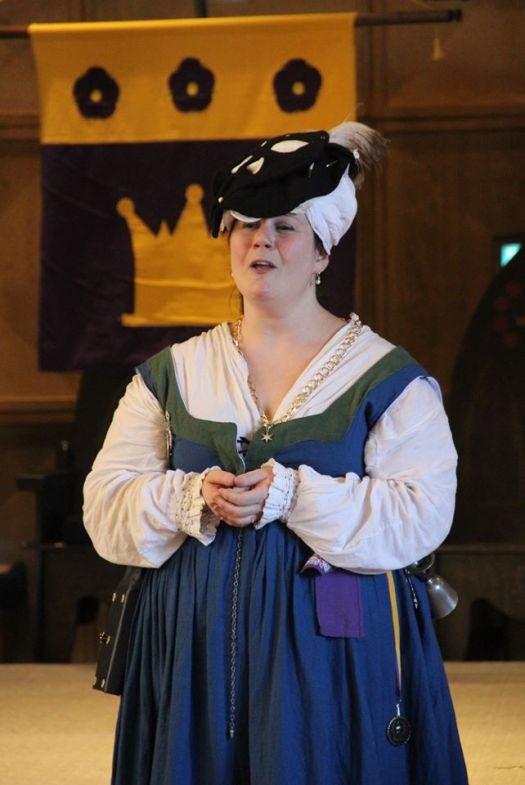
Deep

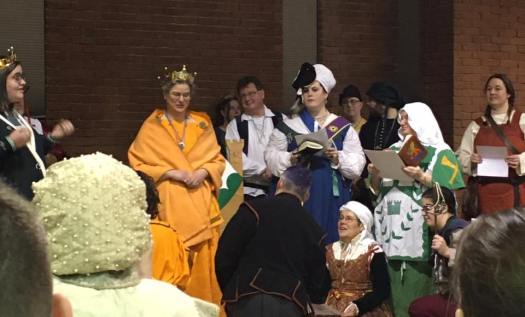
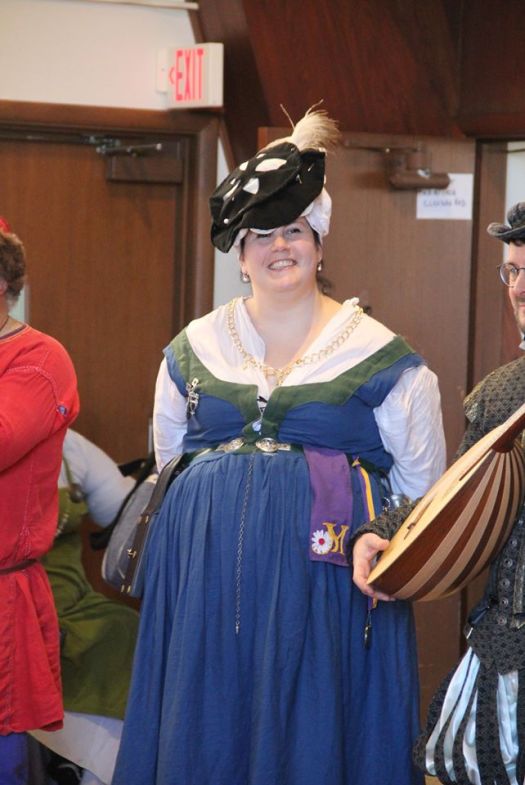
Round 2 had finished. I had made it to the finals the year prior so it was possible I could do it again. I was very blessed to be surrounds by folks around me who were able to hold my hand and support me. Then, I heard it. My name was called? MY NAME WAS CALLED. Oh man… I’m so glad I always have my Bard book on me as a quick reference.
What would the challenge be? What would they have me do? Then, I heard it. “Bring your best”. I quickly ran to my Laurel looking for sagely wisdom. We talked through options. What would make me feel best? What can I emote that shows me off the best? I know I have talked about this piece immensely ad nauseum, but it is never too late to bring out an oldy but a goody. I brought out Amarilli, Mia Bella by Giulio Caccini ( 1551-1618). I also made the specific choice to perform all period acceptable pieces. Although the SCA typically cuts off at 1600, music, due to documentation has been accepted as extended through 1650. I gave my heart to the world as I was the first competitor. I sat and listened to my friends do their things.
Finalist
Here is round 3:

https://video-lga3-1.xx.fbcdn.net/v/t42.9040-2/87452238_1017316311985156_1025122008230264832_n.mp4?_nc_cat=110&_nc_sid=985c63&efg=eyJ2ZW5jb2RlX3RhZyI6ImxlZ2FjeV9zZCJ9&_nc_ohc=KK8jo3K1gzIAX-WSQc3&_nc_ht=video-lga3-1.xx&oh=570b8b2703a3400853f6cdfca12eec45&oe=5E9A28FD

Again, I was not one of the victors, however, in my heart I won. I learned new pieces, I got to see friends grow, meet new performers and I would say this was the best birthday of my life.

Scroll for Alianor Salton

A woman whyt words can find her whey.
Quiet, though well versed, she has her head covered when there is work to be done.
Norse, South, East, West the books take her.
Through research, new mysteries are unveiled.
Her attention to detail brings truths to the light.
Her family, all, gathered in notes, papers, quill and ink.
All this is brought to a head till the very end and capped off with certainty to accuracy.
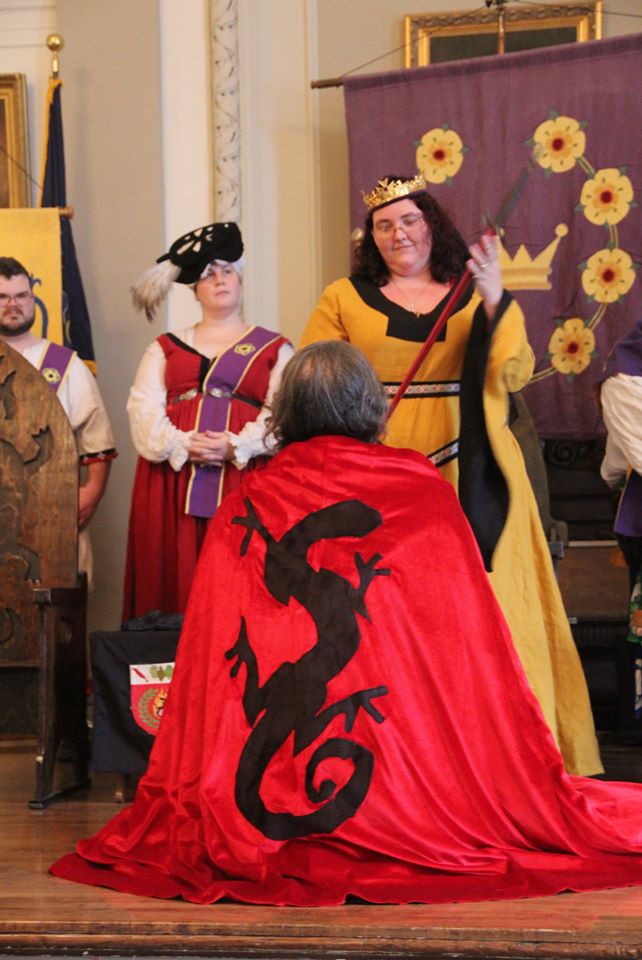
With fine attention to detail, I, Margarita, Sovereign to the East kingdom, do find it only true and proper, to induct Lady Alianor Salton into the Order of the Silver Brooch, this Yule, January 4, Anno Sociotatis LIV, in Ostgardr and have her join her rightful place.

Alianor Salton

It’s the most wonderful shopping of the yearrrrrrrr!

Birka. If you have read any of my blog posts, you know this German/Viking loves bling. Birka, besides Pennsic is my favorite shopping event. The vendors are always changing and bringing new and wonderful wears.
This was also my newest partners first Birka. “I can show you the world! Shining, Shimmering, Splendid!” Also, his first event. I don’t bring them in gently. He seemed to do well with the 90 million people he met in a half second, including Her Royal Majesty, who had given him his first token in the SCA. You could see the magic happening… as far as you can have in a hotel.

He was excited to show off his first garb. I had taught him to sew the week prior. He’s a quick study and eager to create. HE even made himself a haversack. None of these had a pattern. I showed him how to pattern off his previously made clothes as a gentle way to bring him in.

Boyfriend
He met 90 million people in 30 seconds but he was happy as a clam. He is far more social than I am.

First court of the day for us was Baronial court. Although I wasn’t currently living in Barony, Stonemarche has always been my home. I often offer to herald or perform for them.

Herald
When court came around, I showed him the joy of other’s getting awards. I was on queens guard, but made sure when I wasn’t guarding he has someone to keep him company or something to do. He was surrounded by those willing to give him information and he was also keeping his hands busy with his newly learned hobby of crocheting. He even got to hear one of my scrolls going out.

This was based off Beowolf

Delight, praise of the prowess of people-kings
of sword-armed Halfdan, skilled in combat,
we have heard, and what honor this Saxon brings!
Oft foes fought with feuded feats,
from a large tribe, Stonemarche, the bear-pits tremble,
the echos called. Since ego laid down
friend, a feat, fables reclaim him:
for he waxed under weights, in western battles fought,
Pennsic, shoulder to shoulder, far and near,
who wisdom was vast as whale-way, heard his mandate,
gave him recognition: a wealth of reason!
To him minds-worth laid before,
a son in battle, an elder to books
to favor Grímnir’s lip-streams, meeting their flights head on
the Wielder of Wonder, with world’s renown.
Mighty Queen Margarita, glory-filled, awards  you arms
this day, A market day at Birka, AS 54 in the Barony of Stonemarche

Scroll

After court was all said and done, I was off to do my most favorite thing at Birka… THE BARDIC CIRLE! This was my 4th year running it and every year I learn new and different exciting pieces and meet amazing new performers. I task myself with trying to support newer performers, performers who are shy and taking others under my wing. This year was no different.

However, these was something new to me. I had always considered a content warning for age restrictions; however, I had never considered a content warning for triggers based on language or images. This was a new idea to consider. I think it’s important to consider our audience. We aren’t stopping our performance, but we are allowing them to have an opportunity to leave should they have triggers to the content. Even my partner, who doesn’t have faith in his own singing was brave enough o perform. We had a wide variety of performers and skill levels. I can’t wait to see what else comes from these folks.

Much ado about not much

Bhakail yule bonus event!

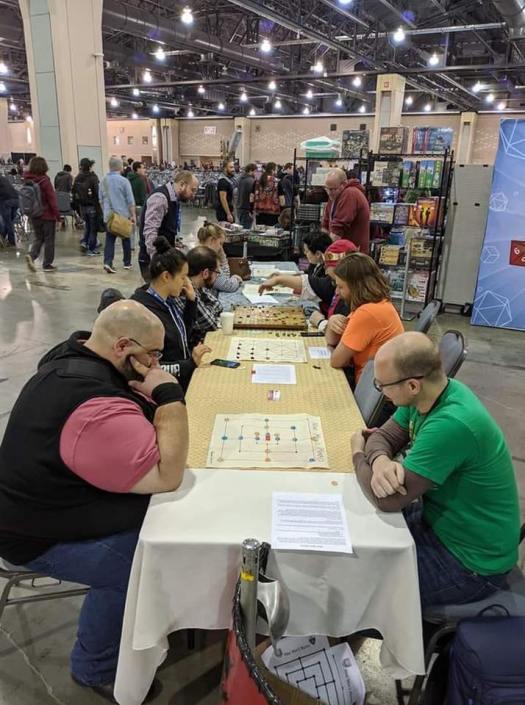
I had been down in Philly the week prior to work at Pax Unplugged (It’s a gigantic board gaming convention). I tend to work at these every year. The SCA was also doing a demo. When I wasn’t on duty, I was assisting the SCA with their demo. Everything from playing medieval board games to singing “Do you wanna learn a board game?” (To the infamous Disney, Frozen tune “Do you wanna build a snow man). Yes… Yes I went there. Don’t judge me.

Pax
I stayed in town for the week so I could try my hand with the Bhakail fencers and also spend time with my local family.

79289475_10101823407907959_9130787462669402112_o
I had also never been to a Bhakail event so I figured this would be a good time since this is where my Laurel lives and my Laurel Aunty lives. There was not much besides Bar side singing going on until Myself and a few other Bard friends of mine noticed that the feast was desolate of singing. We decided this was not to remain the case. We whipped out our voices and instruments and started to make music happen. No holiday festivity should be without music and so we filled it with music. The coolest part was having her Royale Majesty join us on the Balcony to sing. (Pssst. She’s got an awesome voice, Ya’ll)

Guard

It was the best of times; it was the 12 night of times….

Long island! You are a bit of a haul from Maine. 12th night is one of the most exciting social events of the SCA. It’s usually encompassed by the best garb, amazing food and music! Oh no! Music!!! Twist my arm!
I am fairly close with both Royale Bardic champions, so we communicate a lot. I had found that they had an entire track of music for the day. My heart sung with glee. At first, I thought of what I could sing? Would this be holiday related or just my usual run of tracks. Then I had a stunning idea. The adhoc choir would get a chance to finally get their first real performance!
I sent out an email about 3-4 weeks prior to and got a good feeling of head count. There will always be last minute stragglers, people who aren’t on the lists and people who don’t make it. That’s ok! It’s life and it happens. When I figured out there was enough interest, I reached out to the Event Steward and asked if I could kidnap a space for 90 minutes to learn and run 20-25 minutes of music. He agreed!
Next, the music choices came out. During holiday season, we all want to spread cheer no matter what faith we have or don’t have. It’s a great way to bring the community together. I went through and picked out 7 period and traditional pieces. The Boards Head Carol, Ah Robin, Dona Nobis Pacem, Gaudete, Gloucestershire Carol (Traditional, not period), Here we come a wassailing (Traditional) and The Holly and the Ivy (plausibly period). Due to the nature of documented music for vocalists, it can be a challenge to find pieces that were secular in nature and at the skill level of the performers I am working with. I think this diverse set of pieces would give them some challenge as well as some easier pieces to rely on. I even chose to give out a couple Solos to the performers who wanted to try their hand at it.

Choir
I didn’t hold auditions for various reasons, but the primary reason is opportunity. When you are a full-time performer, you tend to get more opportunities to perform as a soloist. The more skill you had, the greater the chance. Most of these folks are all volunteers who just liked to sing or sang in chorus in high school and that was their last real opportunity to sing. Some don’t even read music. That is just fine. Everyone gets a chance if they want it with me.
After rehearsing the pieces, couple of soloists asked for additional help. One expressed concern on rhythm/notes and the other with the language itself. I worked with each for an additional 20 minutes and by the end, they both felt very confident and ready to perform.
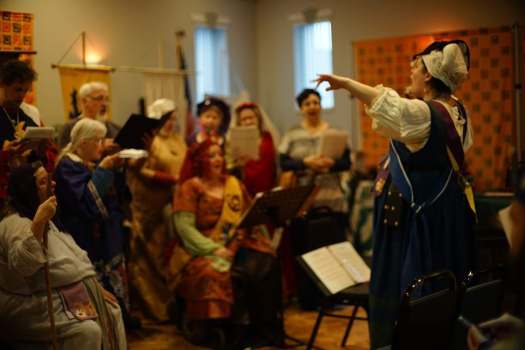
About 1:00 it was their time to shine. Each of them stood proudly in our vocal horseshoe, ready to do a thing. They sang their hearts out with joy. Not even one of them seemed nervous. After about 25 minutes of performance and several pictures being taken, we were approached by a couple of patrons. The one comment that really stuck with me was this: “You made me feel like I was truly immersed in a 12th night feast. The music, the madrigals… I was there. Thank you” and she handed each one of my performers a token of gratitude. Were the pieces perfect? No. Were they enjoyed by all? Yes. Both singer and bystander. My heart flowed for each and every one.


Choir 2
I had my own set later. I used this time to work some of my Crown Bardic pieces to get them in front of an audience, because they were new. One of the pieces of advice I give to all of my performers I have every worked with both solo and group is to make sure you get to perform a piece in front of as many people as you can before you go for the gold. My middle schoolers would have an assembly in front of their peers before they sang for their parents that night. What this does is prepare people ahead of time and make it old hat instead of new and shiny. This is also done with professional performers as well. They have full runs and open dress rehearsals to get feedback from the audience. So, this is done by all skill levels.

Solo
The rest of the night was food and merriment as well as serving my amazing queen. In my free time I have been retaining whenever possible. I helped pack up for the night and home I went. I even got to participate as a mummer in my dear friend’s performance during open bardic performances.

Mummers

The Boar’s Head Carol was first published in English during the 1520’s in a book entitled Christmase Carolles Newly Emprynted at London in the flete street, which was written by Jan van Wynken de Worde.
“Boar’s Head Carol”. Christmas-Carols.org.uk. Archived from the original on December 28, 2009. Retrieved December 8, 2009.
William Cornysh (1468-1523)

Cornish. William. Ah Robin, Gentle Robin. Edited by Alberto Gomez Gomez: 2012.
Encyclopædia Britannica Online, s. v. “William Cornysh,” accessed February 10, 2014, http://www.britannica.com/EBchecked/topic/138138/William-Cornysh.
“Dona nobis pacem” (Ecclesiastical Latin: [ˈdona ˈnobis ˈpatʃem] “Grant us peace”) is a song with Latin text, often sung as a canon or round (where each section starts with a new voice). It is the invocation to the Lamb of God to have mercy and grant peace to the worshipers. It is said to have been introduced into the Mass by Pope Sergius I in 687,

Gaudete ( “rejoice [ye]” in Latin) is a sacred Christmas carol, thought to have been composed in the 16th century. It was published in Piae Cantiones, a collection of Finnish/Swedish sacred songs published in 1581. No music is given for the verses, but the standard tune comes from older liturgical books.

The Holly and the Ivy was first published in a broadside dated 1710 and have have originated somewhere in the Cotswolds.
The Holly & Ivy; Twelve Articles. Birmingham: D. Wrighton. n.d.

Harper’s Retreat!- The “Still not enough Harps” edition

This is one of my favorite events in the year. It is closer to home than most of the events I travel and is in the Barony that in my heart is my Barony. This one, however, was much tougher for me emotionally. Not to bring my personal life in to this, but I had gone through a very devastating event about 2 months prior and still had not resolved all my emotions over it. On top of that, the instigator of the event was scheduled to be present. I was lucky, however, to be camping with several of my SCA families, who would keep me safe. I brought a plethora of instruments with me to bring to the instrument petting zoo, including my harp. This was the first time I was going to get to play it in public. There was a harp ensemble present. I learned quickly of the pains harps have in heat/stage lights regarding tuning. This was not something I encountered practicing in the comforts of my mildly lit and frigid apartment. I got to spend an hour playing with other harpists of varying skill level. It was heaven!
From there, I would twiddle on my recorders outside with an impromptu recorder jam. Everything from chaotic melodies, to soothing waltzes. I met new folks, got to try new instruments with no pressure.

That night, at feast, I was once again honored to be part of the feast entertainment. I had been asked by the current baronial bard to perform. I performed my first ever originally composed story about how the children of the east changed Ozurr, storm bringer. It discussed the several events he had been to, inclusive of the crown tournament where the rains fell, the Estrella where it flooded and Pennsic, raining out the Eastern Court. From there, I sang some of my newer repertoire and enjoyed the feast.

Following court would be the Bardic championship. This year, I decided I would try something new. It’s really important to me to show newer performers that I wasn’t born with all skill. I wanted to show them that I was working on new skills. There theme was fortune and misfortune. I had the idea of performing 3 Ravens first and then Twa Corbies with a guitar accompaniment. I was newer at the guitar and this would only be my second time playing it public. I knew Twa Corbies was also not my strongest vocal piece, but I wanted to try something new. I was pleased enough with my performance and called it a night. Where I was not chosen as the new Baronial Bard, I did win populace choice. I’ll take it.

The lyrics to “The Three Ravens” are here transcribed using 1611 orthography.
“The Three Ravens” (Child 26, Roud 5) is an English folk ballad, printed in the song book Melismata compiled by Thomas Ravenscroft and published in 1611, but it is perhaps older than that.

There were three rauens sat on a tree,
downe a downe, hay downe, hay downe,
There were three rauens sat on a tree,
with a downe,
There were three rauens sat on a tree,
They were as blacke as they might be.
With a downe, derrie, derrie, derrie, downe, downe.
The one of them said to his mate,
Where shall we our breakfast take?
Downe in yonder greene field,
There lies a Knight slain under his shield,
His hounds they lie downe at his feete,
So well they can their Master keepe,
His Hawkes they flie so eagerly,
There’s no fowle dare him come nie
Downe there comes a fallow Doe,
As great with yong as she might goe,
She lift up his bloudy head,
And kist his wounds that were so red,
She got him up upon her backe,
And carried him to earthen lake,
She buried him before the prime
She was dead her self ere euen-song time.
God send euery gentleman,
Such haukes, such hounds, and such a Leman.

Written heavily in the Scots language, “The Twa Corbies” probably dates from the 18th century and was first published in Walter Scott’s Minstrelsy in 1812. Child (I, 253) quotes a letter from Charles Kirkpatrick Sharpe to Walter Scott (August 8, 1802): “The song of ‘The Twa Corbies’ was given to me by Miss Erskine of Alva (now Mrs Kerr), who, I think, said that she had written it down from the recitation of an old woman at Alva.”.

Twa Corbies

As I was walking all alane,
I heard twa corbies making a mane;
The tane unto the t’other say,
‘Where sall we gang and dine to-day?’
‘In behint yon auld fail dyke,
I wot there lies a new slain knight;
And naebody kens that he lies there,
But his hawk, his hound, and lady fair.
‘His hound is to the hunting gane,
His hawk to fetch the wild-fowl hame,
His lady’s taen another mate,
So we may mak our dinner sweet.
‘Ye’ll sit on his white hause-bane,
And I’ll pike out his bonny blue een;
Wi ae lock o his gowden hair
We’ll theek our nest when it grows bare.
‘Mony a one for him makes mane,
But nane sall ken where he is gane;
Oer] his white banes, when they are bare,
The wind sall blaw for evermair.


Meaning of unusual words:
twa=two
corbies=crows (or ravens)
fail dyke=wall of turf
wot=know
kens=knows
hause-bane=neck bone
een=eye
theek=thatch

A whole new world!

Pennsic is a home for many people who may not be as active in the SCA as they’d like to be. For those who are ridden with anxiety, even this town of 12,000 humans who inhabit here for up to two weeks can be a safe haven. For some, it can also be a place where dreams come true and things you would never have done can be realities… so also, dreams coming true.
This was Pennsic #2 for me. Riding solo but still having a group to camp with has been amazing. Mermaid’s song is a group of Bards and Fencers and yes, there is crossover. I arrive and set up my tent hastily. I made a new friend as we had new camp mates. Atilla was kind and welcoming and helped me set up my tent, hastily as, in true Solveig fashion, I have overbooked myself and I don’t really know how to say “no” yet. I’m working on it. With that, I was off to my first Pennsic experience for the year.
Hastily dressed I ran up the hill (Yes, that hill. I live in the bog) to the amphitheater. There was a non-English concert set up to happen. Sadly, there were no spectators, but I think that it made it less of a concert and more of a song sharing session. There were familiar faces and new faces. One face I had seen at this gathering was Heather Dale. For those of you who don’t know Heather, she is an SCA super star and professional touring artist with 20 CD’s available for purchase. It’s like meeting Robert Downey Jr. or any large Hollywood legend. I had met her previously the year before as I was part of Drake Oranwood’s concert which opened for Heather. I didn’t expect her to know or remember me as it was just a glance meeting, but low and behold, like a normal person, she greeted me, said hello and *gasp* remembered my name. I’m terrible with names. Clearly, she was not. I tried to withhold my awestruck words and tried to treat her as a normal person. I -believe- I succeeded. It was eventually my turn and I chose not to sing my best pieces. This was a chance to show languages. I pulled out an old piece I really should memorize.

by Ludwig Senfl (1534, German)
Es Warb Ein Schöner Jüngling
Es warb ein schöner Jüngling
über ein breiten See.
um eines Königes Tochter,
nach leid geschach ihm Weh.

Ach Elselein liebes Elselein mein,
wie gern wär ich bei dir!
So sein zwei tiefe Wasser
wohl zwischen dir und mir.”

“Das bringt mir grossen Schmerzen,
herzallerliebster Gsell.
Redich von ganzem Herzen
Habs für gross Ungefäll.”

Hoff, Zeit werd es wohl enden,
hoff, Glück werd kummen drein
sich in alls Guets verwenden,
herzliebstes Elselein!”
Once there was a handsome young man
from across a wide sea.
Pursuit of a king’s daughter
led him to great sorrow.

“Oh Elselein, my dear Elselein,
how I long to be with you!
But there are two deep waters
between you and me.”

“That brings me great pain, my
dear friend.
I say wholeheartedly this is
great misfortune.”

“Have hope that time will end this.
Have hope that fortune will change.
Have hope that all else will fall into
place, beloved Elselein!”

The rest of the first evening was pretty low key afterwards. Bird the Bard and I spent the rest of the night singing into the hours.

Day 2! Saturday! Low key day as well. Several months prior to I had been asked if I would sing at the East Kingdom/Midrealm invitational Bardic. This was -HUGE-. This is a display of the best/up and coming Bards the kingdoms had to offer. There was no competition involved, just performance. It was certainly quite the show. I had chose to do Amarilli, mia Bella. This piece has a lot of emotional attachment to me as it’s a piece of music I have been doing long before the SCA.

Amarilli, mia bella,                 Amaryllis, my beloved,
Non credi, o del mio cor,       Do you not believe
dolce desio,                           Sweet desired one,
D’esser tu l’amor mio?           That you are my love?
Credilo pur:                            Believe only this:
e se timor t’assale,                 And if fear assails you,
Prendi questo mie strale        Take one of my arrows
Aprimi il petto.                        Open my breast
e vedrai scritto in core:           And see written in my heart,
Amarilli, Amarilli, Amarilli        Amaryllis, Amaryllis, Amaryllis
è il mio amore.                       Is my beloved.

Guilio Caccini (1551-1618). Composed in 1602 and the text was by Alessandro Guarini . Written before the development of the pianoforte (which was invented in 1700), “Amarilli, mia bella” was meant to be accompanied by the lute, which lends it a particularly intimate and hauntingly beautiful atmosphere. Even the words evoke an earlier time—the line, “Prendi questo mie strale” (take one of my arrows) evokes images of bows and arrows. Any performer of “Amarilli, mia bella” will want to sing with a hushed sotto voce (soft singing) throughout with exquisite legato phrasing.
Who decided that waking up prior to 12 on a Sunday was a good idea!? Oh wait… it was the best time for people to meet. ***SIIIGHHHH**** It was time for the EKCOP annual Pennsic meeting. Honestly, I think it was a really constructive meeting. I’ve been the deputy Chatelaine for almost a year now and It was really nice to see how our work has been going and what people had to comment on it. At this meeting I was nominated for Chancellor. I, however, was floored seeing the unanimous vote for my nomination. I know I really care about this group and making performance a safe and tangible place for others, but I never thought my work had gone this noticed. The rest of the day was spent celebrating other delightful musicians such as Cedar Barefoot and the Queen’s Bard, Laila (celebrating her birthday).

Monday was spend rehearsing for our concert on Wednesday and Pirate debauchery at night. Bird has spent many years as a Shantyman. I have always enjoyed a good shanty, but have never thought much about singing them. I was a bel canto singer. We sing pretty. Shanties are for the rough and tough pirates and seaman!!! (Get your head out of the gutter). However, I felt like getting out of my comfort zone. Roll the Old Chariot Along was my song of choice and belting was my game. Mind you, belting is -not- my forte, but the belting muses hit me in the face like a sack of flour. WHOA where did that sound come from!!!!??? I was elated that my voice was continuing to mature. For those of you who don’t know, you go through several vocal puberties during your life. The bigger and darker your voice is, the longer it takes to mature. Mine, according to my voice teachers from college, would be done around age 35. Joy! I digress.

Tuesday was more laid back… I think. Around 11 or so, Bird and I climbed up the brewer’s road hill, filing everyone’s favorite past time song, “Baby Shark”, to motivate us in the intense sun. We eventually made it to our family gathering where the Bard Yard could just relax and enjoy each other’s company. My Laurel and all connections to her, have become some of the most supportive and people in my SCA life. I’ve talked about brain weasels before. They continue to persist. Having a family like this as a performer is essential for building that skin up. I wouldn’t change anyone in this group for the world. Later that night, Bird and I had donated a concert to the royal travel fund. We made our way into the camp of the winners. It was a very “dry” setting despite the alcohol freely flowing. Everything from period pieces to ruckus was performed for an hour. I’m not sure how I felt about this, but I was later told that it was enjoyed. Sometimes, it’s nice to just perform and not peacock. Getting to sing/perform your non forte pieces is a relief sometime.

Wednesday! Oh man. This. This is what you’ve all been waiting for! This would be the day when we would strut all our stuff. I say we, because Bird and I were inseparable this whole war. It started with a very prestigious performance. We had been invited to perform at queen’s tea. That is the big time. Only the “right” performers got to do that. It’s a very specific setting where you are background, not the center of attention. To be invited to perform for this meant you knew how to be unobtrusive, appropriate and a good performer. Bird and I also used this as a warmup for our concert…. Which was 2 hours after. The pieces performed will be discussed after. We were presented a few tokens from attending queens and thanked for our service. It was super magical. It really felt like I was a hired performer in ye olde times… despite some of the modern accouterments. From there, off we went to present, for the first time ever “Song Byrds”. Originally this was supposed to include Collete la Trouvere, however, life happened, and it was just Bird and I. We spent a good amount of time trying to break the concert in to 3 sections that would compliment one another. The first was all period pieces, the second was SCA appropriate/Filks and finally original compositions.

Below is the concert in it’s entirety. Enjoy!

This was the best week of my life, filled with so much song. I regret not being able to perform at the Opera dell’est concert as my voice was shot from the war, but I do not regret having all the opportunities to sing. This only fire up my need to perform more, but I made more connections and started digging for more repetoir!
On an unrelated note, I did meet up with a super amazing lutenist and got to jam to some Dowland with her.

Here’s a demo, there’s a demo

0629181151I suppose this is a little behind, but on 6/29 I ran yet another demo. This was my first grand scheme demo where I expected more than 15-20 folks to engage. The Portcon demo is a large gathering of geek culture, primarily focused on anime and board gaming. The main demographics are younger than our average scadian so it’s a perfect change to work with our future. I don’t have too much to reflect on this besides I’m excited to do it again next year and I am brimming with new ideas on how to streamline it and make it a better experience over all (besides our actual time of the demo and not going against K and Q rattan). I had support from as far away as Burlington and Essex Vermont (Which is 4 hours). I am in awe of the generosity of time for those coming so far. Also, as always, I need to give a huge shoutout to the fencers who put on a good show!!!
The Beginning of a new era!

Panteria was my first camping event in 2010 and has always been a special event to me (Even though a bunch of my friends tried to coax me into go to Roses instead). This year would be no different. Well, I mean, it will be because the event has grown and changed over the years.

With this development of the event, I decided to develop myself farther. I had started a similar idea before, but this will be an ongoing contingency group. I started a travel ad hoc choir in which we would learn some music and then after a few events or so, would get the chance to perform it.

The plan for this one would be to introduce everyone, get a gauge of their skill level and then do a thing! My first meeting has 10 vocalists as I gave out all copies of my music. we had 1 bass, 1 tenor, 4 altos and 4 sopranos. What made this group even more interesting was the addition of a youth (sub 18).  I handed out pieces in various languages. She seemed very concerned that they would potentially contain a swear word. Even after I reassured her several times there we no swears, I even had a native speaker of the language to also confirm that.

It was a challenge to have a youth there as I haven’t been a youth instructor since 2008. So, a few years. She stuck around for about a half hour. With permission, just after she left, I made a recording of the group performing and a second one as well.

By the end of our 2 hour sessions, a complete piece of music was learned as well the groups excitement level was near explosion. They asked over and over again if they could perform that night at Bardic. I had been planning to wait a few rehearsals, but they people have spoken.

Additionally, I had brought my new rounds book which I created. This would be the second event it is making it’s debut at. I am really proud of what I gathered. Now I have a few finishing touches to add to it. However, people are eager to purchase or have a copy of it in general.

Here are a couple recordings of the rehearsal process:

Take 1:

https://drive.google.com/open?id=1-8hj3AmqyfbUb17JhhYOor3FWT3vwzJr


Take 2:

https://drive.google.com/open?id=1-7n480C7IACotD2tIAFFNsL3TeV7ICc6


You can definitely hear the improvement between takes. There is maybe a 20 minute difference between them.  By performance that night they were spot on. I am still hunting down that recording.


During rehearsal I did refrain from singing with the group so they could focus on themselves. However, by performance, we had lost a couple folks and needed to shift around and I ended up singing with them.

NB) This was not taken at tempo for rehearsal reasons.

About the piece:


It was included in Dowland’s First Booke of Songes or Ayres, which appeared in 1597. The piece is often performed as a lute song by soloist and lute, but, like other songs in the First Booke, it is printed in a format that can also be performed as a madrigal by a small vocal group (typically SATB).

This lute song is largely famous for the lovely melody and the striking repetition of rising fourths in the penultimate line of each verse. This is especially effective in the first and second verses, where the text and the music are a perfect fit.

In the first verse, the singer urges the beloved to come to him again, so they can enjoy together the pleasures of love, “to see, to hear, to touch, to kiss, to die, ” in the second he sings of his sorrow, “I sit, I sigh, I weep, I faint, I die, ” and in the somewhat less graceful third verse, he claims that nothing can move her heart, “By sighs, and tears, more hot than are thy shafts/ Did tempt, while she for triumph laughs.”

Come again!
Sweet love doth now invite
Thy graces that refrain
To do me due delight,
To see, to hear, to touch, to kiss, to die,
With thee again in sweetest sympathy.

Come again!
That I may cease to mourn
Through thy unkind disdain;
For now left and forlorn
I sit, I sigh, I weep, I faint, I die
In deadly pain and endless misery.

All the day
The sun that lends me shine
By frowns do cause me pine
And feeds me with delay;
Her smiles, my springs that makes my joys to grow,
Her frowns the Winters of my woe.

All the night
My sleeps are full of dreams,
My eyes are full of streams.
My heart takes no delight
To see the fruits and joys that some do find
And mark the storms are me assign’d.

Out alas,
My faith is ever true,
Yet will she never rue
Nor yield me any grace;
Her eyes of fire, her heart of flint is made,
Whom tears nor truth may once invade.

Gentle Love,
Draw forth thy wounding dart,
Thou canst not pierce her heart;
For I, that do approve
By sighs and tears more hot than are thy shafts
Did tempt while she for triumph laughs.

Local Choir strikes again

Choirs are a lot of fun, but they require more than you. That isn’t a bad thing, but finding other like minded folks with the missing parts you need can be difficult to say the least. Once upon a time (4-5 years ago) I ran a vocal group in Malagentia called, “Voce di Sonata”. I ran this choir for about 2 years. However, with real life comes member depletion.  I moved a bunch, people got married and divorced, houses were sold and people have this thing called a job. So, as it were, life doesn’t always work the way it should and I let the group dissolve.

About 2-3 months ago, a conversation struck up with one of my old vocalists from voce. She had expressed wanting to sing and make music. Then, more specifically, she and her husband wanted to work on “O Magnum Mysterium” by Victoria.

If you haven’t heard this piece, take a listen:


NB) More information about this piece below


However, with the 3 of us, we were missing a crucial voice part. The tenor! I was playing the part of Alto, because… why not. (for any of you who know me, I am not an alto, I just play one on TV). We have a local tenor who is also a shoe in and loves to sing, so without fail, he came to the rescue. 2-3 rehearsals in and we have some music going. This is a volunteer group, who meets every 2 weeks, but again, life happens so we’ve maybe met 2-3 times in 3 months, and that’s ok.

This is for fun. (I have to keep telling myself that. I come from a history of professional musicians who come to their first rehearsal with all their music learned if not memorized. Those, who have perfect pitch or at least relative pitch and work without speaking, singing only for 1-2 hours at a time) This is an ongoing learning experience for me. I’m loving every moment of it. It’s absolutely incredible to work with a group of people who’s passion has not been lost. They do this because it’s fun, not work.

O Magnum has been put aside for now so the group can learn some vital things about working together is a very small chamber group. For now, we are working on Belle Qui Tiens Ma Vie ( Thoinot Arbeau 1520-1595) , Ah Robin, Gentle Robin (William Cornish 1465-1523) and  By the Rose (13th century anonymous poem set by Lady Colette la Trouvere).


With permission from the ensemble, here are the super duper rough recordings done on my terrible cell phone. The one thing I can’t show you is the immense joy and pride on all the vocalists faces when they got to hear their recordings for the first time. The plan is, down the road to make a real recording for them to compare themselves to.

Belle qui tien ma vie:

https://drive.google.com/file/d/1MqexQGOtQD0x3adrQyagqbr1FY8Db0sb/view?usp=sharing

Ah robin:

https://drive.google.com/file/d/17mWec-NLl-nhZvJgNfZzfSHQGSzv9eoT/view?usp=sharing


Latin text
O magnum mysterium,
et admirabile sacramentum,
ut animalia viderent Dominum natum,
iacentem in praesepio!
Beata Virgo, cujus viscera
meruerunt portare
Dominum Iesum Christum.
Alleluia!
English translation
O great mystery,
and wonderful sacrament,
that animals should see the newborn Lord,
lying in a manger!
Blessed is the virgin whose womb
was worthy to bear
the Lord, Jesus Christ.Alleluia!
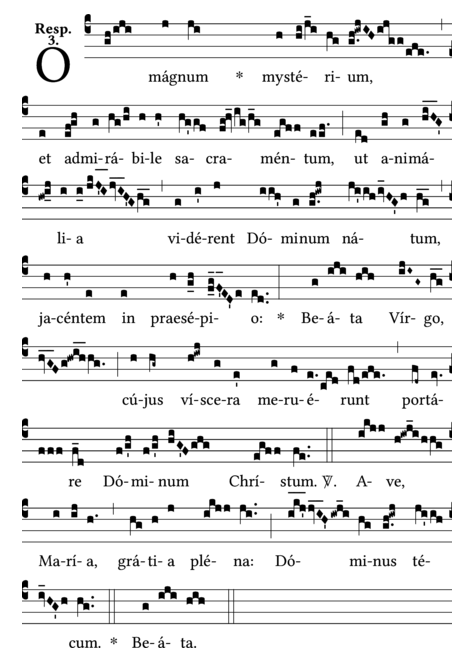
O_magnum_mysterium.png

O Magnum Mysterium is a Catholic church chant sung at Christmastime. As part of the Matins (nighttime worship), the text has been around for centuries. While the exact origins are unknown, historians believe the text (and its use in Catholic Mass) has been around since at least the 10th century.

Because the work is so old, there have been many different settings and versions throughout the years. Today I want to share the version composed by Tomás Luis de Victoria (1548-1611), Spain’s most famous 16th-century composer.

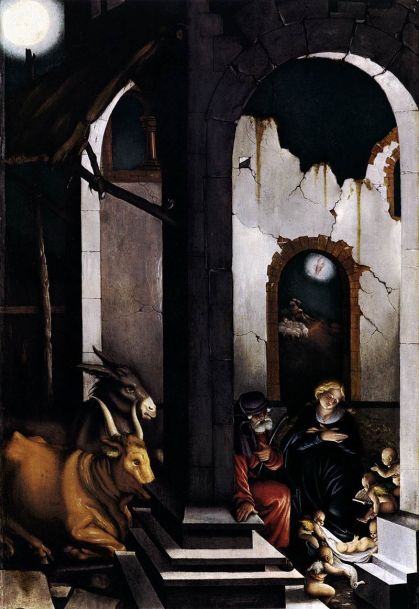
The first half of the chant references the animals present at Jesus’s birth, symbolic of God’s mysterious and lowly life as a mortal. This was a topic of great excitement during the Renaissance; people loved the idea that the animals in the stable recognized the birth of Jesus as an important event. The painting demonstrates this idea.

eb7bb60ff0ee8ce249cc2fd207662371.jpg

The second half of the text relates to the words spoken by Elizabeth when she welcomes Mary, the mother of Jesus, into her home:

“And she spake out with a loud voice, and said, Blessed art thou among women, and blessed is the fruit of thy womb.

And whence is this to me, that the mother of my Lord should come to me?” – Luke 1: 42-43

Music theory: Victoria’s use of open 5th intervals perpetuates a sense of awe in the music. In 5th intervals, the third of the chord is missing; this crucial note determines if the harmony is major or minor, so open 5ths don’t have any harmonic indication (which leaves the listener in suspense).

The music changes to a lilting triple meter as the choir sings “Allelujah!” This is an unexpected yet exciting conclusion to the piece, and it reminds me of a chorus of angels proclaiming the birth of Jesus.


About Belle qui

Thoinot Arbeau” is the pen name and an anagram of Jehan Tabourot, a Catholic priest and canon of Langres.

“Belle quit tiens ma vie” was first published in Tabourot’s 1588 dance manuscript “Orchesography”, which today is a major source of information about Renaissance dance.

This piece is a pavane: a stately dance in slow duple time, popular in the 16th and 17th centuries and performed in elaborate clothing.

Belle qui tien ma vie:

Belle qui tiens ma vie
Captive dans tes yeux,
Qui m’as l’ame ravie
D’un souris gracieux,
Viens tot me secourir
Ou me faudra mourir.
Beautiful one who holds my life
Captive in your eyes,
Who has ravished my soul
With a gracious smile.
Come to my aid
Or I must die.
Pourquoi fuis tu, mignarde,
Si je suis pres de toi?
Quand tes yeux je regarde
Je me perds dedans moi,
Car tes perfection
Changent mes actions
Why do you flee, dainty one,
If I am near you?
When I behold your eyes
I am lost inside myself
Because your perfection
[so affects my behaviour].
Tes beautes et ta graces
Et tes divins propos
Ont echauffe la glace
Qui me gelait les os,
Et ont rempli mon coeur
D’une amoureuse ardeur.
Your beauty and your grace
And your divine ways
Have melted the ice
Which was freezing my bones
And have filled my heart
With a loving ardour.
Mon ame voulait etre
Libre de passion,
Mais l’amour s’est fait maitre
De mes affections
Et a mis sous sa loi
Et mon coeur et ma foi.
My soul wanted to be
Free of passion,
But love became master
Of my affections
And put under its law
My heart and my faith.
Approche donc ma belle,
Approche toi mon bien,
Ne me sois plus rebelle
Puisque mon coeur est tien,
Pour mon mal appaiser
Donne moi un baiser.
Come near, my lovely one,
Come near, my [dear one],
Do not resist me further
For my heart is yours,
To relieve my ills
Give me a kiss.
Je meurs, mon Angelette,
Je meurs en te baisant
Ta bouche tant doucette
Va mon bien ravissant
A ce coup mes esprits
Sont tous d’amour epris.
I die, my Little Angel,
I die when kissing
Your mouth so sweet.
My very lovely one,
With that touch my spirits
Are completely lifted in love.
Plutot on verra l’onde
Contremont reculer,
Et plutot l’oeil du monde
Cessera de bruler,
Que l’amour qui m’epoint
Decroisse d’un seul point.
Sooner will waves
Flow backwards
And sooner will the moon
Cease to shine
Before the love which conquered me
Wanes a single iota.


About Ah, Robin:

This is a secular madrigal

a part-song for several voices, especially one of the Renaissance period, typically arranged in elaborate counterpoint and without instrumental accompaniment. Originally used of a genre of 14th-century Italian songs, the term now usually refers to English or Italian songs of the late 16th and early 17th c., in a free style strongly influenced by the text.

Musical Analysis:

As each voice enters the harmonies expand. Interesting enough the opening sonority begins on a G, adds a B-flat with the other ground voice, and finally an octave G in the soloist. This causes one of the significant part of the piece, the entrance of the third voice, to have a G minor harmony without the fifth of the chord.

This piece is still modal despite the use of F naturals, however, the d minor harmony begins to act as a resting point for phrases. The use of a picardy third appears numerous times through the work at the end of phrases, but not at the end as each voice begins to drop out, eventually making the music monophonic.

Ah, Robin, Gentle, Robin 

Ah, Robin, gentle, Robin,
Tell me how thy leman doth
and thou shalt know of mine.
My lady is unkind I wis,
Alack why is she so?
She lov’th another better than me,
and yet she will say no.
Ah, Robin, gentle, Robin,
Tell me how thy leman doth
and thou shalt know of mine.
I cannot think such doubleness
for I find women true,
In faith my lady lov’th me well
she will change for no new.
Ah, Robin, gentle, Robin,
Tell me how thy leman doth
and thou shalt know of mine.

  • G. Edward Bruner, DMA: “Editions and Analysis of Five Missa Beata Virgine Maria by the Spanish Composers: Morales, Guerreo, Victoria, Vivanco, and Esquivel.” DMA diss., University of Illinois at Urbana-Champaign, 1980.[facsimile: University Microfilms International, Ann Arbor, MI]
  • Gustave Reese, Music in the Renaissance. New York, W.W. Norton & Co., 1954. ISBN 0-393-09530-4
  • Apel, Willi. 1988. The History of Keyboard Music to 1700. Bloomington: Indiana University Press. ISBN 0-253-32795-4.
  • Arbeau, Thoinot. 1967. Orchesography, translated by Mary Stewart Evans, with a new introduction and notes by Julia Sutton and a new Labanotation section by Mireille Backer and Julia Sutton. New York: Dover Publications. ISBN 0-486-21745-0.