My Co-Autocrat and I had spend months and months planning the second iteration of the EKCoP Challenge assembly. This was my first time “running” it and I had found a super sweet location. Weeks before, COVID-19 really started to spread into the US and reared it’s ugly head. The plague doctor could truly not contain this one.
My Co-Autocrat and I made the difficult decision to cancel the even. This was not done lightly. However, not only is this spread via respiratory system, singing/vocal arts were known to be the fastest way to spread it.
I wasn’t willing to go down without a fight. I wasn’t willing to let the performing arts community take a blow to one of their only real chances to gather and perform in a low key environment. Then, it hit me! Why not do this online? What were the logistics?
I spoke to my co-autocrat who has been running monthly online practice to see if this was feasible. It was!
From there we got everything sorted and up and promoted within 5 hours of this idea. Would this work? Would anyone come? Would the delay kill everything? Are we running it like it was run previously? Who knows! here we go!
We eventually settled on a formal of open meet for an hour, classes till 6 and open performances till 10.
Attendance rolled in, every class was attended and well respected.
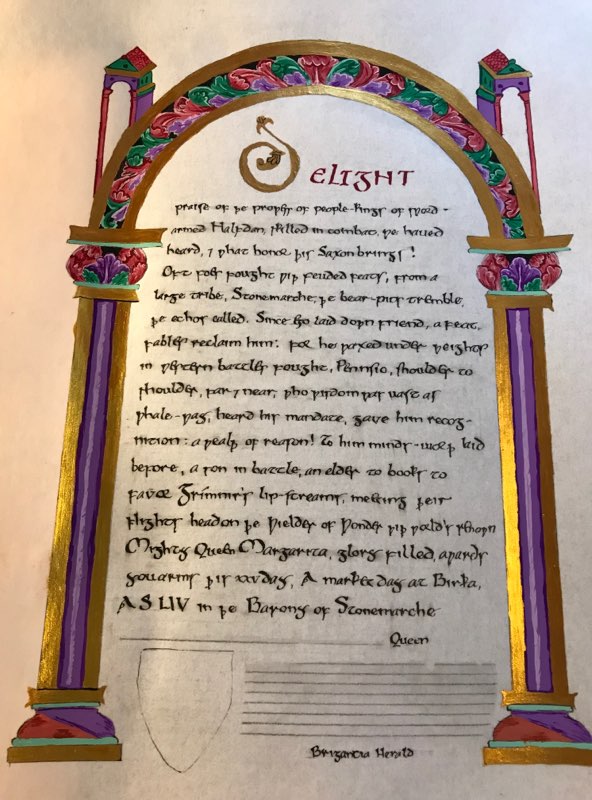
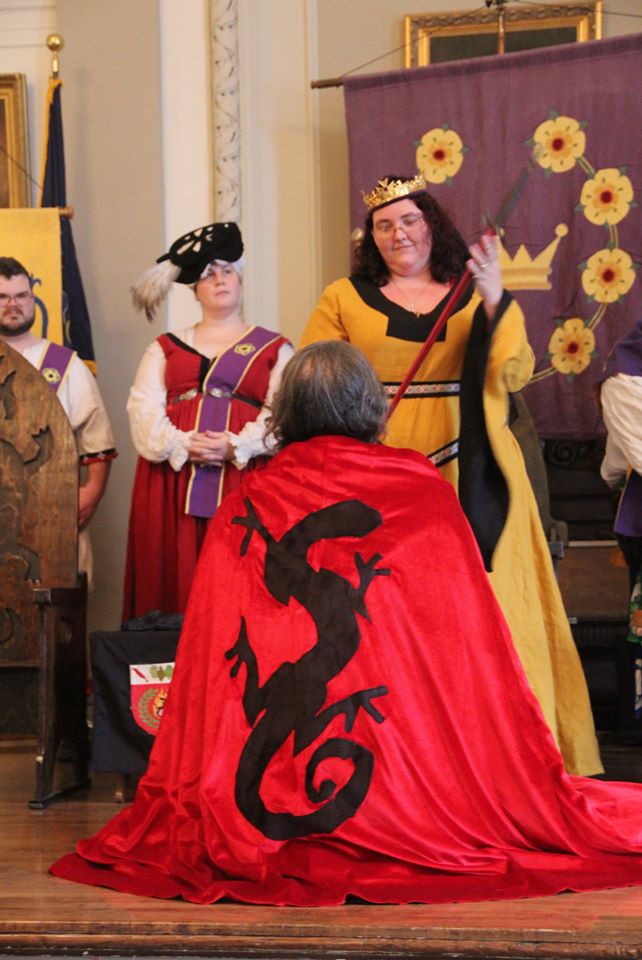
Delight, praise of the prowess of people-kings of sword-armed Halfdan, skilled in combat, we have heard, and what honor this Saxon brings! Oft foes fought with feuded feats, from a large tribe, Stonemarche, the bear-pits tremble, the echos called. Since ego laid down friend, a feat, fables reclaim him: for he waxed under weights, in western battles fought, Pennsic, shoulder to shoulder, far and near, who wisdom was vast as whale-way, heard his mandate, gave him recognition: a wealth of reason! To him minds-worth laid before, a son in battle, an elder to books to favor Grímnir’s lip-streams, meeting their flights head on the Wielder of Wonder, with world’s renown. Mighty Queen Margarita, glory-filled, awards you arms this day, A market day at Birka, AS 54 in the Barony of Stonemarche
A woman whyt words can find her whey.
Quiet, though well versed, she has her head covered when there is work to be done.
Norse, South, East, West the books take her.
Through research, new mysteries are unveiled.
Her attention to detail brings truths to the light.
Her family, all, gathered in notes, papers, quill and ink.
All this is brought to a head till the very end and capped off with certainty to accuracy.
With fine attention to detail, I, Margarita, Sovereign to the East kingdom, do find it only true and proper, to induct Lady Alianor Salton into the Order of the Silver Brooch, this Yule, January 4, Anno Sociotatis LIV, in Ostgardr and have her join her rightful place.
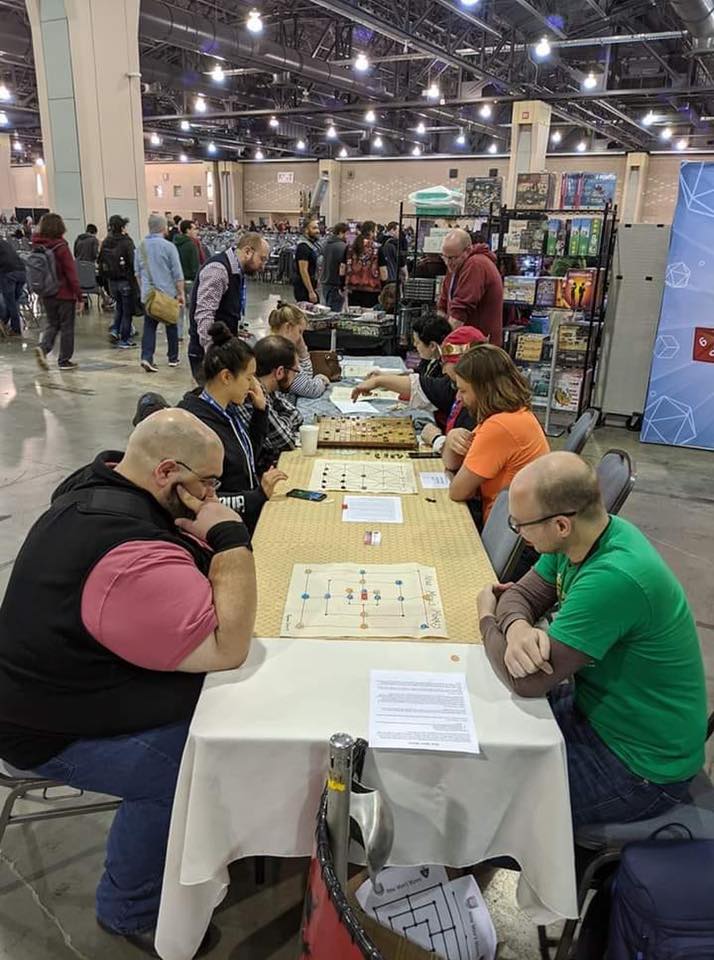
I had been down in Philly the week prior to work at Pax Unplugged (It’s a gigantic board gaming convention). I tend to work at these every year. The SCA was also doing a demo. When I wasn’t on duty, I was assisting the SCA with their demo. Everything from playing medieval board games to singing “Do you wanna learn a board game?” (To the infamous Disney, Frozen tune “Do you wanna build a snow man). Yes… Yes I went there. Don’t judge me.
I stayed in town for the week so I could try my hand with the Bhakail fencers and also spend time with my local family.
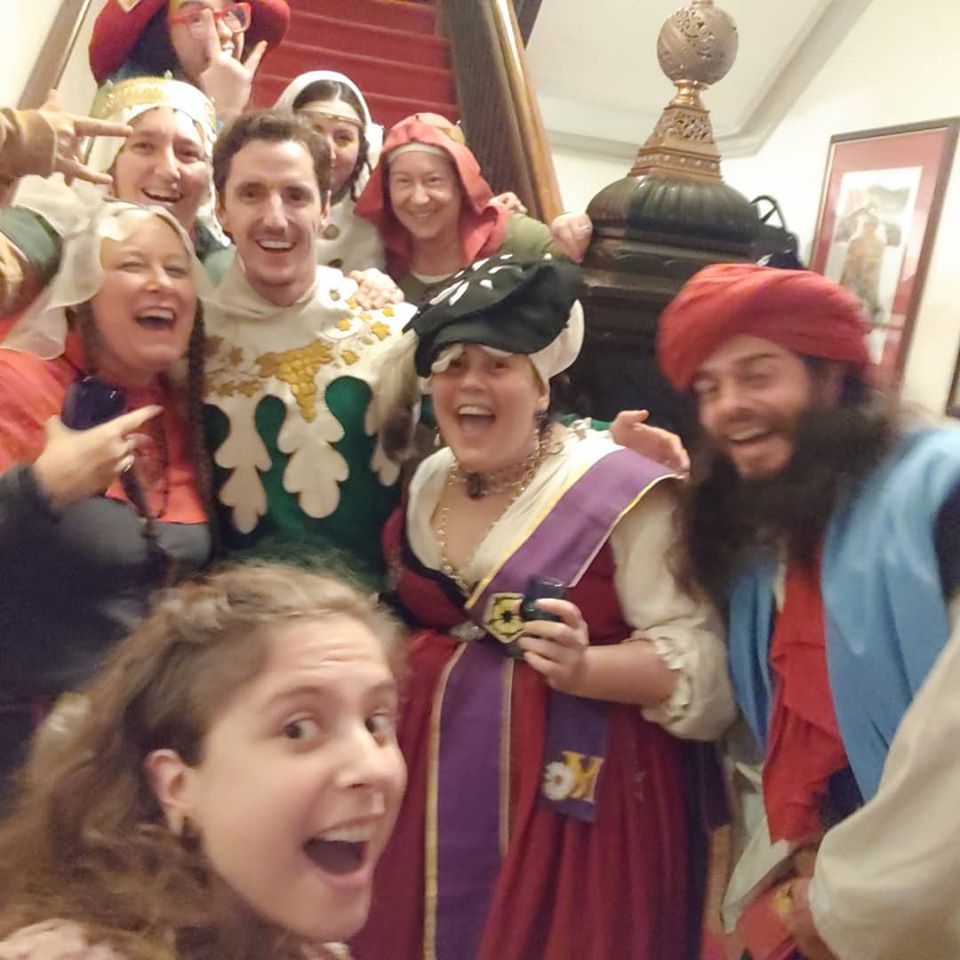
I had also never been to a Bhakail event so I figured this would be a good time since this is where my Laurel lives and my Laurel Aunty lives. There was not much besides Bar side singing going on until Myself and a few other Bard friends of mine noticed that the feast was desolate of singing. We decided this was not to remain the case. We whipped out our voices and instruments and started to make music happen. No holiday festivity should be without music and so we filled it with music. The coolest part was having her Royale Majesty join us on the Balcony to sing. (Pssst. She’s got an awesome voice, Ya’ll)
Long island! You are a bit of a haul from Maine. 12th night is one of the most exciting social events of the SCA. It’s usually encompassed by the best garb, amazing food and music! Oh no! Music!!! Twist my arm!
I am fairly close with both Royale Bardic champions, so we communicate a lot. I had found that they had an entire track of music for the day. My heart sung with glee. At first, I thought of what I could sing? Would this be holiday related or just my usual run of tracks. Then I had a stunning idea. The adhoc choir would get a chance to finally get their first real performance!
I sent out an email about 3-4 weeks prior to and got a good feeling of head count. There will always be last minute stragglers, people who aren’t on the lists and people who don’t make it. That’s ok! It’s life and it happens. When I figured out there was enough interest, I reached out to the Event Steward and asked if I could kidnap a space for 90 minutes to learn and run 20-25 minutes of music. He agreed!
Next, the music choices came out. During holiday season, we all want to spread cheer no matter what faith we have or don’t have. It’s a great way to bring the community together. I went through and picked out 7 period and traditional pieces. The Boards Head Carol, Ah Robin, Dona Nobis Pacem, Gaudete, Gloucestershire Carol (Traditional, not period), Here we come a wassailing (Traditional) and The Holly and the Ivy (plausibly period). Due to the nature of documented music for vocalists, it can be a challenge to find pieces that were secular in nature and at the skill level of the performers I am working with. I think this diverse set of pieces would give them some challenge as well as some easier pieces to rely on. I even chose to give out a couple Solos to the performers who wanted to try their hand at it.
I didn’t hold auditions for various reasons, but the primary reason is opportunity. When you are a full-time performer, you tend to get more opportunities to perform as a soloist. The more skill you had, the greater the chance. Most of these folks are all volunteers who just liked to sing or sang in chorus in high school and that was their last real opportunity to sing. Some don’t even read music. That is just fine. Everyone gets a chance if they want it with me.
After rehearsing the pieces, couple of soloists asked for additional help. One expressed concern on rhythm/notes and the other with the language itself. I worked with each for an additional 20 minutes and by the end, they both felt very confident and ready to perform.
About 1:00 it was their time to shine. Each of them stood proudly in our vocal horseshoe, ready to do a thing. They sang their hearts out with joy. Not even one of them seemed nervous. After about 25 minutes of performance and several pictures being taken, we were approached by a couple of patrons. The one comment that really stuck with me was this: “You made me feel like I was truly immersed in a 12th night feast. The music, the madrigals… I was there. Thank you” and she handed each one of my performers a token of gratitude. Were the pieces perfect? No. Were they enjoyed by all? Yes. Both singer and bystander. My heart flowed for each and every one.
I had my own set later. I used this time to work some of my Crown Bardic pieces to get them in front of an audience, because they were new. One of the pieces of advice I give to all of my performers I have every worked with both solo and group is to make sure you get to perform a piece in front of as many people as you can before you go for the gold. My middle schoolers would have an assembly in front of their peers before they sang for their parents that night. What this does is prepare people ahead of time and make it old hat instead of new and shiny. This is also done with professional performers as well. They have full runs and open dress rehearsals to get feedback from the audience. So, this is done by all skill levels.
The rest of the night was food and merriment as well as serving my amazing queen. In my free time I have been retaining whenever possible. I helped pack up for the night and home I went. I even got to participate as a mummer in my dear friend’s performance during open bardic performances.
The Boar’s Head Carol was first published in English during the 1520’s in a book entitled Christmase Carolles Newly Emprynted at London in the flete street, which was written by Jan van Wynken de Worde.
“Boar’s Head Carol”. Christmas-Carols.org.uk. Archived from the original on December 28, 2009. Retrieved December 8, 2009.
William Cornysh (1468-1523)
Cornish. William. Ah Robin, Gentle Robin. Edited by Alberto Gomez Gomez: 2012.
Encyclopædia Britannica Online, s. v. “William Cornysh,” accessed February 10, 2014, http://www.britannica.com/EBchecked/topic/138138/William-Cornysh.
“Dona nobis pacem” (Ecclesiastical Latin: [ˈdona ˈnobis ˈpatʃem] “Grant us peace”) is a song with Latin text, often sung as a canon or round (where each section starts with a new voice). It is the invocation to the Lamb of God to have mercy and grant peace to the worshipers. It is said to have been introduced into the Mass by Pope Sergius I in 687,
Gaudete ( “rejoice [ye]” in Latin) is a sacred Christmas carol, thought to have been composed in the 16th century. It was published in Piae Cantiones, a collection of Finnish/Swedish sacred songs published in 1581. No music is given for the verses, but the standard tune comes from older liturgical books.
The Holly and the Ivy was first published in a broadside dated 1710 and have have originated somewhere in the Cotswolds.
The Holly & Ivy; Twelve Articles. Birmingham: D. Wrighton. n.d.
This is one of my favorite events in the year. It is closer to home than most of the events I travel and is in the Barony that in my heart is my Barony. This one, however, was much tougher for me emotionally. Not to bring my personal life in to this, but I had gone through a very devastating event about 2 months prior and still had not resolved all my emotions over it. On top of that, the instigator of the event was scheduled to be present. I was lucky, however, to be camping with several of my SCA families, who would keep me safe. I brought a plethora of instruments with me to bring to the instrument petting zoo, including my harp. This was the first time I was going to get to play it in public. There was a harp ensemble present. I learned quickly of the pains harps have in heat/stage lights regarding tuning. This was not something I encountered practicing in the comforts of my mildly lit and frigid apartment. I got to spend an hour playing with other harpists of varying skill level. It was heaven!
From there, I would twiddle on my recorders outside with an impromptu recorder jam. Everything from chaotic melodies, to soothing waltzes. I met new folks, got to try new instruments with no pressure.
That night, at feast, I was once again honored to be part of the feast entertainment. I had been asked by the current baronial bard to perform. I performed my first ever originally composed story about how the children of the east changed Ozurr, storm bringer. It discussed the several events he had been to, inclusive of the crown tournament where the rains fell, the Estrella where it flooded and Pennsic, raining out the Eastern Court. From there, I sang some of my newer repertoire and enjoyed the feast.
Following court would be the Bardic championship. This year, I decided I would try something new. It’s really important to me to show newer performers that I wasn’t born with all skill. I wanted to show them that I was working on new skills. There theme was fortune and misfortune. I had the idea of performing 3 Ravens first and then Twa Corbies with a guitar accompaniment. I was newer at the guitar and this would only be my second time playing it public. I knew Twa Corbies was also not my strongest vocal piece, but I wanted to try something new. I was pleased enough with my performance and called it a night. Where I was not chosen as the new Baronial Bard, I did win populace choice. I’ll take it.
The lyrics to “The Three Ravens” are here transcribed using 1611 orthography.
“The Three Ravens” (Child 26, Roud 5) is an English folk ballad, printed in the song book Melismata compiled by Thomas Ravenscroft and published in 1611, but it is perhaps older than that.
There were three rauens sat on a tree,
downe a downe, hay downe, hay downe,
There were three rauens sat on a tree,
with a downe,
There were three rauens sat on a tree,
They were as blacke as they might be.
With a downe, derrie, derrie, derrie, downe, downe.
The one of them said to his mate,
Where shall we our breakfast take?
Downe in yonder greene field,
There lies a Knight slain under his shield,
His hounds they lie downe at his feete,
So well they can their Master keepe,
His Hawkes they flie so eagerly,
There’s no fowle dare him come nie
Downe there comes a fallow Doe,
As great with yong as she might goe,
She lift up his bloudy head,
And kist his wounds that were so red,
She got him up upon her backe,
And carried him to earthen lake,
She buried him before the prime
She was dead her self ere euen-song time.
God send euery gentleman,
Such haukes, such hounds, and such a Leman.
Written heavily in the Scots language, “The Twa Corbies” probably dates from the 18th century and was first published in Walter Scott’s Minstrelsy in 1812. Child (I, 253) quotes a letter from Charles Kirkpatrick Sharpe to Walter Scott (August 8, 1802): “The song of ‘The Twa Corbies’ was given to me by Miss Erskine of Alva (now Mrs Kerr), who, I think, said that she had written it down from the recitation of an old woman at Alva.”.
Twa Corbies
As I was walking all alane,
I heard twa corbies making a mane;
The tane unto the t’other say,
‘Where sall we gang and dine to-day?’
‘In behint yon auld fail dyke,
I wot there lies a new slain knight;
And naebody kens that he lies there,
But his hawk, his hound, and lady fair.
‘His hound is to the hunting gane,
His hawk to fetch the wild-fowl hame,
His lady’s taen another mate,
So we may mak our dinner sweet.
‘Ye’ll sit on his white hause-bane,
And I’ll pike out his bonny blue een;
Wi ae lock o his gowden hair
We’ll theek our nest when it grows bare.
‘Mony a one for him makes mane,
But nane sall ken where he is gane;
Oer] his white banes, when they are bare,
The wind sall blaw for evermair.
Meaning of unusual words:
twa=two
corbies=crows (or ravens)
fail dyke=wall of turf
wot=know
kens=knows
hause-bane=neck bone
een=eye
theek=thatch
I suppose this is a little behind, but on 6/29 I ran yet another demo. This was my first grand scheme demo where I expected more than 15-20 folks to engage. The Portcon demo is a large gathering of geek culture, primarily focused on anime and board gaming. The main demographics are younger than our average scadian so it’s a perfect change to work with our future. I don’t have too much to reflect on this besides I’m excited to do it again next year and I am brimming with new ideas on how to streamline it and make it a better experience over all (besides our actual time of the demo and not going against K and Q rattan). I had support from as far away as Burlington and Essex Vermont (Which is 4 hours). I am in awe of the generosity of time for those coming so far. Also, as always, I need to give a huge shoutout to the fencers who put on a good show!!!
This weekend was the East Kingdom College of Performers Challenge and Schola down in Iron Bog. This was a little bit of a schlep for a day event, but I am so glad I headed down. This is the first time we’ve done something like this in the East Kingdom. It was a day of classes and challenges. You did not have to master anything to be a part of it, but you would have to be willing to step out of your comfort zone.
With that said, it was a challenging, but positive day over all. I started the day right away with running a rehearsal for the newest addition to the East Kingdom College of performers, Opera D’el Est. The day, however, started more frantically than I hoped it would. Our one and only alto wasn’t able to come. So, I guess I’d sing her part and hopefully make it work. Then, 1/2 of the performers, who were traveling in the same vehicle, were about 45 minutes late (however, due to no fault of their own. Between traffic and weather).
Rehearsal did not go as planned, and that’s ok. We were fighting a lot of odds between company distances, time we had to prepare music and we are a new group. This happens. Everyone had agreed to give up part of their lunch time to meet again for additional rehearsal.
I met with some of the other vocalists after for some one on one help. From there, I whirled into some recorder site reading, which I really haven’t picked up a recorder since 2009… when I graduated college. Not only did I remember some things (Which was huge) I got to encourage 2 more of my friends to come join us. We went from 3- 5! So many tooty flutes!
From there, off to run a class. I have taught this class a couple times prior, but I think this iteration was the best version of the class. I am passionate about making sure performers are well warmed up for performance whether is be Singing, story telling or even heralding. If the body -and- mind are not there, then your performance will suffer. This iteration of the class discussed anatomy, posture, breathing, the parts of your body that make the sounds, projection and location of sound. I had 6 folks join my class of varying experience and age. Everyone seemed to get something new from the class and was able to apply it. Once of the gentleman in the class, who I performed with later in the day, said that it was a comprehensive warm up and encouraged others to do so. This was encouraging.
From there, a very abbreviated lunch and round 2 of rehearsing. This time, the section which the group seemed to be struggling with, seemed to lock in. Though, no real way to test it until performance. TO ADVENTURE!
From there, time to do another class! I have been bringing rounds with me to almost every event I teach at. They are a safe singing space for novice to master and bring joy. 8 folks at my rounds class. Everyone had a varying degree of expertise and it was delightful. There was a young lady, who doesn’t sing much, but her boyfriend does, who came to my class. She spoke to me afterwords, advising that she was over the moon since she got to sing. She felt the class was tailored enough that she could join in and not feel like she was slowing progress, but that she got to sing the songs and sing her part independently.
Whooosh! Off to perform (No, I have not sat down today or stopped for water). It was time for Opera D’el Est to make it’s debut. (See documentation, synopsis and translation below #1). The first piece we did was the Prologue from Eurydice. Despite some minor technical difficulties everyone who sang in that piece, rocked it.
We had a solo from our fearless leader and newest Queen’s Bard, Laila.
Then a solo from me! I died. I love dying on stage. I performed Laciate Morire from L’Arianna (See info below #2). I love death arias. I love dying on stage. To lament, there is no greater form of drama. See! Look, I’m dead… on the floor… singing the high stuff!
We had a beautiful duet from Laila and Ethnye (Enya). Finally, the choral piece from doom. A te qual tu ti, Euridice, Jacopo Peri. (Info below #3) It’s not that this piece was hard or anyone was untalented, it was just a perfect storm. This experience however taught me a new skill. I went to school professionally for singing. Everyone had hours to prep their pieces and weeks to learn music. This was not that. I learned that I should be happy with a product, that I had volunteers. I learned that my standard of performance is not a level for everyone. I don’t want this to come off as condescending. What I mean is that in fact, I should be proud of a group who came so far to even get this going. This was a huge success. Even if the music wasn’t perfect. LOOK AT THESE FOLKS! Look what they accomplished in such a short period of time.
From here, off to the challenges for the day. I stuck myself in a spot just to get out there and do something that I wasn’t necessarily skilled at. I wanted to work on something that wasn’t “Pretty” or necessarily polished. This is a huge fear for me because I was taught to never put anything out there that you weren’t proud of or ready to be recorded for the world. As a Bard, part of my learning is about bringing the news and the stories. They won’t always be perfect, but that is part of the creation and the reality.
The first piece I performed was “Twa Corbies”. This is a spoof written as a response to Raven’s Croft’s “3 ravens”. (See the lyrics and translation of the low Scottish below).
Second, was a completely non period, but SCA appropriate story. I don’t know it’s title, but I shall call it “How I caught the red dragon”. I’m not really a story teller. I do it to challenge myself. Music is my muse. However, I always want to be able to entertain a room. Pretty singing isn’t for everyone. Sometimes, you just need to tell a cheesy story. So I did. I flubbed up some of the words. I didn’t provide enough gesticulations as I’d like, however, I made my goal. I told another story in front of an audience. I’m getting there.
Last but not least, I had the pleasure of presenting the new East Kingdom College of Performer’s Travel journal during the final court. Just prior to, I had sat down in quiet with one of my fellow performers today. She bled her heart to me. She spoke of her struggles and sorrows with today’s events. She exclaimed that she was embarrassed. I shut the door in the room we were… expelling in. I explained to her that this was a new experience. Nothing wen right for any of us. She did well. Was it perfect, no. However, we will grow from good to better to best. I told her of my struggles with the day. That I was just her with 2 years more experience. I told her after the event we would connect and see how we could grow. It was then, I realized I would present the journal to her. She was my inspiration. She fell, she got back up. She is off running again. I could not be more proud of her.
I presented the journal, I shouted, “I”m free” and from court I left.
1)
Prologo: From Eurydice BY Jacopo Peri, Composed in 1600. The composition is typically considered to be the second work of modern opera, and the first such musical drama to survive to the present day. (The first, Dafne, was written by the same authors in 1597.)
Since both the libretto and score were dedicated to the new Queen of France, Marie de’ Medici, some scholars have recognized a possible parallel between Euridice and Orfeo and the Queen and King of France. While the comparison is readily made, some scholars argue that the traits of King Henry IV are different from Orfeo, especially with respect to Orfeo’s most famous deed. Orfeo loved Euridice so much that he journeyed to Hell and back, quite literally, to unite once more with his beloved wife while King Henry IV wouldn’t travel as far as Florence to retrieve Medici.
Peri’s Euridicetells the story of the musician Orpheus and Euridice from Greek Mythology. According to myth, Orpheus was a great musician who journeyed to the underworld to plead with the gods to revive his wife Euridice after she had been fatally injured.
The opera begins with a Prologue delivered by a singer representing Tragedy. She explains to the audience that she has not come this time to reduce them to tears with stories of sorrow, death and cruelty, but has changed her usual costume in order to awaken much sweeter emotions in the human heart. Future artists may well follow in her footsteps, when the whole world admires what she can do in this changed form: the new queen whose wedding is being celebrated, she says, will be more garlanded with laurels than anyone ever was in ancient Athens or Rome. She herself is going to dress up for the royal wedding, and while France prepares to receive its new queen, the wedding guests can relax and listen to the singing of Orpheus.
Hill, John Walter (2005). Baroque Music: Music in Western Europe, 1580–1750. Norton. ISBN 0-393-97800-1.
Oldmeadow, Earnest (1909). Great Musicians. Forgotten Books.
Io, che d’alti sospir vaga e di pianti
spars’or di doglia, or di minacce il volto
fei negl’ampi teatri al popol folto
scolorir di pietà volti, e sembianti.
Non sangue sparso d’innocenti vene
non ciglia spente di tiranno insano,
spettacolo infelice al guardo umano
canto su meste, e lagrimose scene.
Lungi via lungi pur da regi tetti
simolacri funesti, ombre d’affanni,
ecco i mesti coturni, e i foschi panni
cangio, e desto nei cor più dolci affetti.
Or s’avverrà, che le cangiate forme
non senza alto stupor la terra ammiri,
tal ch’ogni alma gentil ch’Apollo inspiri
del mio novo cammin calpesti l’orme.
Vostro regina sia cotanto alloro
qual forse anco non colse Atene, o Roma,
fregio non vil fu l’onorata chioma
fronda febea fra due corone d’oro.
Tal per voi torno, e con sereno aspetto
ne’ reali imenei, m’adorno anch’io,
e su corde più liete il canto mio
tempro al nobile cor dolce diletto.
Mentre Senna real prepara intanto
alto diadema, onde il bel crin si fregi,
e i manti, e seggi degl’antichi regi
del tracio Orfeo date l’orecchia al canto
I, who eager for loud sighs and tears, My face now filled with sorrow, now with threats, Once made the faces of the crowd in great theaters Turn pale with Pity
No longer of blood shed by innocent veins, Nor of eyes put out by the insane Tyrant, Unhappy spectacle to human sight, Do I sing now on a gloomy and tear-filled stage
Away, away from this royal house, Funereal images, shades of sorrow! Behold, I change my gloomy buskins and dark robes to awaken in the heart sweeter emotions
Should it now come to pass that the world admire, with great amazement, these changed forms, So that every gentle spirit that Apollo inspires will treat in the tracks of my new path
Yours, Queen, will be so much laurel, That perhaps not even Athens or Rome gathered more, an ornament worth of those honored tresses A frond of Phoebus between two crowns of gold.
Thus changed, I return; serenely, I, too, adorn myself for the Royal wedding, And temper my song with happier notes, Sweet delight to the noble heart
While the royal Seine prepares A noble crown to decorate the beautiful hair, and the mantle and throne of the ancient Kings, Listen to the singing of Orpheus of Thrace.
2)
This is from Arianna (1608), Arianna’s Lament, the only aria surviving from this opera, with text by Rinuccini. The manuscript survives in two copies: Manuscript Mus. G239, Biblioteca Estense, Modena, Italy and (in the handwriting of composer Luigi Rossi) as British Library Ad. 30491.
Ariadne’s sadness is a prime example of the effects of a man’s false words. In the myth of Theseus, her lover, he promised her a marriage in exchange for her aiding his journey to kill the Minotaur. However, Theseus soon abandons his bride-to-be, leaving her all alone to bathe herself in grief. She then became inspiration to many painters, sculptors, artists and musicians, mainly depicted weeping and in obvious despair.
Lasciatemi morire,
Lasciatemi morire;
E che volete voi che mi conforte
In così dura sorte,
In così gran martire?
Lasciatemi morire.
Let me die,
Let me die;
And what you would think could comfort me
In such a harsh fate,
In such a great martyrdom?
Let me die.
A te qual tu ti, Euridice, Jacopo Peri
A te qual tu ti sia de gl’alti numi
ch’al nobile pastor recasti aita
mentre avran queste membra, e spirto, e vita
canterem lodi ogn’or tra incensi, e fumi.
Se de’ boschi i verdi onori
raggirar su nudi campi
fa stridor d’orrido verno
sorgono anco, e frond’e fiori
appressando i dolci lampi
della luce il carro eterno.
S’al soffiar d’Austro nemboso
crolla in mar gli scogli alteri
l’onda torbida spumante,
dolce increspa il tergo ondoso
sciolti i nembi oscuri, e feri
aura tremula, e vagante.
Al rotar del ciel superno
non pur l’aer, e ‘l foco intorno
ma si volve il tutto in giro,
non è il ben nel pianto eterno.
Come or sorge, or cade il giorno,
regna qui gioia, o martiro.
Poi che dal bel sereno
in queste piagge umil tra noi mortali
scendan li dèi pietosi a’ nostri mali
pria che Febo nasconda a Teti in seno
i rai lucenti, e chiari
al tempio ai sacri altari
andiam devoti, e con celeste zelo
alziam le voci e il cor cantando al cielo.
Aurelio et Ludovico Osanna, Mantua, 1608. Publication of the text included in Federico Follini’s report of the 1608 performance
G. F. Gundulić, Ancona, 1633. Croatian translation, prepared for possible performance in Dubrovnik c. 1620. (5 scenes version)
L’Arianna (English: Ariadne) (SV 291), composed in 1607–1608, was the (now lost) second opera by Italian composer Claudio Monteverdi. One of the earliest operas in general, it was first performed on 28 May 1608, as part of the musical festivities for a royal wedding at the court of Duke Vincenzo Gonzaga in Mantua. All the music is lost apart from the extended recitative known as “Lamento d’Arianna” (“Ariadne’s Lament”). The libretto, which survives complete, was written in eight scenes by Ottavio Rinuccini, who used Ovid’s Heroides and other classical sources to relate the story of Ariadne’s abandonment by Theseus on the island of Naxos and her subsequent elevation as bride to the god Bacchus.
The opera was composed under severe pressure of time; the composer later said that the effort of creating it almost killed him. The initial performance, produced with lavish and innovative special effects, was highly praised, and the work was equally well received in Venice when it was revived under the composer’s direction in 1640 as the inaugural work for the Teatro San Moisè.
Rinuccini’s libretto is available in a number of editions. The music of the “Lamento” survives because it was published by Monteverdi, in several different versions, independently from the opera. This fragment became a highly influential musical work and was widely imitated; the “expressive lament” became an integral feature of Italian opera for much of the 17th century. In recent years the “Lamento” has become popular as a concert and recital piece and has been frequently recorded.
Scene 3
Arcetro recounts that while Orfeo lay weeping, Venus, goddess of love, carries him off in her chariot.
To you, what are you of the high ,
That to the noble pastor recasts
While these members have the spirit and life
Singing praises each between incense and fumes.
If of woods the green honors
Brawl on bare fields
Make gasps of horrid
Battle still, and frond’e flowers
Prepare with sweet flashes
Of light the eternal cart.
Seal and blow of Austro nervously
collapses into the sea, the rocks alter
the murky wave sparkling
Sweetly purse back wave
Melting the dark clouds and wounded
Aura flickers, and rambling.
At the top of the sky excees
Not just the air, and the fire around
But it all turns around
It’s not the way, in the eternal cry
How the day or the day falls
Reigns here joy and martyr.
We raise the voices and the heart singing to Heaven
I don’t even know where to begin about K and Q Bardic, yesterday. Parts of it were a blur, however, I cannot express how much my community means to me. I suppose I will start at the very beginning. I hear it’s a good place to start.
This is my 3rd year competing in K and Q Bardic. I never try to say ” I am going to win”, instead, I set smaller goals and achievements. It makes everything less stressful.
The evening before I stayed at the home of the amazing Sarah Byrd. She, as the day I met her 2 years prior, was full of kindness, warmth and a immense hospitality. I was unaware she had any staff duties at the event, meaning her hospitality was even more elevated.
The next morning I was fed and coffee’d… as Bards typically do -not- wake up before 11. It’s cruel and unusual punishment. This was heaven in a cup and plate. Sarah, Aegir and I dressed and walked the long and rigorous 4 block walk to site. We were greeted on our way by planned parenthood supporters (while we were in full garb), and wished them well as they stood for hours, in the cold, defending what they believed in. They asked where we were off too and we explained we had a competition just up the road. They cheered us on and off we went.
At site, we have a super secret delivery to a vigil and made that first priority before getting in the correct head space for the day. I talk about head space because as a performer, if you do not connect with yourself in the appropriate way for the day, it could cause your performance to suffer. I originally had a plan to perform “Twa Corbies” the Scottish “parody” of Three Ravens by Thomas Ravenscroft. However, I was unable to find detailed enough documentation to make it fit the day. So, with that said, 2 weeks prior to the competition, I decided to change it out for a much newer piece in my repertoire. I changed the piece to Depairt, Depairt, by Alexander Scott (See below for documentation). It took a while to settle in to my body. This was not my original piece and I was have problems coming to terms with it. However, over the two weeks I took to focus on it, I felt it in my soul.
Round 1) I was the 4th performer to go (out of 19). I do not envy anyone who has to go early in the rounds. It can be very unnerving. I was however blessed to follow two story tellers and a song that was very different from my own style. This allowed me to set the stage for my own unique performance style. I opened up and out it came. I have no regrets starting with that piece. I only regret not singing out as much, but perhaps that is what allowed me to really open up. I sat the rest of the time, listening to each performer with their own unique performance. I was moved by several. When the round was over, I went to almost every single performer and presented them with my token and a genuine compliment. If you had read my last post, I have made it my mission to become more open about telling people about the talents they posses and not addressing anything negative at any point. I wanted people to enjoy their day as much as possible.
Between rounds I was introduced to a newer performer in the area who had won the novice day prize. I spoke with her at lengths about her passions and listened to what she had to share. I offered any assistance I could and encouraged her to come out to the event next weekend, which would be a friendly performance space. She also had mentioned she wanted to complete but was intimidated by not having enough rep. My friend and I both reassured her she should compete and if she needed help, we would help her find some.
I have made it to round two every year so far. This was good news. The competition for round 1 was super fierce. When I heard my name called I was relieved that I could at the very least continue this tradition. I went second in round 2. Again, I don’t really like going to close to beginning, but with the field narrowed down to 9, I wouldn’t have too much of a choice. I had a piece that Aegir and I really enjoy singing together and in the car. It’s a Ladino piece called “La Prima Vez”. (More on Ladino below) It is possibly period, however, because Ladino was only prominently around for such a short period of time, we cannot document that this piece was indeed period. It’s pretty enough and the emotion is universal. At some point during the performance, the lights went out for a few short moments. I don’t recall it much as I was in the midst of performance, but I don’t remember even hearing a gasp. The lights went back on and I was still going.
Round two was probably the best I have ever seen in my performance career in the SCA. I took my time afterwords trying to re hydrate (Just in case). I spent the time between the announcements speaking with fellow friends and mentors. Speaking to my fellow performers and sharing our experiences today. Planning more shenanigans in the future. No matter the outcome today, more music to come!!!
The finals: I was surrounded by my family! My friend, Phillipe who I had met the year prior, who inspires me with his flare for the dramatics, his composition and his genuine kindness. Margretta (I can’t make the symbol to spell her name correctly… I guess I’ll figure it out eventually) who is my big sister. I wear her apprentice belt from Sabine. She is amazing in everything she does. She is dedicated to the music and the panache it deserves. She is who I aspire to be when I grow up! And finally Laila, new friend who I just met at Coronation of Wilhlem and Vienna. She met making music. We have connected and have been working on an opera company together. We have been planning to make more music. THIS IS MY FAMILY. There is no losing no matter what.
For the finals, we were challenged two fold. 1) To compliment the person who would be performing after you. This was no challenge, because I love all these people dearly. 2) To perform a piece that embodies kindness.
I didn’t hesitate more than a moment before picking my piece. I walked over to my Laurel and I showed her what I wanted to do. She agreed full heartily to it and so I ran into the hall for my “10 minute” prep time. (I think it ran longer, but i’m not complaining)
Hokay! I was going first. I spoke about Phillipe and then I revealed…. THE PIECE. About a year ago I composed a lullaby for Matilde. I spoke of the event that had sparked it. Though I was not close with her, I was moved by her kindness and selflessness she gave to the kingdom. I saw her having a rough time (while I was surfing the Visage of Tomes //Facebook) and when I got home from work, I wrote it down, recorded it and sent it to her. I generally do not share pieces I’ve composed in public. It’s a piece of my soul and if it got damaged I don’t know what I would do. I write for people often, but it’s for them in their private moments. I sang it with all my heart. I sang it for a crowded room. I didn’t cry… then, but inside I wept because I shared my soul. This song is posted to my blog, but I suspect not a lot of folks actually read it.
It was decision making time and I didn’t care. We made music and reveled. We sang rounds and songs. We heard others play. My heart sang. I won the day. I was making music with old friends and new.
Court came. I was not announced the winner. That’s ok. I WON. My FAMILY was standing as champions. They are MY champions. They have always been my champions. Baldric or not. I love them. I screamed as they were announced. I cheered as they were addressed.
Not long after they had been announced, her Majesty, Vienna was announcing that she had been inspired by two other individuals in round 2. Myself and my brother, Phillipe. We were awarded a very rarely given award know as the Golden Lyre. (About the Golden Lyre below)
I sat down to enjoy the rest of court. I was reveling again in the day. Surrounded by my community. The Bardic community. However, I was called into court for one more piece of business. The EKCoP (East Kingdom College of Performers) announced a new travel journal to be passed around. This journal is to document someone who inspired you that day (and a few more details). It is to be passed on to them at that event and taken home to the next event. Today, it was presented to me.
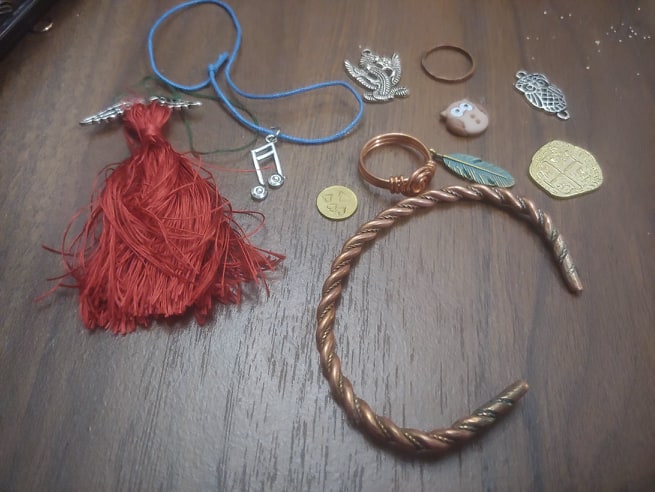
Also, throughout the event, I was presented these tokens by the populace for my performances. I added these into my “I guess I don’t suck” box. I keep every single token I’ve ever received as a way to remember on those days when the worms get to me that I am not as terrible as my brain tells me. HAND OUT TOKENS. GIVE COMPLIMENTS. These could help motivate and save your friends or strangers.
This was my 3rd year. You bet you will see me next year. Until then, I have won the day. I hope everyone else won theirs too!
Depairt, Depairt
Alexander Scott (16th-century poet) (c. 1520–1582/83), Scottish poet. Scottish lyricist who is regarded as one of the last of the makaris (or poets) of the 16th century, because of his skill in handling the old Scottish metrical forms. His 35 extant poems are contained in the Bannatyne Manuscript (1568).
This was composed in Courtly verse in the grand manner. Poetry in this manner comprises several elaborate dream-allegories more or less saturated with classical, as well as, rather more incidentally and cursorily, scriptural, allusion somewhat simpler love-allegories and dream-visions and debates, grandiose panegyrics and lament. Almost all of this is in more or less elaborate Chaucerian stanzas, mostly of seven, eight or nine lines of inter-rhyming pentameter lines. Set pieces in the courtly manner are also prefaced or appended to, or introduced into, works mainly in the narrative and didactic modes – as more or less conventional and pretentious prologues and prohemes, and conventional panegyrics and hymns, and some ‘complaynts’ or laments.
Depairt, depairt, (depart)*
Allace, I most depairte (Alas)
From her that hes my hairt (heart)
With hairt full soir (sore)
Aganis my will in deid (indeed)
And can find no remeid, (remedy)
I wait the panis of deid (pains of death)
Can do no moir. (more)
Adew sueit thing (Adieu sweet)
My joy and comforting,
My mirth and sollesing (delight)
Of erdly gloir: (earthly glory)
Fair weill, my lady bricht (bright)
And my remembrance rycht, (rich)
Fair weill and haif gud nycht, (have good night)
I say no moir.
Daiches, D. (1982), Literature and Gentility in Scotland, The University Press, Edinburgh
Ladino is very nearly extinct in many of these areas. A very archaic form of Castillian Spanish mixed somewhat with Hebrew elements (as well as Aramaic, Arabic, Turkish, Greek, French, Bulgarian, and Italian), Ladino originated in Spain and was carried to its present speech areas by the descendants of the Spanish jews who were expelled from Spain after 1492.
About the golden Lyre:
Given to an individual or group whose single work or performance, either displayed publicly or in an arts & sciences display at a Royal Progress, in The Crown’s sole opinion and discretion, manifests and represents the fire and passion of the East Kingdom arts. The basis for bestowing the Award of the Golden Lyre will rely on the artistic use of period mediums, creativity, and/or inspirational value of the work or performance. The work or performance may be a work in progress. Documentation is not required, but is highly recommended. Individuals/groups can receive the award more than once during a reign, but not for the same work or performance. The Award of the Golden Lyre may be awarded by the King or Queen, together or individually.
Typically I would talk about my event and my connection to it. I will briefly, but I want to talk about something more than that in particular so I will provide the lead up to it.
This years winter nights was just a time for me to go and hang with my other Bardy friends(not to be confused with baudy, though these are not mutually exclusive) , get a little challenge. No intent on winning. I went with the intent of celebrating Bard friends and being connected to my community, old and new.
This was also Aegir’s first true bardic event. I wanted him to get a view of my world. The second we got there, he ran off with a friend he had made at another event to go make arrows. Whatever.
Round 1 had 26 competitors and every last one was enjoyable. I had asked Aegir what he wanted me to perform and he picked an Irish traditional piece called ” If I were a blackbird”. It fits the SCA feeling so I decided to go with it. It felt solid and I felt like I performed it well.
Round 2 was my first (and only challenge, spoiler alert). I was challenged to do a late period piece which would “Blow a hole through the roof”. This made me a little nervous as I hadn’t sang in about 2 weeks due to being ill. Whatever, I’ll pull it out. I’m a big girl! (5’11 and built like a valkyrie). I decided to go with a Monteverdi piece, “Lasciate Morire” from the opera L’Arianna composed in 1607 into 1608. I did indeed, blow the roof off. Everything, for the first time, with this piece lined up, like the stars and heavens. I was moved to even take the ground and sing from the ground. This isn’t easy to do, but it felt like the right thing to do.
Fast forward to the end of the event. We were all cleaning up and I was approached by someone who knows me from the outskirts but we haven’t been close. She approached me to tell me how much she enjoyed my performance and was wowed by me singing from the ground. I thanked her immensely for her words. They meant a lot to me.
Shortly after, Aegir advised he had been speaking with the same woman earlier. This is the conversation he provided to me. “She said she almost didn’t tell you that. She said you needed to hear it like you needed another hole in the head because you know it to be true.” So, moral of the story. TELL EVERYONE
The reason I wanted to bring this up is for one reason. If you hear or see something you like, tell the artist. We are our own worst critics. We have our own brain worms. I can tell you, day after day, I never feel good enough. The only thing I have to remind me I have some semblance of talent are your words and your tokens.






 I suppose this is a little behind, but on 6/29 I ran yet another demo. This was my first grand scheme demo where I expected more than 15-20 folks to engage. The Portcon demo is a large gathering of geek culture, primarily focused on anime and board gaming. The main demographics are younger than our average scadian so it’s a perfect change to work with our future. I don’t have too much to reflect on this besides I’m excited to do it again next year and I am brimming with new ideas on how to streamline it and make it a better experience over all (besides our actual time of the demo and not going against K and Q rattan). I had support from as far away as Burlington and Essex Vermont (Which is 4 hours). I am in awe of the generosity of time for those coming so far. Also, as always, I need to give a huge shoutout to the fencers who put on a good show!!!




 Meddlings of the Minnesinger