My Co-Autocrat and I had spend months and months planning the second iteration of the EKCoP Challenge assembly. This was my first time “running” it and I had found a super sweet location. Weeks before, COVID-19 really started to spread into the US and reared it’s ugly head. The plague doctor could truly not contain this one.
My Co-Autocrat and I made the difficult decision to cancel the even. This was not done lightly. However, not only is this spread via respiratory system, singing/vocal arts were known to be the fastest way to spread it.
I wasn’t willing to go down without a fight. I wasn’t willing to let the performing arts community take a blow to one of their only real chances to gather and perform in a low key environment. Then, it hit me! Why not do this online? What were the logistics?
I spoke to my co-autocrat who has been running monthly online practice to see if this was feasible. It was!
From there we got everything sorted and up and promoted within 5 hours of this idea. Would this work? Would anyone come? Would the delay kill everything? Are we running it like it was run previously? Who knows! here we go!
We eventually settled on a formal of open meet for an hour, classes till 6 and open performances till 10.
Attendance rolled in, every class was attended and well respected.
Vermont! Here I come. One of the smaller, but favorite events I get to teach at is Mimir’s well. This is a Viking descriptive event which is all about classes and an A and S display and contest (some years). I tend to offer up on the Bardic track because there are a lot of folks who enjoy performance but not a ton who teach. That’s ok. Not everyone teaches, but I love doing it. In addition, I was asked to teach a class on pewter casting. I have been making tokens for the last year or so as well as award medallions. The Event Stewards wanted to get more folks into doing it since it was as far spread in this part of the Northern Region. I happily agreed.
I had decided to challenge myself. I have a really big fear of putting my own work for the general public. Not only that, I never feel like my polyphonic works are good enough. I was inspired by their Royale Highnesses to compose them a processional. His Royal Highness crown winner has an early roman persona. I pulled from the texts of Augustus. I used a small portion of the texts that I felt would represent our Royalty
Bella terra et mari civilia externaque tóto in orbe terrarum suscepi3 victorque omnibus veniam petentibus4 cívibus pepercí. Externas gentés, quibus túto ignosci potuit, conserváre quam excídere malui. Míllia civium Rómanorum adacta sacrámento meo fuerunt circiter quingen ta.
Wars, both civil and foreign, I undertook throughout the world, on sea and land, and when victorious I spared all citizens who sued for pardon. The foreign nations which could with safety be pardoned I preferred to save rather than to destroy.
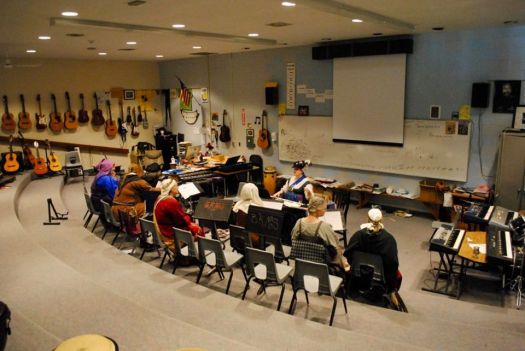
Below, find the MP3 and the recording I made during rehearsal. Sheet music to follow. I chose to teach this during the ad hoc choir that I run. It was a dream group because I had a pretty good balance on all voice parts. Everyone learned it quickly and took direction well. Again, everyone was excited to perform this during court while THR processed. TRH were banished from the room while we rehearsed because I wanted this to be a big surprise.
https://drive.google.com/open?id=1xSn0BGTbBZfLUvubdQLD7hwQkYXfbw8J
Pewter casting came later. I went through all the different forms of casting materials from clay, cuttlefish bone, soap stone and sand. We went over the materials I use in my anachronistic process (which you can see in my post for making the tokens for Ozurr and Fortune) and then, everyone who gave a donation could bring their own piece home. I had made two molds, one a Mjolnir and one a Viking brooch replica. I wanted to keep with the mood of the event. Also, this is the first time I’ve ever let anyone use my supplies or cast in front of me. I made sure to bring safety equipment to make sure everyone was safe and was ready to have my first vict-.. first student attempt this as HRH walks in. I of course offered him the chance to cast and he took it. A perfect pour! It wasn’t the first time I’ve ever had royalty attend my class, but it was the first time they were ever actively a part of it.
Everyone had gone home with their own, personally casted piece. There were no injuries. Only a few broken rubber bands and my mantra (NO PAPERWORK) seemed to work.
If you’re curious about the site tokens I made (all 200 of them) here is a picture of the completed tokens.
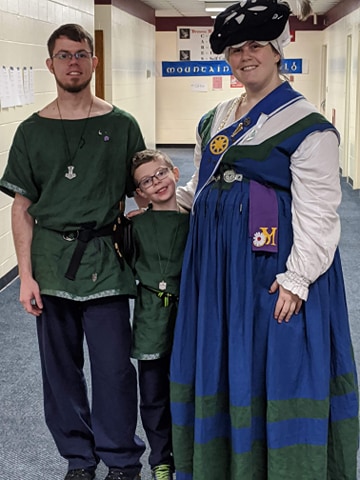
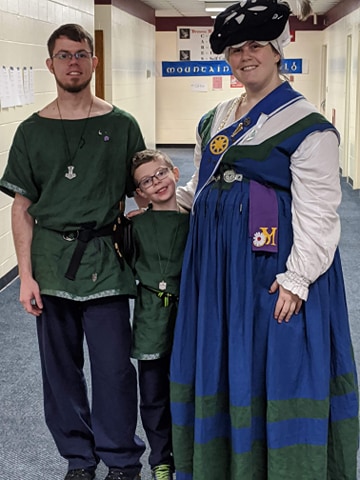
The rest of the day I got to enjoy classes. I had my Partner with me and his son, in matching garb (which was cute as heck!). It was also his son’s first event. He got to calligraph, make an LED lantern, chainmail and even got a token from TRH. You could see the magic in his eyes as he entered our little village and made new friends. He felt right at home. This is a huge deal because he doesn’t have a lot of friends. They say he’s weird (Honestly, he’s a normal kid who really enjoys Pokémon and telling you about it. Also, wicked smart at math). If you have been part of our village, these are qualities we all share.
The end of the day was here. Court! My partner loves court and he’s only been to one. It’s not the gift he got (both times) but the celebration of people and the pomp and circumstance that goes with it. I got to explain the awards people were getting, the vocabulary we were using and what was what and who was who.
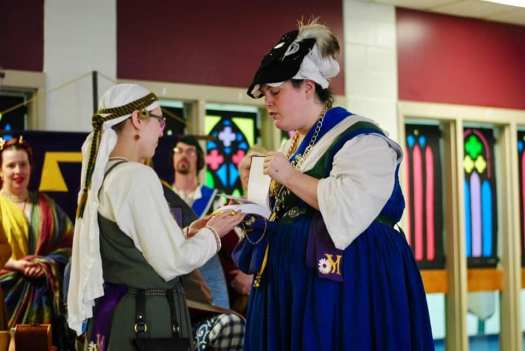
It was my turn in court. I am one of the officers for EKCoP (east Kingdom College of Performers). I serve as Chancellor as well as Deputy Chatelaine for the Northern Region. I had been given the Travel journal to pass on since the recipient was sick (with the world being like it is right now, we don’t want any of your flu/COVID-19 crud). I asked if I could present it in court. It’s a cheesy way to get the college some recognition and make the recipient feel more special. As I was about to sit down, their royal highnesses told me to hold on.
What had I done? Did they hate my song? Wha I being Banished because I’m an obnoxious and loud Bard? No.. they were doing a thing.
I was inducted into the Order of the Silver Wheel. This is an armigerous level award for those who do community service. I never expect to get awards for what I do. Sure, I dream about them like anyone else, but I do what I do because I enjoy it and want others to enjoy. I was literally dive tackled by 2 of my peers in the order… who also happen to be in the Free Company of the Stella Maris. With teers and joy I entered the order.
Please see this BEAUTIFUL scroll done by the hand of Kenneric Aubrey. Text is based off of L’homme Arme (The Armed Man)
Here is a copy of the sheet music for the processional:
This is one of my favorite events in the year. It is closer to home than most of the events I travel and is in the Barony that in my heart is my Barony. This one, however, was much tougher for me emotionally. Not to bring my personal life in to this, but I had gone through a very devastating event about 2 months prior and still had not resolved all my emotions over it. On top of that, the instigator of the event was scheduled to be present. I was lucky, however, to be camping with several of my SCA families, who would keep me safe. I brought a plethora of instruments with me to bring to the instrument petting zoo, including my harp. This was the first time I was going to get to play it in public. There was a harp ensemble present. I learned quickly of the pains harps have in heat/stage lights regarding tuning. This was not something I encountered practicing in the comforts of my mildly lit and frigid apartment. I got to spend an hour playing with other harpists of varying skill level. It was heaven!
From there, I would twiddle on my recorders outside with an impromptu recorder jam. Everything from chaotic melodies, to soothing waltzes. I met new folks, got to try new instruments with no pressure.
That night, at feast, I was once again honored to be part of the feast entertainment. I had been asked by the current baronial bard to perform. I performed my first ever originally composed story about how the children of the east changed Ozurr, storm bringer. It discussed the several events he had been to, inclusive of the crown tournament where the rains fell, the Estrella where it flooded and Pennsic, raining out the Eastern Court. From there, I sang some of my newer repertoire and enjoyed the feast.
Following court would be the Bardic championship. This year, I decided I would try something new. It’s really important to me to show newer performers that I wasn’t born with all skill. I wanted to show them that I was working on new skills. There theme was fortune and misfortune. I had the idea of performing 3 Ravens first and then Twa Corbies with a guitar accompaniment. I was newer at the guitar and this would only be my second time playing it public. I knew Twa Corbies was also not my strongest vocal piece, but I wanted to try something new. I was pleased enough with my performance and called it a night. Where I was not chosen as the new Baronial Bard, I did win populace choice. I’ll take it.
The lyrics to “The Three Ravens” are here transcribed using 1611 orthography.
“The Three Ravens” (Child 26, Roud 5) is an English folk ballad, printed in the song book Melismata compiled by Thomas Ravenscroft and published in 1611, but it is perhaps older than that.
There were three rauens sat on a tree,
downe a downe, hay downe, hay downe,
There were three rauens sat on a tree,
with a downe,
There were three rauens sat on a tree,
They were as blacke as they might be.
With a downe, derrie, derrie, derrie, downe, downe.
The one of them said to his mate,
Where shall we our breakfast take?
Downe in yonder greene field,
There lies a Knight slain under his shield,
His hounds they lie downe at his feete,
So well they can their Master keepe,
His Hawkes they flie so eagerly,
There’s no fowle dare him come nie
Downe there comes a fallow Doe,
As great with yong as she might goe,
She lift up his bloudy head,
And kist his wounds that were so red,
She got him up upon her backe,
And carried him to earthen lake,
She buried him before the prime
She was dead her self ere euen-song time.
God send euery gentleman,
Such haukes, such hounds, and such a Leman.
Written heavily in the Scots language, “The Twa Corbies” probably dates from the 18th century and was first published in Walter Scott’s Minstrelsy in 1812. Child (I, 253) quotes a letter from Charles Kirkpatrick Sharpe to Walter Scott (August 8, 1802): “The song of ‘The Twa Corbies’ was given to me by Miss Erskine of Alva (now Mrs Kerr), who, I think, said that she had written it down from the recitation of an old woman at Alva.”.
Twa Corbies
As I was walking all alane,
I heard twa corbies making a mane;
The tane unto the t’other say,
‘Where sall we gang and dine to-day?’
‘In behint yon auld fail dyke,
I wot there lies a new slain knight;
And naebody kens that he lies there,
But his hawk, his hound, and lady fair.
‘His hound is to the hunting gane,
His hawk to fetch the wild-fowl hame,
His lady’s taen another mate,
So we may mak our dinner sweet.
‘Ye’ll sit on his white hause-bane,
And I’ll pike out his bonny blue een;
Wi ae lock o his gowden hair
We’ll theek our nest when it grows bare.
‘Mony a one for him makes mane,
But nane sall ken where he is gane;
Oer] his white banes, when they are bare,
The wind sall blaw for evermair.
Meaning of unusual words:
twa=two
corbies=crows (or ravens)
fail dyke=wall of turf
wot=know
kens=knows
hause-bane=neck bone
een=eye
theek=thatch
Panteria was my first camping event in 2010 and has always been a special event to me (Even though a bunch of my friends tried to coax me into go to Roses instead). This year would be no different. Well, I mean, it will be because the event has grown and changed over the years.
With this development of the event, I decided to develop myself farther. I had started a similar idea before, but this will be an ongoing contingency group. I started a travel ad hoc choir in which we would learn some music and then after a few events or so, would get the chance to perform it.
The plan for this one would be to introduce everyone, get a gauge of their skill level and then do a thing! My first meeting has 10 vocalists as I gave out all copies of my music. we had 1 bass, 1 tenor, 4 altos and 4 sopranos. What made this group even more interesting was the addition of a youth (sub 18). I handed out pieces in various languages. She seemed very concerned that they would potentially contain a swear word. Even after I reassured her several times there we no swears, I even had a native speaker of the language to also confirm that.
It was a challenge to have a youth there as I haven’t been a youth instructor since 2008. So, a few years. She stuck around for about a half hour. With permission, just after she left, I made a recording of the group performing and a second one as well.
By the end of our 2 hour sessions, a complete piece of music was learned as well the groups excitement level was near explosion. They asked over and over again if they could perform that night at Bardic. I had been planning to wait a few rehearsals, but they people have spoken.
Additionally, I had brought my new rounds book which I created. This would be the second event it is making it’s debut at. I am really proud of what I gathered. Now I have a few finishing touches to add to it. However, people are eager to purchase or have a copy of it in general.
Here are a couple recordings of the rehearsal process:
You can definitely hear the improvement between takes. There is maybe a 20 minute difference between them. By performance that night they were spot on. I am still hunting down that recording.
During rehearsal I did refrain from singing with the group so they could focus on themselves. However, by performance, we had lost a couple folks and needed to shift around and I ended up singing with them.
NB) This was not taken at tempo for rehearsal reasons.
About the piece:
It was included in Dowland’s First Booke of Songes or Ayres, which appeared in 1597. The piece is often performed as a lute song by soloist and lute, but, like other songs in the First Booke, it is printed in a format that can also be performed as a madrigal by a small vocal group (typically SATB).
This lute song is largely famous for the lovely melody and the striking repetition of rising fourths in the penultimate line of each verse. This is especially effective in the first and second verses, where the text and the music are a perfect fit.
In the first verse, the singer urges the beloved to come to him again, so they can enjoy together the pleasures of love, “to see, to hear, to touch, to kiss, to die, ” in the second he sings of his sorrow, “I sit, I sigh, I weep, I faint, I die, ” and in the somewhat less graceful third verse, he claims that nothing can move her heart, “By sighs, and tears, more hot than are thy shafts/ Did tempt, while she for triumph laughs.”
Come again!
Sweet love doth now invite
Thy graces that refrain
To do me due delight,
To see, to hear, to touch, to kiss, to die,
With thee again in sweetest sympathy.
Come again!
That I may cease to mourn
Through thy unkind disdain;
For now left and forlorn
I sit, I sigh, I weep, I faint, I die
In deadly pain and endless misery.
All the day
The sun that lends me shine
By frowns do cause me pine
And feeds me with delay;
Her smiles, my springs that makes my joys to grow,
Her frowns the Winters of my woe.
All the night
My sleeps are full of dreams,
My eyes are full of streams.
My heart takes no delight
To see the fruits and joys that some do find
And mark the storms are me assign’d.
Out alas,
My faith is ever true,
Yet will she never rue
Nor yield me any grace;
Her eyes of fire, her heart of flint is made,
Whom tears nor truth may once invade.
Gentle Love,
Draw forth thy wounding dart,
Thou canst not pierce her heart;
For I, that do approve
By sighs and tears more hot than are thy shafts
Did tempt while she for triumph laughs.
Choirs are a lot of fun, but they require more than you. That isn’t a bad thing, but finding other like minded folks with the missing parts you need can be difficult to say the least. Once upon a time (4-5 years ago) I ran a vocal group in Malagentia called, “Voce di Sonata”. I ran this choir for about 2 years. However, with real life comes member depletion. I moved a bunch, people got married and divorced, houses were sold and people have this thing called a job. So, as it were, life doesn’t always work the way it should and I let the group dissolve.
About 2-3 months ago, a conversation struck up with one of my old vocalists from voce. She had expressed wanting to sing and make music. Then, more specifically, she and her husband wanted to work on “O Magnum Mysterium” by Victoria.
If you haven’t heard this piece, take a listen:
NB) More information about this piece below
However, with the 3 of us, we were missing a crucial voice part. The tenor! I was playing the part of Alto, because… why not. (for any of you who know me, I am not an alto, I just play one on TV). We have a local tenor who is also a shoe in and loves to sing, so without fail, he came to the rescue. 2-3 rehearsals in and we have some music going. This is a volunteer group, who meets every 2 weeks, but again, life happens so we’ve maybe met 2-3 times in 3 months, and that’s ok.
This is for fun. (I have to keep telling myself that. I come from a history of professional musicians who come to their first rehearsal with all their music learned if not memorized. Those, who have perfect pitch or at least relative pitch and work without speaking, singing only for 1-2 hours at a time) This is an ongoing learning experience for me. I’m loving every moment of it. It’s absolutely incredible to work with a group of people who’s passion has not been lost. They do this because it’s fun, not work.
O Magnum has been put aside for now so the group can learn some vital things about working together is a very small chamber group. For now, we are working on Belle Qui Tiens Ma Vie ( Thoinot Arbeau 1520-1595) , Ah Robin, Gentle Robin (William Cornish 1465-1523) and By the Rose (13th century anonymous poem set by Lady Colette la Trouvere).
With permission from the ensemble, here are the super duper rough recordings done on my terrible cell phone. The one thing I can’t show you is the immense joy and pride on all the vocalists faces when they got to hear their recordings for the first time. The plan is, down the road to make a real recording for them to compare themselves to.
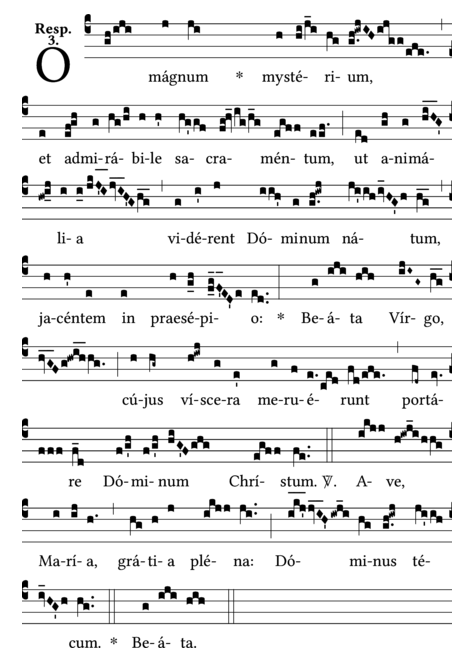
O Magnum Mysterium is a Catholic church chant sung at Christmastime. As part of the Matins (nighttime worship), the text has been around for centuries. While the exact origins are unknown, historians believe the text (and its use in Catholic Mass) has been around since at least the 10th century.
Because the work is so old, there have been many different settings and versions throughout the years. Today I want to share the version composed by Tomás Luis de Victoria (1548-1611), Spain’s most famous 16th-century composer.
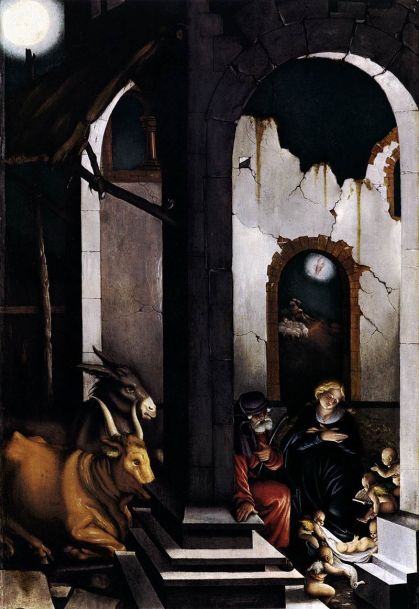
The first half of the chant references the animals present at Jesus’s birth, symbolic of God’s mysterious and lowly life as a mortal. This was a topic of great excitement during the Renaissance; people loved the idea that the animals in the stable recognized the birth of Jesus as an important event. The painting demonstrates this idea.
The second half of the text relates to the words spoken by Elizabeth when she welcomes Mary, the mother of Jesus, into her home:
“And she spake out with a loud voice, and said, Blessed art thou among women, and blessed is the fruit of thy womb.
And whence is this to me, that the mother of my Lord should come to me?” – Luke 1: 42-43
Music theory: Victoria’s use of open 5th intervals perpetuates a sense of awe in the music. In 5th intervals, the third of the chord is missing; this crucial note determines if the harmony is major or minor, so open 5ths don’t have any harmonic indication (which leaves the listener in suspense).
The music changes to a lilting triple meter as the choir sings “Allelujah!” This is an unexpected yet exciting conclusion to the piece, and it reminds me of a chorus of angels proclaiming the birth of Jesus.
About Belle qui
Thoinot Arbeau” is the pen name and an anagram of Jehan Tabourot, a Catholic priest and canon of Langres.
“Belle quit tiens ma vie” was first published in Tabourot’s 1588 dance manuscript “Orchesography”, which today is a major source of information about Renaissance dance.
This piece is a pavane: a stately dance in slow duple time, popular in the 16th and 17th centuries and performed in elaborate clothing.
Belle qui tien ma vie:
Belle qui tiens ma vie
Captive dans tes yeux,
Qui m’as l’ame ravie
D’un souris gracieux,
Viens tot me secourir
Ou me faudra mourir.
Beautiful one who holds my life
Captive in your eyes,
Who has ravished my soul
With a gracious smile.
Come to my aid
Or I must die.
Pourquoi fuis tu, mignarde,
Si je suis pres de toi?
Quand tes yeux je regarde
Je me perds dedans moi,
Car tes perfection
Changent mes actions
Why do you flee, dainty one,
If I am near you?
When I behold your eyes
I am lost inside myself
Because your perfection
[so affects my behaviour].
Tes beautes et ta graces
Et tes divins propos
Ont echauffe la glace
Qui me gelait les os,
Et ont rempli mon coeur
D’une amoureuse ardeur.
Your beauty and your grace
And your divine ways
Have melted the ice
Which was freezing my bones
And have filled my heart
With a loving ardour.
Mon ame voulait etre
Libre de passion,
Mais l’amour s’est fait maitre
De mes affections
Et a mis sous sa loi
Et mon coeur et ma foi.
My soul wanted to be
Free of passion,
But love became master
Of my affections
And put under its law
My heart and my faith.
Approche donc ma belle,
Approche toi mon bien,
Ne me sois plus rebelle
Puisque mon coeur est tien,
Pour mon mal appaiser
Donne moi un baiser.
Come near, my lovely one,
Come near, my [dear one],
Do not resist me further
For my heart is yours,
To relieve my ills
Give me a kiss.
Je meurs, mon Angelette,
Je meurs en te baisant
Ta bouche tant doucette
Va mon bien ravissant
A ce coup mes esprits
Sont tous d’amour epris.
I die, my Little Angel,
I die when kissing
Your mouth so sweet.
My very lovely one,
With that touch my spirits
Are completely lifted in love.
Plutot on verra l’onde
Contremont reculer,
Et plutot l’oeil du monde
Cessera de bruler,
Que l’amour qui m’epoint
Decroisse d’un seul point.
Sooner will waves
Flow backwards
And sooner will the moon
Cease to shine
Before the love which conquered me
Wanes a single iota.
About Ah, Robin:
This is a secular madrigal
a part-song for several voices, especially one of the Renaissance period, typically arranged in elaborate counterpoint and without instrumental accompaniment. Originally used of a genre of 14th-century Italian songs, the term now usually refers to English or Italian songs of the late 16th and early 17th c., in a free style strongly influenced by the text.
Musical Analysis:
As each voice enters the harmonies expand. Interesting enough the opening sonority begins on a G, adds a B-flat with the other ground voice, and finally an octave G in the soloist. This causes one of the significant part of the piece, the entrance of the third voice, to have a G minor harmony without the fifth of the chord.
This piece is still modal despite the use of F naturals, however, the d minor harmony begins to act as a resting point for phrases. The use of a picardy third appears numerous times through the work at the end of phrases, but not at the end as each voice begins to drop out, eventually making the music monophonic.
Ah, Robin, Gentle, Robin
Ah, Robin, gentle, Robin,
Tell me how thy leman doth
and thou shalt know of mine. My lady is unkind I wis, Alack why is she so? She lov’th another better than me, and yet she will say no.
Ah, Robin, gentle, Robin,
Tell me how thy leman doth
and thou shalt know of mine. I cannot think such doubleness for I find women true, In faith my lady lov’th me well she will change for no new.
Ah, Robin, gentle, Robin,
Tell me how thy leman doth
and thou shalt know of mine.
G. Edward Bruner, DMA: “Editions and Analysis of Five Missa Beata Virgine Maria by the Spanish Composers: Morales, Guerreo, Victoria, Vivanco, and Esquivel.” DMA diss., University of Illinois at Urbana-Champaign, 1980.[facsimile: University Microfilms International, Ann Arbor, MI]
Gustave Reese, Music in the Renaissance. New York, W.W. Norton & Co., 1954. ISBN 0-393-09530-4
Apel, Willi. 1988. The History of Keyboard Music to 1700. Bloomington: Indiana University Press. ISBN0-253-32795-4.
Arbeau, Thoinot. 1967. Orchesography, translated by Mary Stewart Evans, with a new introduction and notes by Julia Sutton and a new Labanotation section by Mireille Backer and Julia Sutton. New York: Dover Publications. ISBN0-486-21745-0.
Mimir’s well, year 3 was a resounding success. It was really nice to be able to teach and actually have time to take classes as well as socialize.
About 6 months ago, the Autocrat, Eleanor Grey, had asked me to come teach to make sure there was once again a bardic representation at their lovely event. I agreed. Mountain freehold is a great little shire with great people. Last year, I wrote them a song because they deserved it.
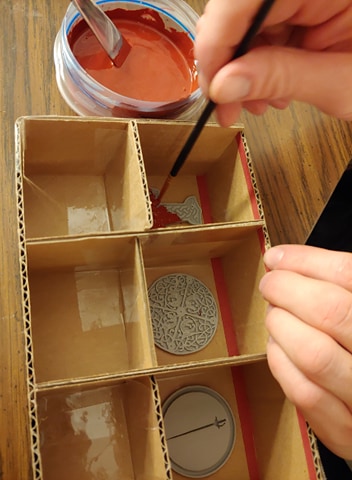
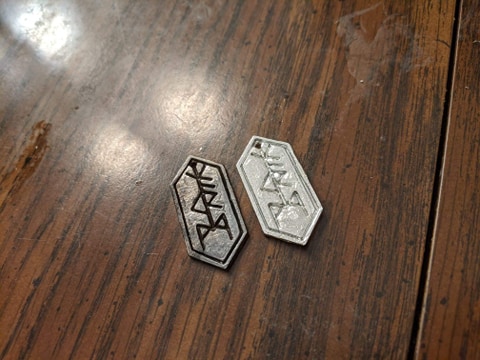
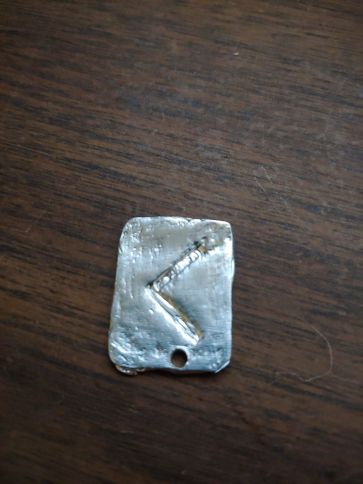
About 1.5 months ago, I was also asked if I could make the site tokens. I happily agreed. Mimir’s well is about wisdom. So, I chose to make tiny wisdom tokens. I sent Aegir the image to 3-d model as I had other work commitments I had to manage and he loves to play in fusion 360 (The 3-d modeling program we use). From there we printed and molded the tokens. She had requested that we make 100 of them. I had also decided that I didn’t want them to look like pristine metal. So, when creating the positive before creating the mold, I covered it in modgepodge and while it was still tacky, took same sandpaper to it to make it appear more stone-like by taking some divits out of the modgepodge.
Here are the final tokens (Though this one has the hole drilled in the wrong side):
From there, off to teach classes! I had a bright eyed and bush tailed class right at 10:00am. I always dread the first class of the day. I feel like no one wants to be there that early and no one is emotionally awake. It’s also the same as first performer stage fright. Always so hard to go on first, however, once the stage is set, everyone is ready to go!
My first class is how to warm up your body to perform. Yes, I taught this class the week before, however it is never the same. Here is the outline of the class so you know more (in a bullet form, what was gone over in the class)
Why do we warm up our bodies?
Athletes
Protection from harm
Emotionally warmed up
Setting the stage
Setting nerves aside
Ready to move
Anatomy of the mouth
Lips, Teeth, Alvular ridge, Hard pallet, Soft pallet
Discussion of how body is connected
Posture- Demonstration
Body stretches and massage
Head/temples
Neck
Head rolls
Arm body crosses
Pliet
Foot stretches
Rag dolls
Group massage
Breathing
Clavicle breathing
Proper way to breath in (order of operations)
Floor breathing
Engaging diaphragm and low back muscles
Breathing exercises
In outs on “Straw”
In outs on “Shhh”
Bubbles
Coughing/laughing
Projection
Talk about notes/polyps/hemorrhaging (Julie Andrews story)
5 locations to send sound in mouth
Discovering the soft pallet
Lollipops/York peppermint paddies
Eyebrows/yawning
Tongue twisters (Diction is done… Mommy made me…)
Finding nasal air flow spot
Tongue position
Dynamic projection (Using soft “stage whispers” to speak across the room)
Body tension
Finding tension in your body
Finding good mouth space
What you can do to loosen up your body
Questions:
From there, I hung out, ate, made some music with friends and enjoyed. I finally got to sing a few filks I had composed to those who had never heard them and saw the glee as disney and queen were attached to their favorite SCA activities. In addition, I got to see Aegir working in the kitchen, which he had a blast with.
My final class was just us singing period rounds. I just finished compiling a book of about 50 all period rounds (Sans “Le coq et mort”… which is a traditional, but hey, everyone likes to sing about dead chickens… plus I added the german. Morbid…dead..german… chickens). However, what makes my book different, besides it being so long, is I wrote up all the translations, IPA (Internation Phoenetic Alphabet) dictions and newspaper diction. I will be adding my written documentation on this shortly as well as the appropriate IPA charts, however, after the class, all 14 of my students were begging me to publish it now. (it was 25 pages, so I was remiss to keep printing more copies out of my pocket). I did, however, sell the 8 copies I made for charity and donated the funds on behalf of my class.
Finally, Aegir and I displayed our molds and casts we’ve been doing over the last few months. We had a BLAST telling everyone about the process. Again, making everything more accessible. We really want to make our arts accessible to people. I find it to be a gateway drug. If you find an easy/cheap way to do it, you most likely will want to explore how it was done. *GASP RESEARCH*
This weekend was the East Kingdom College of Performers Challenge and Schola down in Iron Bog. This was a little bit of a schlep for a day event, but I am so glad I headed down. This is the first time we’ve done something like this in the East Kingdom. It was a day of classes and challenges. You did not have to master anything to be a part of it, but you would have to be willing to step out of your comfort zone.
With that said, it was a challenging, but positive day over all. I started the day right away with running a rehearsal for the newest addition to the East Kingdom College of performers, Opera D’el Est. The day, however, started more frantically than I hoped it would. Our one and only alto wasn’t able to come. So, I guess I’d sing her part and hopefully make it work. Then, 1/2 of the performers, who were traveling in the same vehicle, were about 45 minutes late (however, due to no fault of their own. Between traffic and weather).
Rehearsal did not go as planned, and that’s ok. We were fighting a lot of odds between company distances, time we had to prepare music and we are a new group. This happens. Everyone had agreed to give up part of their lunch time to meet again for additional rehearsal.
I met with some of the other vocalists after for some one on one help. From there, I whirled into some recorder site reading, which I really haven’t picked up a recorder since 2009… when I graduated college. Not only did I remember some things (Which was huge) I got to encourage 2 more of my friends to come join us. We went from 3- 5! So many tooty flutes!
From there, off to run a class. I have taught this class a couple times prior, but I think this iteration was the best version of the class. I am passionate about making sure performers are well warmed up for performance whether is be Singing, story telling or even heralding. If the body -and- mind are not there, then your performance will suffer. This iteration of the class discussed anatomy, posture, breathing, the parts of your body that make the sounds, projection and location of sound. I had 6 folks join my class of varying experience and age. Everyone seemed to get something new from the class and was able to apply it. Once of the gentleman in the class, who I performed with later in the day, said that it was a comprehensive warm up and encouraged others to do so. This was encouraging.
From there, a very abbreviated lunch and round 2 of rehearsing. This time, the section which the group seemed to be struggling with, seemed to lock in. Though, no real way to test it until performance. TO ADVENTURE!
From there, time to do another class! I have been bringing rounds with me to almost every event I teach at. They are a safe singing space for novice to master and bring joy. 8 folks at my rounds class. Everyone had a varying degree of expertise and it was delightful. There was a young lady, who doesn’t sing much, but her boyfriend does, who came to my class. She spoke to me afterwords, advising that she was over the moon since she got to sing. She felt the class was tailored enough that she could join in and not feel like she was slowing progress, but that she got to sing the songs and sing her part independently.
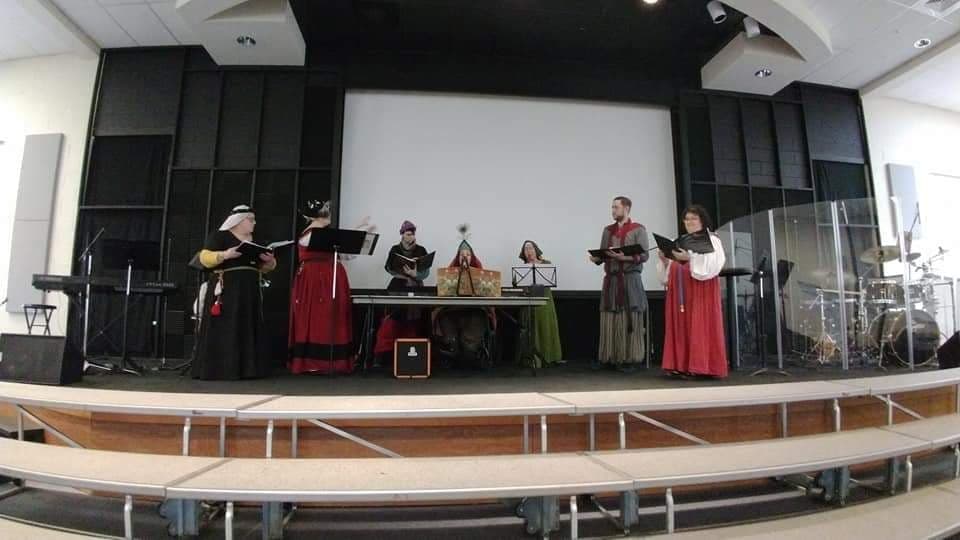
Whooosh! Off to perform (No, I have not sat down today or stopped for water). It was time for Opera D’el Est to make it’s debut. (See documentation, synopsis and translation below #1). The first piece we did was the Prologue from Eurydice. Despite some minor technical difficulties everyone who sang in that piece, rocked it.
We had a solo from our fearless leader and newest Queen’s Bard, Laila.
Then a solo from me! I died. I love dying on stage. I performed Laciate Morire from L’Arianna (See info below #2). I love death arias. I love dying on stage. To lament, there is no greater form of drama. See! Look, I’m dead… on the floor… singing the high stuff!
We had a beautiful duet from Laila and Ethnye (Enya). Finally, the choral piece from doom. A te qual tu ti, Euridice, Jacopo Peri. (Info below #3) It’s not that this piece was hard or anyone was untalented, it was just a perfect storm. This experience however taught me a new skill. I went to school professionally for singing. Everyone had hours to prep their pieces and weeks to learn music. This was not that. I learned that I should be happy with a product, that I had volunteers. I learned that my standard of performance is not a level for everyone. I don’t want this to come off as condescending. What I mean is that in fact, I should be proud of a group who came so far to even get this going. This was a huge success. Even if the music wasn’t perfect. LOOK AT THESE FOLKS! Look what they accomplished in such a short period of time.
From here, off to the challenges for the day. I stuck myself in a spot just to get out there and do something that I wasn’t necessarily skilled at. I wanted to work on something that wasn’t “Pretty” or necessarily polished. This is a huge fear for me because I was taught to never put anything out there that you weren’t proud of or ready to be recorded for the world. As a Bard, part of my learning is about bringing the news and the stories. They won’t always be perfect, but that is part of the creation and the reality.
The first piece I performed was “Twa Corbies”. This is a spoof written as a response to Raven’s Croft’s “3 ravens”. (See the lyrics and translation of the low Scottish below).
Second, was a completely non period, but SCA appropriate story. I don’t know it’s title, but I shall call it “How I caught the red dragon”. I’m not really a story teller. I do it to challenge myself. Music is my muse. However, I always want to be able to entertain a room. Pretty singing isn’t for everyone. Sometimes, you just need to tell a cheesy story. So I did. I flubbed up some of the words. I didn’t provide enough gesticulations as I’d like, however, I made my goal. I told another story in front of an audience. I’m getting there.
Last but not least, I had the pleasure of presenting the new East Kingdom College of Performer’s Travel journal during the final court. Just prior to, I had sat down in quiet with one of my fellow performers today. She bled her heart to me. She spoke of her struggles and sorrows with today’s events. She exclaimed that she was embarrassed. I shut the door in the room we were… expelling in. I explained to her that this was a new experience. Nothing wen right for any of us. She did well. Was it perfect, no. However, we will grow from good to better to best. I told her of my struggles with the day. That I was just her with 2 years more experience. I told her after the event we would connect and see how we could grow. It was then, I realized I would present the journal to her. She was my inspiration. She fell, she got back up. She is off running again. I could not be more proud of her.
I presented the journal, I shouted, “I”m free” and from court I left.
1)
Prologo: From Eurydice BY Jacopo Peri, Composed in 1600. The composition is typically considered to be the second work of modern opera, and the first such musical drama to survive to the present day. (The first, Dafne, was written by the same authors in 1597.)
Since both the libretto and score were dedicated to the new Queen of France, Marie de’ Medici, some scholars have recognized a possible parallel between Euridice and Orfeo and the Queen and King of France. While the comparison is readily made, some scholars argue that the traits of King Henry IV are different from Orfeo, especially with respect to Orfeo’s most famous deed. Orfeo loved Euridice so much that he journeyed to Hell and back, quite literally, to unite once more with his beloved wife while King Henry IV wouldn’t travel as far as Florence to retrieve Medici.
Peri’s Euridicetells the story of the musician Orpheus and Euridice from Greek Mythology. According to myth, Orpheus was a great musician who journeyed to the underworld to plead with the gods to revive his wife Euridice after she had been fatally injured.
The opera begins with a Prologue delivered by a singer representing Tragedy. She explains to the audience that she has not come this time to reduce them to tears with stories of sorrow, death and cruelty, but has changed her usual costume in order to awaken much sweeter emotions in the human heart. Future artists may well follow in her footsteps, when the whole world admires what she can do in this changed form: the new queen whose wedding is being celebrated, she says, will be more garlanded with laurels than anyone ever was in ancient Athens or Rome. She herself is going to dress up for the royal wedding, and while France prepares to receive its new queen, the wedding guests can relax and listen to the singing of Orpheus.
Hill, John Walter (2005). Baroque Music: Music in Western Europe, 1580–1750. Norton. ISBN 0-393-97800-1.
Oldmeadow, Earnest (1909). Great Musicians. Forgotten Books.
Io, che d’alti sospir vaga e di pianti
spars’or di doglia, or di minacce il volto
fei negl’ampi teatri al popol folto
scolorir di pietà volti, e sembianti.
Non sangue sparso d’innocenti vene
non ciglia spente di tiranno insano,
spettacolo infelice al guardo umano
canto su meste, e lagrimose scene.
Lungi via lungi pur da regi tetti
simolacri funesti, ombre d’affanni,
ecco i mesti coturni, e i foschi panni
cangio, e desto nei cor più dolci affetti.
Or s’avverrà, che le cangiate forme
non senza alto stupor la terra ammiri,
tal ch’ogni alma gentil ch’Apollo inspiri
del mio novo cammin calpesti l’orme.
Vostro regina sia cotanto alloro
qual forse anco non colse Atene, o Roma,
fregio non vil fu l’onorata chioma
fronda febea fra due corone d’oro.
Tal per voi torno, e con sereno aspetto
ne’ reali imenei, m’adorno anch’io,
e su corde più liete il canto mio
tempro al nobile cor dolce diletto.
Mentre Senna real prepara intanto
alto diadema, onde il bel crin si fregi,
e i manti, e seggi degl’antichi regi
del tracio Orfeo date l’orecchia al canto
I, who eager for loud sighs and tears, My face now filled with sorrow, now with threats, Once made the faces of the crowd in great theaters Turn pale with Pity
No longer of blood shed by innocent veins, Nor of eyes put out by the insane Tyrant, Unhappy spectacle to human sight, Do I sing now on a gloomy and tear-filled stage
Away, away from this royal house, Funereal images, shades of sorrow! Behold, I change my gloomy buskins and dark robes to awaken in the heart sweeter emotions
Should it now come to pass that the world admire, with great amazement, these changed forms, So that every gentle spirit that Apollo inspires will treat in the tracks of my new path
Yours, Queen, will be so much laurel, That perhaps not even Athens or Rome gathered more, an ornament worth of those honored tresses A frond of Phoebus between two crowns of gold.
Thus changed, I return; serenely, I, too, adorn myself for the Royal wedding, And temper my song with happier notes, Sweet delight to the noble heart
While the royal Seine prepares A noble crown to decorate the beautiful hair, and the mantle and throne of the ancient Kings, Listen to the singing of Orpheus of Thrace.
2)
This is from Arianna (1608), Arianna’s Lament, the only aria surviving from this opera, with text by Rinuccini. The manuscript survives in two copies: Manuscript Mus. G239, Biblioteca Estense, Modena, Italy and (in the handwriting of composer Luigi Rossi) as British Library Ad. 30491.
Ariadne’s sadness is a prime example of the effects of a man’s false words. In the myth of Theseus, her lover, he promised her a marriage in exchange for her aiding his journey to kill the Minotaur. However, Theseus soon abandons his bride-to-be, leaving her all alone to bathe herself in grief. She then became inspiration to many painters, sculptors, artists and musicians, mainly depicted weeping and in obvious despair.
Lasciatemi morire,
Lasciatemi morire;
E che volete voi che mi conforte
In così dura sorte,
In così gran martire?
Lasciatemi morire.
Let me die,
Let me die;
And what you would think could comfort me
In such a harsh fate,
In such a great martyrdom?
Let me die.
A te qual tu ti, Euridice, Jacopo Peri
A te qual tu ti sia de gl’alti numi
ch’al nobile pastor recasti aita
mentre avran queste membra, e spirto, e vita
canterem lodi ogn’or tra incensi, e fumi.
Se de’ boschi i verdi onori
raggirar su nudi campi
fa stridor d’orrido verno
sorgono anco, e frond’e fiori
appressando i dolci lampi
della luce il carro eterno.
S’al soffiar d’Austro nemboso
crolla in mar gli scogli alteri
l’onda torbida spumante,
dolce increspa il tergo ondoso
sciolti i nembi oscuri, e feri
aura tremula, e vagante.
Al rotar del ciel superno
non pur l’aer, e ‘l foco intorno
ma si volve il tutto in giro,
non è il ben nel pianto eterno.
Come or sorge, or cade il giorno,
regna qui gioia, o martiro.
Poi che dal bel sereno
in queste piagge umil tra noi mortali
scendan li dèi pietosi a’ nostri mali
pria che Febo nasconda a Teti in seno
i rai lucenti, e chiari
al tempio ai sacri altari
andiam devoti, e con celeste zelo
alziam le voci e il cor cantando al cielo.
Aurelio et Ludovico Osanna, Mantua, 1608. Publication of the text included in Federico Follini’s report of the 1608 performance
G. F. Gundulić, Ancona, 1633. Croatian translation, prepared for possible performance in Dubrovnik c. 1620. (5 scenes version)
L’Arianna (English: Ariadne) (SV 291), composed in 1607–1608, was the (now lost) second opera by Italian composer Claudio Monteverdi. One of the earliest operas in general, it was first performed on 28 May 1608, as part of the musical festivities for a royal wedding at the court of Duke Vincenzo Gonzaga in Mantua. All the music is lost apart from the extended recitative known as “Lamento d’Arianna” (“Ariadne’s Lament”). The libretto, which survives complete, was written in eight scenes by Ottavio Rinuccini, who used Ovid’s Heroides and other classical sources to relate the story of Ariadne’s abandonment by Theseus on the island of Naxos and her subsequent elevation as bride to the god Bacchus.
The opera was composed under severe pressure of time; the composer later said that the effort of creating it almost killed him. The initial performance, produced with lavish and innovative special effects, was highly praised, and the work was equally well received in Venice when it was revived under the composer’s direction in 1640 as the inaugural work for the Teatro San Moisè.
Rinuccini’s libretto is available in a number of editions. The music of the “Lamento” survives because it was published by Monteverdi, in several different versions, independently from the opera. This fragment became a highly influential musical work and was widely imitated; the “expressive lament” became an integral feature of Italian opera for much of the 17th century. In recent years the “Lamento” has become popular as a concert and recital piece and has been frequently recorded.
Scene 3
Arcetro recounts that while Orfeo lay weeping, Venus, goddess of love, carries him off in her chariot.
To you, what are you of the high ,
That to the noble pastor recasts
While these members have the spirit and life
Singing praises each between incense and fumes.
If of woods the green honors
Brawl on bare fields
Make gasps of horrid
Battle still, and frond’e flowers
Prepare with sweet flashes
Of light the eternal cart.
Seal and blow of Austro nervously
collapses into the sea, the rocks alter
the murky wave sparkling
Sweetly purse back wave
Melting the dark clouds and wounded
Aura flickers, and rambling.
At the top of the sky excees
Not just the air, and the fire around
But it all turns around
It’s not the way, in the eternal cry
How the day or the day falls
Reigns here joy and martyr.
We raise the voices and the heart singing to Heaven







 Meddlings of the Minnesinger