
This is my documentation for the A and S Team. Please see my blog post for more indepth feelings and responses from Pennsic 2022.
Hamlet, Hamlet!

Although this was not my own production, I was granted a chance to perform with the gifted cast. A few days ago, my Laurel, Sabine, had reached out to me asking if I would be willing to be a part of the live intermission music for Hamlet. This was a live reading so I thought it would also be really cool to be a part of a live performance in any way I could.
I was trying to wrap my head around a way to make this work. Sure, I have some ok recording equipment which make for OK sound equipment when recording. I also don’t really have any period instruments that I play well enough to accompany myself. However, it hit me that I didn’t -need- one. I have a keyboard in my house and music!
This would probably be the only chance I will have in the foreseeable future to be able to play piano and sing without it being too jarring.
Among that challenge, there is the looming of the novel virus COVID-19, which, has put a damper on my performance muse. I won’t even really sing seriously in front of my fiancé. It’s amazing what isolation will do to your singing spirit.
From there, a small bit of rehearsal and details to iron out.
Day of, everything that could go wrong on the musical side of technology went wrong. After multiple reboots, some sound engineering (Thanks to my fiancé for helping listen for balance checks) and then leveling the volume of the keyboard versus my voice, it was time to go.
Right before I was going to sing, the power supply blew and a quick changing of sockets fixed everything.
Was this my best performance? No. Did I get to be a part of an amazing production? Absolutely.
Thank you again, Sabine for coordinating this and to my fellow performers who made a magical day.
If you have not watched this, please enjoy!
Crown Bardic

Delaware is far! I live in Maine, currently. In order for me to get to Delaware alone I need to fly. I don’t really feel like driving 7-8 hours *without stopping* alone so an airplane it is! Shoot, this is school vacation week as well… Cheapest plane ticket round trip is $300 (still cheaper than driving based on gas, tolls, oil change, wear and tear on tires etc). Oh well. Worth it. Usually tickets are around $150 round trip. Oh man! It’s also my Birthday. Welp, what a better way to spend your Birthday than around friends making music. NAILED IT.
I flew down to spend some time with my Laurel 2 nights before. Her advice and mentorship are always invaluable.
I had spent most of the day when I had silence in the house rehearsing my pieces. It was a luxury to have high ceilings versus my small apartment where I can’t even sing out due to this thing called neighbors. I also hadn’t had much time to practice in front of peers except for at 12th night. I ended up skyping with a few of my trusted friends and fellow performers for feedback. Not only on the performance itself but on my intros. Performance is not just the piece itself; it’s about setting the scene. You want everything to flow and be connected.
The night prior to competition I was surrounded by fellow competitors… no.. friends. That is a better word. Sure, we were in competition with one another, but one of the best things I love about my community is the love and support we share for one another. We all possess several special talents and none of us are the same. It’s a gift that we have such a variety of folks to learn from.

Day of. Up and at em! A hearty breakfast of nothing but protein to make sure nothing would go awry in my stomach. I made to hydrate well. You should always begin hydrating the night before or you will be playing catch up all day. Your bladder may also decide it needs tango lessons. I was greeted by familiar and nervous faces. Stage fright/competition fright never goes away. It’s something we all still cope with from time to time. It’s not even that we are afraid. It’s that we want something immensely and if something doesn’t go perfectly, you may be upset with yourself. I do try to point out to anyone that art should not be perfect. It should never be the same each time. It should never feel the same each time. I always try to find something new in a piece every time I perform it as well.
Anyways, Birthday wishes rolled in and it was time to begin. My first piece I chose was brand new repertoire to me. No one except for those I rehearsed in front of had every heard me sing it. IN fact, although it was a late period piece, most people had never heard of it.
Here is round 1:
Francis Pilkington (ca. 1570–1638) (The First Book of Songs or Ayres of Four Parts, 1605). This was originally set as a Madrigal. Each verse of text consists of the entire musical work, which then repeats back to the beginning with each consecutive stanza. Internal repetition starts with the nonsense syllables “Lulla, lullaby” to create an unbalanced binary (ABB) form. As such, the rhyme scheme, ababcddc, is divided at the “fa-la chorus,” splitting each octave into two quartets. Pilkington also altered meter between these quartets to create melodic and rhythmic variation
https://drive.google.com/open?id=1PhNWh6t2eObdYBc9C2S-TxtNp3VoG3sH
Rest, sweet nymphs, let golden sleep
charm thy star brighter eyes
Whilst my lute the watch doth keep
in pleasing sympathies.
Lulla lullabye, lulla lullabye,
Sleep sweetly, sleep sweetly,
let nothing afright ye,
in calm contentments lie.
Dream, fair virgins, of delight
and blest Elysian groves
while the wandering shades of night
resemble your true loves.
Lulla lullabye, lulla lullabye,
Your kisses, your blisses
send them by your wishes
although they be not nigh.
Thus, dear damsels, I do give goodnight,
and so am gone;
With your hearts’ desires long live,
Still joy, and never mourn.
Lulla lullabye, lulla lullabye,
Hath pleased you and eased you,
and sweet slumber seized you —
And now to bed I hie.
Lulla lullabye, lulla lullabye,
Sleep sweetly, sleep sweetly,
let nothing afright ye,
in calm contentments lie.
Brief biographical sketch of Francis Pilkington in the Grove Concise Dictionary of Music, 1994, Oxford University Press.
I never expect anything regarding moving on. You never know what the judges and the royalty are looking for in their champions. Everyone has a different taste to what they like and they don’t like. The first round was over and I swallowed hard waiting to find out if I had made it to round 2. I did in fact make it to round 2.
I chose a new strategy this. I chose pieces that made me happy and highlighted what I liked to sing. I chose a Dowland piece. If you know anything about me, I love to sing dark pieces. I like to make people feel. I chose Flow, my tears.
Here is round 2:
Flow, my tears” is a lute song (specifically, an “ayre”) by the accomplished lutenist and composer John Dowland (1563–1626). Originally composed as an instrumental under the name “Lachrimae pavane” in 1596, it is Dowland’s most famous ayre,[1] and became his signature song, literally as well as metaphorically: he would occasionally sign his name “Jo. Dolandi de Lachrimae”.Like others of Dowland’s lute songs, the piece’s musical form and style are based on a dance, in this case the pavan. It was first published in The Second Booke of Songs or Ayres of 2, 4 and 5 parts.
https://drive.google.com/open?id=1PfSHXUg3tdK9qSFg_paP3opxdZHmDlYl
Flow, my tears, fall from your springs!
Exiled for ever, let me mourn;
Where night’s black bird her sad infamy sings,
There let me live forlorn.
Down vain lights, shine you no more!
No nights are dark enough for those
That in despair their last fortunes deplore.
Light doth but shame disclose.
Never may my woes be relieved,
Since pity is fled;
And tears and sighs and groans my weary days, my weary days
Of all joys have deprived.
From the highest spire of contentment
My fortune is thrown;
And fear and grief and pain for my deserts, for my deserts
Are my hopes, since hope is gone.
Hark! you shadows that in darkness dwell,
Learn to contemn light
Happy, happy they that in hell
Feel not the world’s despite.
Boden, Anthony. Thomas Tomkins: The Last Elizabethan. Ashgate Publishing Limited, Aldershot, England, 2005. ISBN 0-7546-5118-5
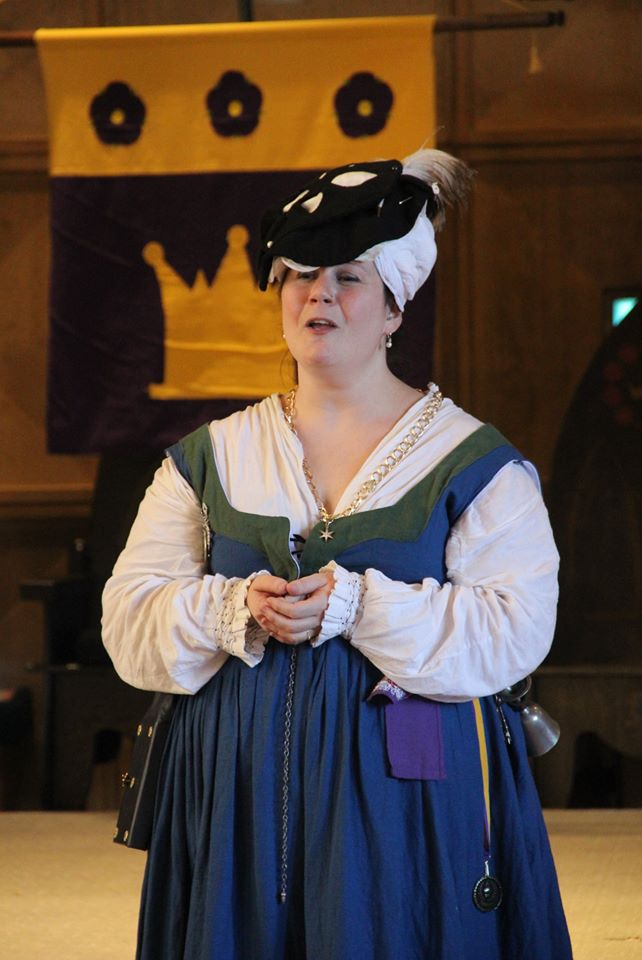
Round 2 had finished. I had made it to the finals the year prior so it was possible I could do it again. I was very blessed to be surrounds by folks around me who were able to hold my hand and support me. Then, I heard it. My name was called? MY NAME WAS CALLED. Oh man… I’m so glad I always have my Bard book on me as a quick reference.
What would the challenge be? What would they have me do? Then, I heard it. “Bring your best”. I quickly ran to my Laurel looking for sagely wisdom. We talked through options. What would make me feel best? What can I emote that shows me off the best? I know I have talked about this piece immensely ad nauseum, but it is never too late to bring out an oldy but a goody. I brought out Amarilli, Mia Bella by Giulio Caccini ( 1551-1618). I also made the specific choice to perform all period acceptable pieces. Although the SCA typically cuts off at 1600, music, due to documentation has been accepted as extended through 1650. I gave my heart to the world as I was the first competitor. I sat and listened to my friends do their things.

Here is round 3:
Again, I was not one of the victors, however, in my heart I won. I learned new pieces, I got to see friends grow, meet new performers and I would say this was the best birthday of my life.
The Beginning of a new era!

Panteria was my first camping event in 2010 and has always been a special event to me (Even though a bunch of my friends tried to coax me into go to Roses instead). This year would be no different. Well, I mean, it will be because the event has grown and changed over the years.
With this development of the event, I decided to develop myself farther. I had started a similar idea before, but this will be an ongoing contingency group. I started a travel ad hoc choir in which we would learn some music and then after a few events or so, would get the chance to perform it.
The plan for this one would be to introduce everyone, get a gauge of their skill level and then do a thing! My first meeting has 10 vocalists as I gave out all copies of my music. we had 1 bass, 1 tenor, 4 altos and 4 sopranos. What made this group even more interesting was the addition of a youth (sub 18). I handed out pieces in various languages. She seemed very concerned that they would potentially contain a swear word. Even after I reassured her several times there we no swears, I even had a native speaker of the language to also confirm that.
It was a challenge to have a youth there as I haven’t been a youth instructor since 2008. So, a few years. She stuck around for about a half hour. With permission, just after she left, I made a recording of the group performing and a second one as well.
By the end of our 2 hour sessions, a complete piece of music was learned as well the groups excitement level was near explosion. They asked over and over again if they could perform that night at Bardic. I had been planning to wait a few rehearsals, but they people have spoken.
Additionally, I had brought my new rounds book which I created. This would be the second event it is making it’s debut at. I am really proud of what I gathered. Now I have a few finishing touches to add to it. However, people are eager to purchase or have a copy of it in general.
Here are a couple recordings of the rehearsal process:
Take 1:
https://drive.google.com/open?id=1-8hj3AmqyfbUb17JhhYOor3FWT3vwzJr
Take 2:
https://drive.google.com/open?id=1-7n480C7IACotD2tIAFFNsL3TeV7ICc6
You can definitely hear the improvement between takes. There is maybe a 20 minute difference between them. By performance that night they were spot on. I am still hunting down that recording.
During rehearsal I did refrain from singing with the group so they could focus on themselves. However, by performance, we had lost a couple folks and needed to shift around and I ended up singing with them.
NB) This was not taken at tempo for rehearsal reasons.
About the piece:
It was included in Dowland’s First Booke of Songes or Ayres, which appeared in 1597. The piece is often performed as a lute song by soloist and lute, but, like other songs in the First Booke, it is printed in a format that can also be performed as a madrigal by a small vocal group (typically SATB).
This lute song is largely famous for the lovely melody and the striking repetition of rising fourths in the penultimate line of each verse. This is especially effective in the first and second verses, where the text and the music are a perfect fit.
In the first verse, the singer urges the beloved to come to him again, so they can enjoy together the pleasures of love, “to see, to hear, to touch, to kiss, to die, ” in the second he sings of his sorrow, “I sit, I sigh, I weep, I faint, I die, ” and in the somewhat less graceful third verse, he claims that nothing can move her heart, “By sighs, and tears, more hot than are thy shafts/ Did tempt, while she for triumph laughs.”
Come again!
Sweet love doth now invite
Thy graces that refrain
To do me due delight,
To see, to hear, to touch, to kiss, to die,
With thee again in sweetest sympathy.
Come again!
That I may cease to mourn
Through thy unkind disdain;
For now left and forlorn
I sit, I sigh, I weep, I faint, I die
In deadly pain and endless misery.
All the day
The sun that lends me shine
By frowns do cause me pine
And feeds me with delay;
Her smiles, my springs that makes my joys to grow,
Her frowns the Winters of my woe.
All the night
My sleeps are full of dreams,
My eyes are full of streams.
My heart takes no delight
To see the fruits and joys that some do find
And mark the storms are me assign’d.
Out alas,
My faith is ever true,
Yet will she never rue
Nor yield me any grace;
Her eyes of fire, her heart of flint is made,
Whom tears nor truth may once invade.
Gentle Love,
Draw forth thy wounding dart,
Thou canst not pierce her heart;
For I, that do approve
By sighs and tears more hot than are thy shafts
Did tempt while she for triumph laughs.
 Meddlings of the Minnesinger