

This is one of my favorite events in the year. It is closer to home than most of the events I travel and is in the Barony that in my heart is my Barony. This one, however, was much tougher for me emotionally. Not to bring my personal life in to this, but I had gone through a very devastating event about 2 months prior and still had not resolved all my emotions over it. On top of that, the instigator of the event was scheduled to be present. I was lucky, however, to be camping with several of my SCA families, who would keep me safe. I brought a plethora of instruments with me to bring to the instrument petting zoo, including my harp. This was the first time I was going to get to play it in public. There was a harp ensemble present. I learned quickly of the pains harps have in heat/stage lights regarding tuning. This was not something I encountered practicing in the comforts of my mildly lit and frigid apartment. I got to spend an hour playing with other harpists of varying skill level. It was heaven!
From there, I would twiddle on my recorders outside with an impromptu recorder jam. Everything from chaotic melodies, to soothing waltzes. I met new folks, got to try new instruments with no pressure.
That night, at feast, I was once again honored to be part of the feast entertainment. I had been asked by the current baronial bard to perform. I performed my first ever originally composed story about how the children of the east changed Ozurr, storm bringer. It discussed the several events he had been to, inclusive of the crown tournament where the rains fell, the Estrella where it flooded and Pennsic, raining out the Eastern Court. From there, I sang some of my newer repertoire and enjoyed the feast.
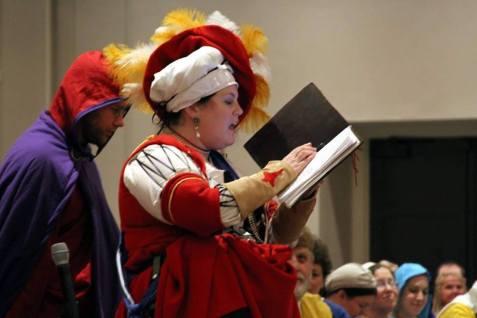
Following court would be the Bardic championship. This year, I decided I would try something new. It’s really important to me to show newer performers that I wasn’t born with all skill. I wanted to show them that I was working on new skills. There theme was fortune and misfortune. I had the idea of performing 3 Ravens first and then Twa Corbies with a guitar accompaniment. I was newer at the guitar and this would only be my second time playing it public. I knew Twa Corbies was also not my strongest vocal piece, but I wanted to try something new. I was pleased enough with my performance and called it a night. Where I was not chosen as the new Baronial Bard, I did win populace choice. I’ll take it.
The lyrics to “The Three Ravens” are here transcribed using 1611 orthography.
“The Three Ravens” (Child 26, Roud 5) is an English folk ballad, printed in the song book Melismata compiled by Thomas Ravenscroft and published in 1611, but it is perhaps older than that.
There were three rauens sat on a tree,
downe a downe, hay downe, hay downe,
There were three rauens sat on a tree,
with a downe,
There were three rauens sat on a tree,
They were as blacke as they might be.
With a downe, derrie, derrie, derrie, downe, downe.
The one of them said to his mate,
Where shall we our breakfast take?
Downe in yonder greene field,
There lies a Knight slain under his shield,
His hounds they lie downe at his feete,
So well they can their Master keepe,
His Hawkes they flie so eagerly,
There’s no fowle dare him come nie
Downe there comes a fallow Doe,
As great with yong as she might goe,
She lift up his bloudy head,
And kist his wounds that were so red,
She got him up upon her backe,
And carried him to earthen lake,
She buried him before the prime
She was dead her self ere euen-song time.
God send euery gentleman,
Such haukes, such hounds, and such a Leman.
Written heavily in the Scots language, “The Twa Corbies” probably dates from the 18th century and was first published in Walter Scott’s Minstrelsy in 1812. Child (I, 253) quotes a letter from Charles Kirkpatrick Sharpe to Walter Scott (August 8, 1802): “The song of ‘The Twa Corbies’ was given to me by Miss Erskine of Alva (now Mrs Kerr), who, I think, said that she had written it down from the recitation of an old woman at Alva.”.
Twa Corbies
As I was walking all alane,
I heard twa corbies making a mane;
The tane unto the t’other say,
‘Where sall we gang and dine to-day?’
‘In behint yon auld fail dyke,
I wot there lies a new slain knight;
And naebody kens that he lies there,
But his hawk, his hound, and lady fair.
‘His hound is to the hunting gane,
His hawk to fetch the wild-fowl hame,
His lady’s taen another mate,
So we may mak our dinner sweet.
‘Ye’ll sit on his white hause-bane,
And I’ll pike out his bonny blue een;
Wi ae lock o his gowden hair
We’ll theek our nest when it grows bare.
‘Mony a one for him makes mane,
But nane sall ken where he is gane;
Oer] his white banes, when they are bare,
The wind sall blaw for evermair.
Meaning of unusual words:
twa=two
corbies=crows (or ravens)
fail dyke=wall of turf
wot=know
kens=knows
hause-bane=neck bone
een=eye
theek=thatch


 Meddlings of the Minnesinger