
Audio- I Care Not For These Ladies
Title: I Care Not for These Ladies
Composer: Thomas Campion (1567–1620)
Date: Early 17th Century (published 1601)
Type of Work: English lute song (ayre)
Source: A Booke of Ayres (1601)
I Care Not for These Ladies is a lute song composed by Thomas Campion, a prolific English composer, poet, and physician active during the late Elizabethan and early Jacobean periods. The piece appears in A Booke of Ayres, published in 1601—a collection co-authored with lutenist Philip Rosseter, representing the English art song tradition known as the ayre. An ayre (also spelled air, ayir, or ayre) is a type of solo song with instrumental accompaniment that was popular in England during the late Renaissance and early Baroque periods—roughly from the late 1500s to the early 1600s. (Boyd, Elizabethan Music and the Ayre, p. 42) Ayres typically had a clear melody, were strophic, expressive but not overly complex and finally were often were dealing with themes of love, nature, melancholy, or pastoral life. These songs were typically written for solo voice and lute accompaniment and were enjoyed in both courtly and domestic settings. (Greer, “Campion, Thomas,” Grove Music Online).
Campion’s work stood out for its graceful lyrical economy and integration of poetry and music. His ayres often featured simple, clear textures and a refined sense of word-setting.
“I Care Not for These Ladies” exemplifies Campion’s lyrical wit and poetic satire. It rejects the superficial charms of courtly women in favor of a more rustic and sensual ideal, in a tone both humorous and sharply critical of affectation. This theme of rejecting artificiality was common in Renaissance poetry, especially in contrast to the elaborate conventions of Petrarchan love. The poem is written in a light, playful tone, contrasting the courtly lady—requiring wealth, formal wooing, and luxury—with the “wanton country maid,” who offers affection without financial demands. Campion’s choice of plain diction reflects his poetic philosophy as stated in his treatise Observations in the Art of English Poesie (1602), where he argued against excessive ornamentation in favor of “a certain plainnesse and flowing measure.”
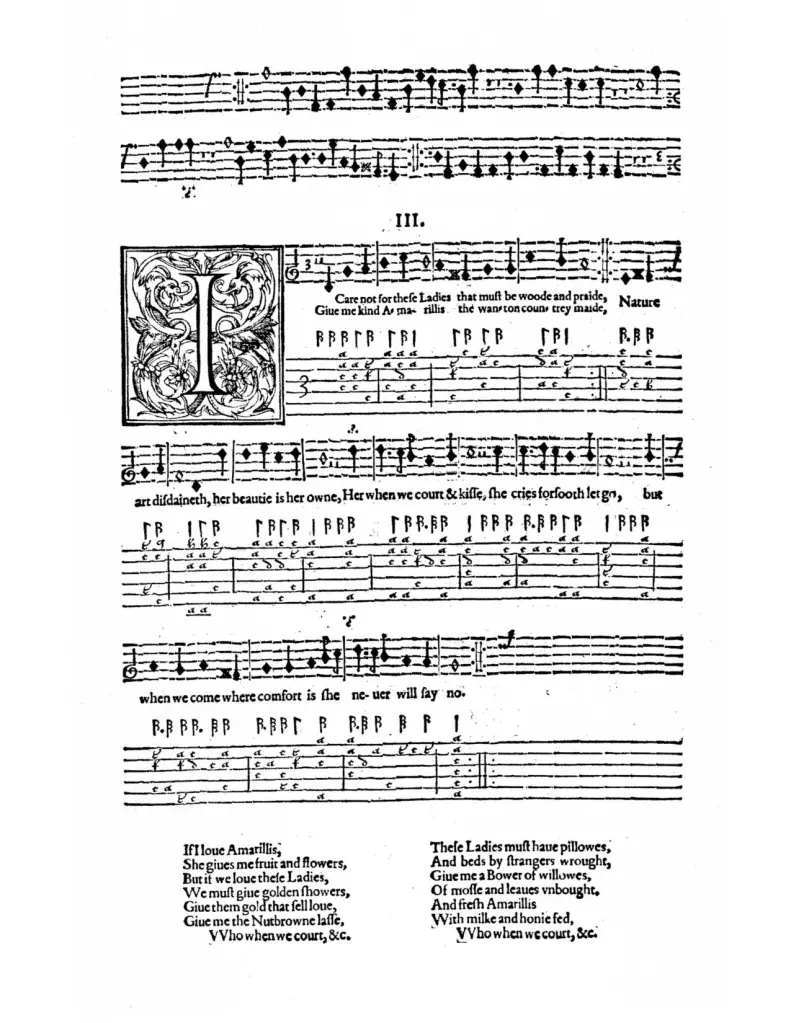
I care not for these ladies,
That must be wooed and prayed:
Give me kind Amaryllis,
The wanton country maid.
Nature art disdaineth,
Her beauty is her own.
Her when we court and kiss,
She cries, “Forsooth, let go!”
But when we come where comfort is,
She never will say no.
If I love Amaryllis,
She gives me fruit and flowers:
But if we love these ladies,
We must give golden showers.
Give them gold, that sell love,
Give me the nut-brown lass,
Who, when we court and kiss,
She cries, “Forsooth, let go!”
But when we come where comfort is,
She never will say no.
These ladies must have pillows,
And beds by strangers wrought;
Give me a bower of willows,
Of moss and leaves unbought,
And fresh Amaryllis,
With milk and honey fed;
Who, when we court and kiss,
She cries, “Forsooth, let go!”
But when we come where comfort is,
She never will say no.
This poem is a satirical rejection of courtly love conventions, favoring a more natural, earthy relationship over the artificial rituals of noble romance. The speaker dismisses the elaborate performances of upper-class women—those who “must be wooed and prayed”—in favor of a more direct and sensual bond with a rural maiden named Amaryllis.
Courtly Women represent artificiality, chastity performed as power, and romantic delay. Where as Amaryllis represents a pastoral, mythological name common in Renaissance poetry, symbolizing a more natural and sexual freedom.
“Nature art disdaineth” implies that true beauty comes from nature, not cosmetic or social artifice.
This stanza opens with a rejection of courtly ladies, who require elaborate rituals of wooing and begging. The speaker prefers Amaryllis, a common pastoral name symbolizing rustic, natural love. “Wanton country maid” conveys sexual openness but also innocence in contrast to the jaded court. The closing lines play with mock modesty: she resists at first (“let go!”) but ultimately consents (“never will say no”), a humorous portrayal of flirtation and desire common in Renaissance literature.
The “nut-brown lass” further invokes natural beauty—sun-kissed, not pale and powdered. The repetition of the refrain serves to reinforce the speaker’s preference for sincerity and physical closeness over ornament and pretense.
Court ladies require fancy “pillows” and beds “by strangers wrought” (i.e., expensive, manufactured luxuries). In contrast, the speaker desires a bower of willows—a simple natural shelter symbolizing freedom, intimacy, and peace.
“Milk and honey” alludes to pastoral abundance, drawing on biblical imagery (e.g., the Promised Land) and classical ideals of Arcadian pleasure. Again, the stanza ends with the comic mock-virginal protest followed by consent, emphasizing both Amaryllis’s modesty and her availability.
Amaryllis gives “fruit and flowers”—symbols of fertility, nature, and affection freely given. In contrast, the ladies of the court expect “golden showers”—interpreted in the 17th-century context as gifts of wealth, referencing materialism and even transactional love.The phrase “Give them gold, that sell love” is sharp: the speaker equates court ladies with prostitutes, or at least as women whose affection must be purchased.
Note: This flirtatious treatment of consent should be approached critically by modern performers—acknowledging the cultural context while avoiding romanticization of ambiguous consent.
Campion’s song reflects the Elizabethan and early Stuart shift from the Petrarchan model (idealizing women and love from afar) to a more ironic, earthly view of love. The use of a pastoral figure (Amaryllis) is typical of the time: country life was idealized as simpler, more honest, and more passionate. The poem is in dialogue with other poets of the age, like Christopher Marlowe (“Come live with me and be my love”) and Sir Walter Raleigh, who similarly contrast court and country values.
Sources and References:
- Bullen, A. H., editor. Lyrics from the Song-Books of the Elizabethan Age. John C. Nimmo, 1887.
- Campion, Thomas and Philip Rosseter. A Booke of Ayres, 1601. (Facsimiles and editions available through Early English Books Online and modern publishers)
- Fellowes, Edmund H. English Lute Songs (Stainer & Bell)
- Fortune, Nigel. “Campion, Thomas.” Grove Music Online. Oxford University Press.
http://www.oxfordmusiconline.com (Access may require institutional login.) - Greer, David. Thomas Campion: Poems, Songs, and Masques (Oxford University Press)
- Thomas, Raymond C. “The Function of Song in the Poetry of Thomas Campion.” Studies in Philology, vol. 55, no. 4, 1958, pp. 673–688. JSTOR, http://www.jstor.org/stable/4172933.
- Sabol, Andrew, editor. The Songs and Masques of Thomas Campion. Harvard University Press, 1973.
- Spring, Matthew. The Lute in Britain: A History of the Instrument and Its Music. Oxford University Press, 2001.
- Tillyard, E. M. W. The Elizabethan World Picture. Chatto and Windus, 1943.
- Thomas, Raymond C. “The Function of Song in the Poetry of Thomas Campion.” Studies in Philology, vol. 55, no. 4, 1958, pp. 673–688. JSTOR, http://www.jstor.org/stable/4172933.
- Waller, Gary. English Poetry of the Sixteenth Century. Longman, 1986.
- Woudhuysen, H. R., editor. The Penguin Book of Renaissance Verse 1509–1659. Penguin Books, 1992.
 Meddlings of the Minnesinger