Many Much Tokens! And classes!

Mimir’s well, year 3 was a resounding success. It was really nice to be able to teach and actually have time to take classes as well as socialize.

About 6 months ago, the Autocrat, Eleanor Grey, had asked me to come teach to make sure there was once again a bardic representation at their lovely event. I agreed. Mountain freehold is a great little shire with great people. Last year, I wrote them a song because they deserved it.

About 1.5 months ago, I was also asked if I could make the site tokens. I happily agreed. Mimir’s well is about wisdom. So, I chose to make tiny wisdom tokens. I sent Aegir the image to 3-d model as I had other work commitments I had to manage and he loves to play in fusion 360 (The 3-d modeling program we use). From there we printed and molded the tokens. She had requested that we make 100 of them.  I had also decided that I didn’t want them to look like pristine metal. So, when creating the positive before creating the mold, I covered it in modgepodge and while it was still tacky, took same sandpaper to it to make it appear more stone-like by taking some divits out of the modgepodge.

Here are the final tokens (Though this one has the hole drilled in the wrong side):
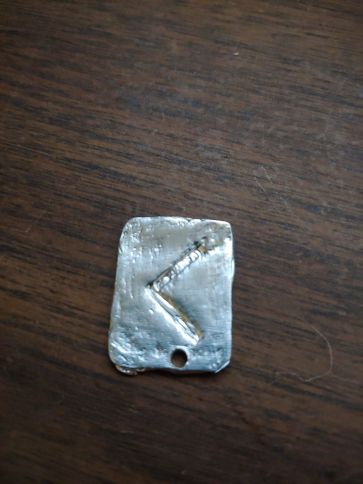
 

54514104_2294728344138437_8900480613199380480_n.jpg


From there, off to teach classes! I had a bright eyed and bush tailed class right at 10:00am. I always dread the first class of the day. I feel like no one wants to be there that early and no one is emotionally awake. It’s also the same as first performer stage fright. Always so hard to go on first, however, once the stage is set, everyone is ready to go!

My first class is how to warm up your body to perform. Yes, I taught this class the week before, however it is never the same. Here is the outline of the class so you know more (in a bullet form, what was gone over in the class)

  1. Why do we warm up our bodies?
    1. Athletes
    2. Protection from harm
    3. Emotionally warmed up
    4. Setting the stage
    5. Setting nerves aside
    6. Ready to move
  2. Anatomy of the mouth
    1. Lips, Teeth, Alvular ridge, Hard pallet, Soft pallet
    2. Discussion of how body is connected
    3. Posture- Demonstration
  3. Body stretches and massage
    1. Head/temples
    2. Neck
    3. Head rolls
    4. Arm body crosses
    5. Pliet
    6. Foot stretches
    7. Rag dolls
    8. Group massage
  4. Breathing
    1. Clavicle breathing
    2. Proper way to breath in (order of operations)
    3. Floor breathing
    4. Engaging diaphragm and low back muscles
  5. Breathing exercises
    1. In outs on “Straw”
    2. In outs on “Shhh”
    3. Bubbles
    4. Coughing/laughing
  6. Projection
    1. Talk about notes/polyps/hemorrhaging (Julie Andrews story)
    2. 5 locations to send sound in mouth
    3. Discovering the soft pallet
    4. Lollipops/York peppermint paddies
    5. Eyebrows/yawning
    6. Tongue twisters (Diction is done… Mommy made me…)
    7. Finding nasal air flow spot
    8. Tongue position
    9.  Dynamic projection (Using soft “stage whispers” to speak across the room)
  7. Body tension
    1. Finding tension in your body
    2. Finding good mouth space
    3. What you can do to loosen up your body

Questions:


From there, I hung out, ate, made some music with friends and enjoyed. I finally got to sing a few filks I had composed to those who had never heard them and saw the glee as disney and queen were attached to their favorite SCA activities. In addition, I got to see Aegir working in the kitchen, which he had a blast with.

My final class was just us singing period rounds. I just finished compiling a book of about 50 all period rounds (Sans “Le coq et mort”… which is a traditional, but hey, everyone likes to sing about dead chickens… plus I added the german. Morbid…dead..german… chickens). However, what makes my book different, besides it being so long, is I wrote up all the translations, IPA (Internation Phoenetic Alphabet) dictions and newspaper diction. I will be adding my written documentation on this shortly as well as the appropriate IPA charts, however, after the class, all 14 of my students were begging me to publish it now. (it was 25 pages, so I was remiss to keep printing more copies out of my pocket).  I did, however, sell the 8 copies I made for charity and donated the funds on behalf of my class.

Here is the book, documentation to come!

https://docs.google.com/document/d/1PvID7hHNG2gvJjWctuWdpQiK-OyhmB_GlVLQhHqEcI8/edit?usp=sharing

Finally, Aegir and I displayed our molds and casts we’ve been doing over the last few months. We had a BLAST telling everyone about the process. Again, making everything more accessible. We really want to make our arts accessible to people. I find it to be a gateway drug. If you find an easy/cheap way to do it, you most likely will want to explore how it was done. *GASP RESEARCH*


Mimir’s Well — The Quest for More Knowledge

I gave up an arm and a leg — or should I say an eye — to obtain more knowledge, or at least the pursuit there of. The Shire of Mountain Freehold, though small, is mighty. Especially with quenching their thirst for knowledge. This is the second year this event has been running, after many years of hiatus.

The previous year, from what I have been told, had an attendance of 30-40. This year had 87 if I remember correctly. This beautiful church was filled with banners, arts and science projects, a scrumptious day board, and duh, classes. I decided that I would enter an A&S project that was not bardic related. My secondary pastime in the SCA is fencing. Under the tutelage of Don Connor Scamus O’Neil, I was able to craft my own rapier, sans the blade.

This sword is affectionately named Stevie Nicks, because of how many times I nicked her on the belt sander. I left my baby in the anachronistic category, to be judged — I had separation anxiety all day. It was like my baby was in another nest.

I was teaching two classes today: the first would be campfire rounds and the second would be on improving storytelling, a master class.

Before it was my time to teach, I got to attend a class on The Fools. I learned everything from Jongleurs, to the natural fool. I had never thought about the prospective of the fool as a bardic art until I attended this class. Lady Ailiniore shared her vast amounts of knowledge and had in depth discussion, inviting each of us to take part in the class.

Shortly after it was my turn to lead my own class. I did not know how many bodies to expect, because it had been explained to me that there were not many singers in the shire. However, to my gleeful surprise, we had 13 attendees! Holy smokes, Batman! Or, something bardlike.

We sang in English, French, Hebrew, and Cockney. That’s like English, right?

I had mixed levels of skill in the room, and those who I knew were stronger singers were sitting beside those who could use some assistance. We sang songs in two, three, four, and even five parts. I had even done my own individual creation of a combination of Rose, Rose, Hey Ho! and Ah! Poor Bird. See the video below. When the class had completed, I had a few of the Quebecois ask me to come teach this class at their event next January. It was delightful to be able to work with individuals who were not English as a first language speakers, and switching to their native language.


After dayboard, which was delicious, it was time for my master class. This is my first time teaching this class; my heart was racing as I am just beginning to find myself as a storyteller, and guiding others to do so was a new adventure for me. I once again prayed that no one would show up, but that was not to be the case.

I had four excited students of varying levels; I had one that went to school professionally for musical theater, one woman who was an experienced storyteller, one who was a viscount, and champion storyteller, and a young lady who was just getting her feet wet.

I went over four basic points of storytelling, and then went through each point, discussing each in depth and how they enhance your skills. Next I had each student tell me about a time they were excited about something. The story did not have to be true, but it was helpful.

The first student told a story in persona about how he got his dog. We worked on body language, vocal variances, and levels. Upon second performance, he agreed he felt more engaged with his piece and the audience was likewise more engaged. The audience and myself provided feedback both positive as well as areas of improvement.

My second student, the experienced storyteller, had a unique outtake on her story. When discussing her piece, she said that she felt stuck, so we talked about development of her piece and how to create that vision and how to make her journey more tangible. She felt that her story grew in leaps and bounds and had a greater crescendo and ending due to this experiment.

The young lady who was just getting her feet wet was excited to go, but I noticed that within her performance that she would fidget and have no place for her hands. I realized that this young lady had some sort of neurological, or a-typical behavior. I had to think of how I could gently broach the topic without making her feel uncomfortable in a public setting such as this. She disclosed that she had a form of autism, and what the basis of that fidgeting was. We gave her focus, and choreography to her storytelling dance. She now knew what to do with her hands, so she would no longer pull at her dress or fingers, and she would have intention in her movements and focus with her audience.

We talked about varying gaze, and how to stare at her audience without staring them down. I felt like a proud Mama Bird — from a different nest this time — watching this young lady go from a scared chicklet to a swan proud to show her work, who even preened a little bit under the praise from her audience.

The final student was the well-established viscount. She, without knowing it, had shown every point that I had discussed before she had walked into class just a wee bit late. We finally as a group discussed improvisation, and how imperative it is to be able to do in any storytelling situation. My viscount student was given three words to build a story around, and made up an entire story on the spot with those words given.

At that point the class was over, but I was greeted by the newer students asking for my contact information. Every member of the class said this was immensely helpful and the best version of this class they had attended, so I guess I did okay.

The event was coming to a close, and the autocrats would be announcing the winners of each category for the Arts and Sciences Competition. I am once again proud to say that Stevie Nicks had taken home the Anachronistic category. That’s my baby!