
Choirs are a lot of fun, but they require more than you. That isn’t a bad thing, but finding other like minded folks with the missing parts you need can be difficult to say the least. Once upon a time (4-5 years ago) I ran a vocal group in Malagentia called, “Voce di Sonata”. I ran this choir for about 2 years. However, with real life comes member depletion. I moved a bunch, people got married and divorced, houses were sold and people have this thing called a job. So, as it were, life doesn’t always work the way it should and I let the group dissolve.
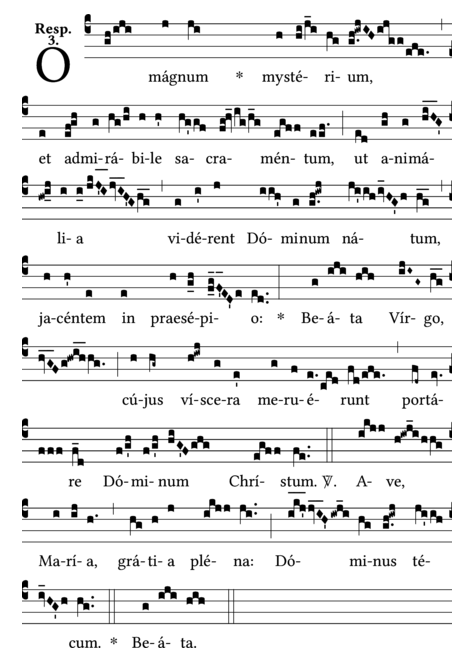
About 2-3 months ago, a conversation struck up with one of my old vocalists from voce. She had expressed wanting to sing and make music. Then, more specifically, she and her husband wanted to work on “O Magnum Mysterium” by Victoria.
If you haven’t heard this piece, take a listen:
NB) More information about this piece below
However, with the 3 of us, we were missing a crucial voice part. The tenor! I was playing the part of Alto, because… why not. (for any of you who know me, I am not an alto, I just play one on TV). We have a local tenor who is also a shoe in and loves to sing, so without fail, he came to the rescue. 2-3 rehearsals in and we have some music going. This is a volunteer group, who meets every 2 weeks, but again, life happens so we’ve maybe met 2-3 times in 3 months, and that’s ok.
This is for fun. (I have to keep telling myself that. I come from a history of professional musicians who come to their first rehearsal with all their music learned if not memorized. Those, who have perfect pitch or at least relative pitch and work without speaking, singing only for 1-2 hours at a time) This is an ongoing learning experience for me. I’m loving every moment of it. It’s absolutely incredible to work with a group of people who’s passion has not been lost. They do this because it’s fun, not work.
O Magnum has been put aside for now so the group can learn some vital things about working together is a very small chamber group. For now, we are working on Belle Qui Tiens Ma Vie ( Thoinot Arbeau 1520-1595) , Ah Robin, Gentle Robin (William Cornish 1465-1523) and By the Rose (13th century anonymous poem set by Lady Colette la Trouvere).
With permission from the ensemble, here are the super duper rough recordings done on my terrible cell phone. The one thing I can’t show you is the immense joy and pride on all the vocalists faces when they got to hear their recordings for the first time. The plan is, down the road to make a real recording for them to compare themselves to.
Belle qui tien ma vie:
https://drive.google.com/file/d/1MqexQGOtQD0x3adrQyagqbr1FY8Db0sb/view?usp=sharing
Ah robin:
https://drive.google.com/file/d/17mWec-NLl-nhZvJgNfZzfSHQGSzv9eoT/view?usp=sharing
- Latin text
- O magnum mysterium,
- et admirabile sacramentum,
- ut animalia viderent Dominum natum,
- iacentem in praesepio!
- Beata Virgo, cujus viscera
- meruerunt portare
- Dominum Iesum Christum.
- Alleluia!
- English translation
- O great mystery,
- and wonderful sacrament,
- that animals should see the newborn Lord,
- lying in a manger!
- Blessed is the virgin whose womb
- was worthy to bear
- the Lord, Jesus Christ.Alleluia!

O Magnum Mysterium is a Catholic church chant sung at Christmastime. As part of the Matins (nighttime worship), the text has been around for centuries. While the exact origins are unknown, historians believe the text (and its use in Catholic Mass) has been around since at least the 10th century.
Because the work is so old, there have been many different settings and versions throughout the years. Today I want to share the version composed by Tomás Luis de Victoria (1548-1611), Spain’s most famous 16th-century composer.
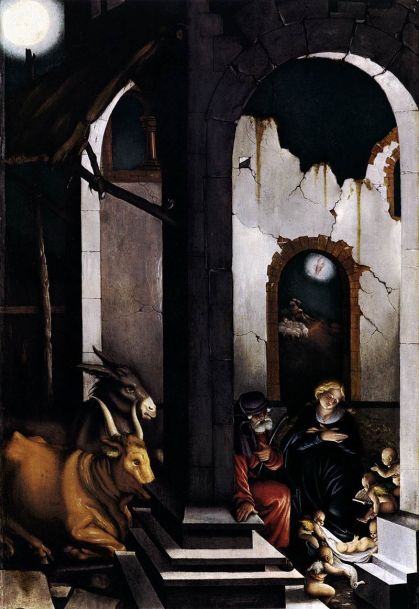
The first half of the chant references the animals present at Jesus’s birth, symbolic of God’s mysterious and lowly life as a mortal. This was a topic of great excitement during the Renaissance; people loved the idea that the animals in the stable recognized the birth of Jesus as an important event. The painting demonstrates this idea.
The second half of the text relates to the words spoken by Elizabeth when she welcomes Mary, the mother of Jesus, into her home:
“And she spake out with a loud voice, and said, Blessed art thou among women, and blessed is the fruit of thy womb.
And whence is this to me, that the mother of my Lord should come to me?” – Luke 1: 42-43
Music theory: Victoria’s use of open 5th intervals perpetuates a sense of awe in the music. In 5th intervals, the third of the chord is missing; this crucial note determines if the harmony is major or minor, so open 5ths don’t have any harmonic indication (which leaves the listener in suspense).
The music changes to a lilting triple meter as the choir sings “Allelujah!” This is an unexpected yet exciting conclusion to the piece, and it reminds me of a chorus of angels proclaiming the birth of Jesus.
About Belle qui
Thoinot Arbeau” is the pen name and an anagram of Jehan Tabourot, a Catholic priest and canon of Langres.
“Belle quit tiens ma vie” was first published in Tabourot’s 1588 dance manuscript “Orchesography”, which today is a major source of information about Renaissance dance.
This piece is a pavane: a stately dance in slow duple time, popular in the 16th and 17th centuries and performed in elaborate clothing.
Belle qui tien ma vie:
| Belle qui tiens ma vie Captive dans tes yeux, Qui m’as l’ame ravie D’un souris gracieux, Viens tot me secourir Ou me faudra mourir. |
Beautiful one who holds my life Captive in your eyes, Who has ravished my soul With a gracious smile. Come to my aid Or I must die. |
| Pourquoi fuis tu, mignarde, Si je suis pres de toi? Quand tes yeux je regarde Je me perds dedans moi, Car tes perfection Changent mes actions |
Why do you flee, dainty one, If I am near you? When I behold your eyes I am lost inside myself Because your perfection [so affects my behaviour]. |
| Tes beautes et ta graces Et tes divins propos Ont echauffe la glace Qui me gelait les os, Et ont rempli mon coeur D’une amoureuse ardeur. |
Your beauty and your grace And your divine ways Have melted the ice Which was freezing my bones And have filled my heart With a loving ardour. |
| Mon ame voulait etre Libre de passion, Mais l’amour s’est fait maitre De mes affections Et a mis sous sa loi Et mon coeur et ma foi. |
My soul wanted to be Free of passion, But love became master Of my affections And put under its law My heart and my faith. |
| Approche donc ma belle, Approche toi mon bien, Ne me sois plus rebelle Puisque mon coeur est tien, Pour mon mal appaiser Donne moi un baiser. |
Come near, my lovely one, Come near, my [dear one], Do not resist me further For my heart is yours, To relieve my ills Give me a kiss. |
| Je meurs, mon Angelette, Je meurs en te baisant Ta bouche tant doucette Va mon bien ravissant A ce coup mes esprits Sont tous d’amour epris. |
I die, my Little Angel, I die when kissing Your mouth so sweet. My very lovely one, With that touch my spirits Are completely lifted in love. |
| Plutot on verra l’onde Contremont reculer, Et plutot l’oeil du monde Cessera de bruler, Que l’amour qui m’epoint Decroisse d’un seul point. |
Sooner will waves Flow backwards And sooner will the moon Cease to shine Before the love which conquered me Wanes a single iota. |
About Ah, Robin:
This is a secular madrigal
a part-song for several voices, especially one of the Renaissance period, typically arranged in elaborate counterpoint and without instrumental accompaniment. Originally used of a genre of 14th-century Italian songs, the term now usually refers to English or Italian songs of the late 16th and early 17th c., in a free style strongly influenced by the text.
Musical Analysis:
As each voice enters the harmonies expand. Interesting enough the opening sonority begins on a G, adds a B-flat with the other ground voice, and finally an octave G in the soloist. This causes one of the significant part of the piece, the entrance of the third voice, to have a G minor harmony without the fifth of the chord.
This piece is still modal despite the use of F naturals, however, the d minor harmony begins to act as a resting point for phrases. The use of a picardy third appears numerous times through the work at the end of phrases, but not at the end as each voice begins to drop out, eventually making the music monophonic.
Ah, Robin, Gentle, Robin
Ah, Robin, gentle, Robin,
Tell me how thy leman doth
and thou shalt know of mine.
My lady is unkind I wis,
Alack why is she so?
She lov’th another better than me,
and yet she will say no.
Ah, Robin, gentle, Robin,
Tell me how thy leman doth
and thou shalt know of mine.
I cannot think such doubleness
for I find women true,
In faith my lady lov’th me well
she will change for no new.
Ah, Robin, gentle, Robin,
Tell me how thy leman doth
and thou shalt know of mine.
- G. Edward Bruner, DMA: “Editions and Analysis of Five Missa Beata Virgine Maria by the Spanish Composers: Morales, Guerreo, Victoria, Vivanco, and Esquivel.” DMA diss., University of Illinois at Urbana-Champaign, 1980.[facsimile: University Microfilms International, Ann Arbor, MI]
- Gustave Reese, Music in the Renaissance. New York, W.W. Norton & Co., 1954. ISBN 0-393-09530-4
- Apel, Willi. 1988. The History of Keyboard Music to 1700. Bloomington: Indiana University Press. ISBN 0-253-32795-4.
- Arbeau, Thoinot. 1967. Orchesography, translated by Mary Stewart Evans, with a new introduction and notes by Julia Sutton and a new Labanotation section by Mireille Backer and Julia Sutton. New York: Dover Publications. ISBN 0-486-21745-0.
 Meddlings of the Minnesinger