I was approached by one of the coordinators to do a bardic piece of Ethereal court # 2. I was honored and floored.
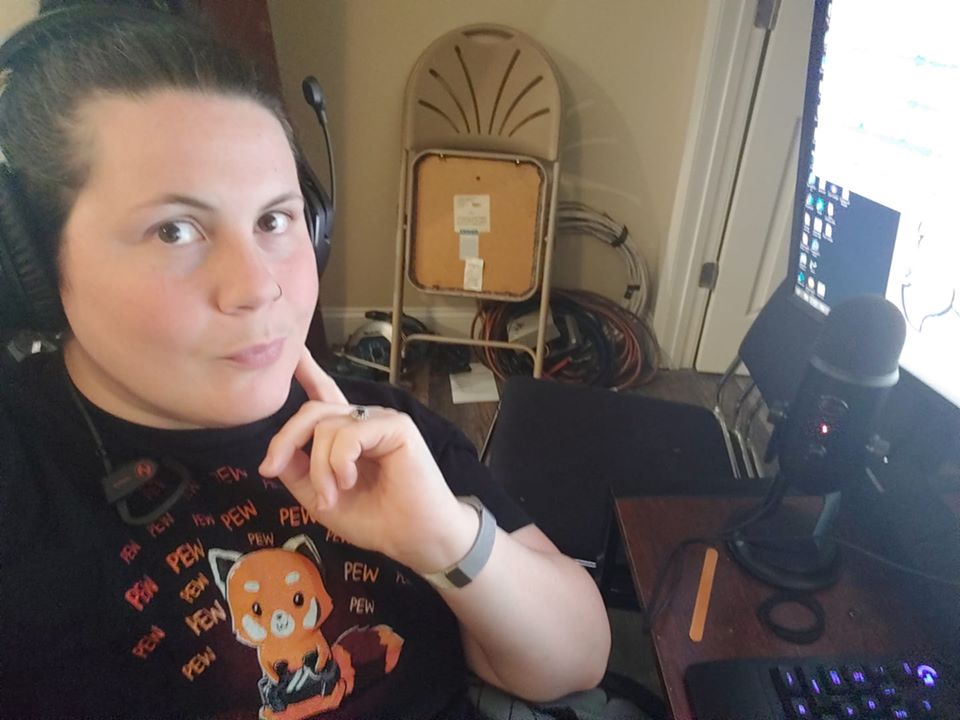
I was only given 2 weeks leeway to get it recorded. Would my new mic be in? Would I have time around my new child to get this completed? Oh! Oh! Let’s add one more layer. It needs instruments.
Oh! A theme! Let’s make sure this is 100% period.
I did some digging for my theme, which was mother’s and essential workers. What better than to use the Cantigas de Santa Maria.
I have never performed any of the Cantigas prior to this. This involved me digging, finding correct pronunciation, performance style and accompaniment. The pronunciation of early Spanish is different from the modern Castilian I learned back in middle/high school. I Also, I haven’t done any musical mixing since 20XX…. long time ago. NEW FUN PROJECT!!!!
Cantiga 357: Como tórç’ o dém’ os nembros do hóme per séus pecados
My Co-Autocrat and I had spend months and months planning the second iteration of the EKCoP Challenge assembly. This was my first time “running” it and I had found a super sweet location. Weeks before, COVID-19 really started to spread into the US and reared it’s ugly head. The plague doctor could truly not contain this one.
My Co-Autocrat and I made the difficult decision to cancel the even. This was not done lightly. However, not only is this spread via respiratory system, singing/vocal arts were known to be the fastest way to spread it.
I wasn’t willing to go down without a fight. I wasn’t willing to let the performing arts community take a blow to one of their only real chances to gather and perform in a low key environment. Then, it hit me! Why not do this online? What were the logistics?
I spoke to my co-autocrat who has been running monthly online practice to see if this was feasible. It was!
From there we got everything sorted and up and promoted within 5 hours of this idea. Would this work? Would anyone come? Would the delay kill everything? Are we running it like it was run previously? Who knows! here we go!
We eventually settled on a formal of open meet for an hour, classes till 6 and open performances till 10.
Attendance rolled in, every class was attended and well respected.
Pennsic is a home for many people who may not be as active in the SCA as they’d like to be. For those who are ridden with anxiety, even this town of 12,000 humans who inhabit here for up to two weeks can be a safe haven. For some, it can also be a place where dreams come true and things you would never have done can be realities… so also, dreams coming true.
This was Pennsic #2 for me. Riding solo but still having a group to camp with has been amazing. Mermaid’s song is a group of Bards and Fencers and yes, there is crossover. I arrive and set up my tent hastily. I made a new friend as we had new camp mates. Atilla was kind and welcoming and helped me set up my tent, hastily as, in true Solveig fashion, I have overbooked myself and I don’t really know how to say “no” yet. I’m working on it. With that, I was off to my first Pennsic experience for the year.
Hastily dressed I ran up the hill (Yes, that hill. I live in the bog) to the amphitheater. There was a non-English concert set up to happen. Sadly, there were no spectators, but I think that it made it less of a concert and more of a song sharing session. There were familiar faces and new faces. One face I had seen at this gathering was Heather Dale. For those of you who don’t know Heather, she is an SCA super star and professional touring artist with 20 CD’s available for purchase. It’s like meeting Robert Downey Jr. or any large Hollywood legend. I had met her previously the year before as I was part of Drake Oranwood’s concert which opened for Heather. I didn’t expect her to know or remember me as it was just a glance meeting, but low and behold, like a normal person, she greeted me, said hello and *gasp* remembered my name. I’m terrible with names. Clearly, she was not. I tried to withhold my awestruck words and tried to treat her as a normal person. I -believe- I succeeded. It was eventually my turn and I chose not to sing my best pieces. This was a chance to show languages. I pulled out an old piece I really should memorize.
by Ludwig Senfl (1534, German)
Es Warb Ein Schöner Jüngling
Es warb ein schöner Jüngling
über ein breiten See.
um eines Königes Tochter,
nach leid geschach ihm Weh.
Ach Elselein liebes Elselein mein,
wie gern wär ich bei dir!
So sein zwei tiefe Wasser
wohl zwischen dir und mir.”
“Das bringt mir grossen Schmerzen,
herzallerliebster Gsell.
Redich von ganzem Herzen
Habs für gross Ungefäll.”
Hoff, Zeit werd es wohl enden,
hoff, Glück werd kummen drein
sich in alls Guets verwenden,
herzliebstes Elselein!”
Once there was a handsome young man
from across a wide sea.
Pursuit of a king’s daughter
led him to great sorrow.
“Oh Elselein, my dear Elselein,
how I long to be with you!
But there are two deep waters
between you and me.”
“That brings me great pain, my
dear friend.
I say wholeheartedly this is
great misfortune.”
“Have hope that time will end this.
Have hope that fortune will change.
Have hope that all else will fall into
place, beloved Elselein!”
The rest of the first evening was pretty low key afterwards. Bird the Bard and I spent the rest of the night singing into the hours.
Day 2! Saturday! Low key day as well. Several months prior to I had been asked if I would sing at the East Kingdom/Midrealm invitational Bardic. This was -HUGE-. This is a display of the best/up and coming Bards the kingdoms had to offer. There was no competition involved, just performance. It was certainly quite the show. I had chose to do Amarilli, mia Bella. This piece has a lot of emotional attachment to me as it’s a piece of music I have been doing long before the SCA.
Amarilli, mia bella, Amaryllis, my beloved,
Non credi, o del mio cor, Do you not believe
dolce desio, Sweet desired one,
D’esser tu l’amor mio? That you are my love?
Credilo pur: Believe only this:
e se timor t’assale, And if fear assails you,
Prendi questo mie strale Take one of my arrows
Aprimi il petto. Open my breast
e vedrai scritto in core: And see written in my heart,
Amarilli, Amarilli, Amarilli Amaryllis, Amaryllis, Amaryllis
è il mio amore. Is my beloved.
Guilio Caccini (1551-1618). Composed in 1602 and the text was by Alessandro Guarini . Written before the development of the pianoforte (which was invented in 1700), “Amarilli, mia bella” was meant to be accompanied by the lute, which lends it a particularly intimate and hauntingly beautiful atmosphere. Even the words evoke an earlier time—the line, “Prendi questo mie strale” (take one of my arrows) evokes images of bows and arrows. Any performer of “Amarilli, mia bella” will want to sing with a hushed sotto voce (soft singing) throughout with exquisite legato phrasing.
Who decided that waking up prior to 12 on a Sunday was a good idea!? Oh wait… it was the best time for people to meet. ***SIIIGHHHH**** It was time for the EKCOP annual Pennsic meeting. Honestly, I think it was a really constructive meeting. I’ve been the deputy Chatelaine for almost a year now and It was really nice to see how our work has been going and what people had to comment on it. At this meeting I was nominated for Chancellor. I, however, was floored seeing the unanimous vote for my nomination. I know I really care about this group and making performance a safe and tangible place for others, but I never thought my work had gone this noticed. The rest of the day was spent celebrating other delightful musicians such as Cedar Barefoot and the Queen’s Bard, Laila (celebrating her birthday).
Monday was spend rehearsing for our concert on Wednesday and Pirate debauchery at night. Bird has spent many years as a Shantyman. I have always enjoyed a good shanty, but have never thought much about singing them. I was a bel canto singer. We sing pretty. Shanties are for the rough and tough pirates and seaman!!! (Get your head out of the gutter). However, I felt like getting out of my comfort zone. Roll the Old Chariot Along was my song of choice and belting was my game. Mind you, belting is -not- my forte, but the belting muses hit me in the face like a sack of flour. WHOA where did that sound come from!!!!??? I was elated that my voice was continuing to mature. For those of you who don’t know, you go through several vocal puberties during your life. The bigger and darker your voice is, the longer it takes to mature. Mine, according to my voice teachers from college, would be done around age 35. Joy! I digress.
Tuesday was more laid back… I think. Around 11 or so, Bird and I climbed up the brewer’s road hill, filing everyone’s favorite past time song, “Baby Shark”, to motivate us in the intense sun. We eventually made it to our family gathering where the Bard Yard could just relax and enjoy each other’s company. My Laurel and all connections to her, have become some of the most supportive and people in my SCA life. I’ve talked about brain weasels before. They continue to persist. Having a family like this as a performer is essential for building that skin up. I wouldn’t change anyone in this group for the world. Later that night, Bird and I had donated a concert to the royal travel fund. We made our way into the camp of the winners. It was a very “dry” setting despite the alcohol freely flowing. Everything from period pieces to ruckus was performed for an hour. I’m not sure how I felt about this, but I was later told that it was enjoyed. Sometimes, it’s nice to just perform and not peacock. Getting to sing/perform your non forte pieces is a relief sometime.
Wednesday! Oh man. This. This is what you’ve all been waiting for! This would be the day when we would strut all our stuff. I say we, because Bird and I were inseparable this whole war. It started with a very prestigious performance. We had been invited to perform at queen’s tea. That is the big time. Only the “right” performers got to do that. It’s a very specific setting where you are background, not the center of attention. To be invited to perform for this meant you knew how to be unobtrusive, appropriate and a good performer. Bird and I also used this as a warmup for our concert…. Which was 2 hours after. The pieces performed will be discussed after. We were presented a few tokens from attending queens and thanked for our service. It was super magical. It really felt like I was a hired performer in ye olde times… despite some of the modern accouterments. From there, off we went to present, for the first time ever “Song Byrds”. Originally this was supposed to include Collete la Trouvere, however, life happened, and it was just Bird and I. We spent a good amount of time trying to break the concert in to 3 sections that would compliment one another. The first was all period pieces, the second was SCA appropriate/Filks and finally original compositions.
Below is the concert in it’s entirety. Enjoy!
This was the best week of my life, filled with so much song. I regret not being able to perform at the Opera dell’est concert as my voice was shot from the war, but I do not regret having all the opportunities to sing. This only fire up my need to perform more, but I made more connections and started digging for more repetoir!
On an unrelated note, I did meet up with a super amazing lutenist and got to jam to some Dowland with her.
Panteria was my first camping event in 2010 and has always been a special event to me (Even though a bunch of my friends tried to coax me into go to Roses instead). This year would be no different. Well, I mean, it will be because the event has grown and changed over the years.
With this development of the event, I decided to develop myself farther. I had started a similar idea before, but this will be an ongoing contingency group. I started a travel ad hoc choir in which we would learn some music and then after a few events or so, would get the chance to perform it.
The plan for this one would be to introduce everyone, get a gauge of their skill level and then do a thing! My first meeting has 10 vocalists as I gave out all copies of my music. we had 1 bass, 1 tenor, 4 altos and 4 sopranos. What made this group even more interesting was the addition of a youth (sub 18). I handed out pieces in various languages. She seemed very concerned that they would potentially contain a swear word. Even after I reassured her several times there we no swears, I even had a native speaker of the language to also confirm that.
It was a challenge to have a youth there as I haven’t been a youth instructor since 2008. So, a few years. She stuck around for about a half hour. With permission, just after she left, I made a recording of the group performing and a second one as well.
By the end of our 2 hour sessions, a complete piece of music was learned as well the groups excitement level was near explosion. They asked over and over again if they could perform that night at Bardic. I had been planning to wait a few rehearsals, but they people have spoken.
Additionally, I had brought my new rounds book which I created. This would be the second event it is making it’s debut at. I am really proud of what I gathered. Now I have a few finishing touches to add to it. However, people are eager to purchase or have a copy of it in general.
Here are a couple recordings of the rehearsal process:
You can definitely hear the improvement between takes. There is maybe a 20 minute difference between them. By performance that night they were spot on. I am still hunting down that recording.
During rehearsal I did refrain from singing with the group so they could focus on themselves. However, by performance, we had lost a couple folks and needed to shift around and I ended up singing with them.
NB) This was not taken at tempo for rehearsal reasons.
About the piece:
It was included in Dowland’s First Booke of Songes or Ayres, which appeared in 1597. The piece is often performed as a lute song by soloist and lute, but, like other songs in the First Booke, it is printed in a format that can also be performed as a madrigal by a small vocal group (typically SATB).
This lute song is largely famous for the lovely melody and the striking repetition of rising fourths in the penultimate line of each verse. This is especially effective in the first and second verses, where the text and the music are a perfect fit.
In the first verse, the singer urges the beloved to come to him again, so they can enjoy together the pleasures of love, “to see, to hear, to touch, to kiss, to die, ” in the second he sings of his sorrow, “I sit, I sigh, I weep, I faint, I die, ” and in the somewhat less graceful third verse, he claims that nothing can move her heart, “By sighs, and tears, more hot than are thy shafts/ Did tempt, while she for triumph laughs.”
Come again!
Sweet love doth now invite
Thy graces that refrain
To do me due delight,
To see, to hear, to touch, to kiss, to die,
With thee again in sweetest sympathy.
Come again!
That I may cease to mourn
Through thy unkind disdain;
For now left and forlorn
I sit, I sigh, I weep, I faint, I die
In deadly pain and endless misery.
All the day
The sun that lends me shine
By frowns do cause me pine
And feeds me with delay;
Her smiles, my springs that makes my joys to grow,
Her frowns the Winters of my woe.
All the night
My sleeps are full of dreams,
My eyes are full of streams.
My heart takes no delight
To see the fruits and joys that some do find
And mark the storms are me assign’d.
Out alas,
My faith is ever true,
Yet will she never rue
Nor yield me any grace;
Her eyes of fire, her heart of flint is made,
Whom tears nor truth may once invade.
Gentle Love,
Draw forth thy wounding dart,
Thou canst not pierce her heart;
For I, that do approve
By sighs and tears more hot than are thy shafts
Did tempt while she for triumph laughs.
Choirs are a lot of fun, but they require more than you. That isn’t a bad thing, but finding other like minded folks with the missing parts you need can be difficult to say the least. Once upon a time (4-5 years ago) I ran a vocal group in Malagentia called, “Voce di Sonata”. I ran this choir for about 2 years. However, with real life comes member depletion. I moved a bunch, people got married and divorced, houses were sold and people have this thing called a job. So, as it were, life doesn’t always work the way it should and I let the group dissolve.
About 2-3 months ago, a conversation struck up with one of my old vocalists from voce. She had expressed wanting to sing and make music. Then, more specifically, she and her husband wanted to work on “O Magnum Mysterium” by Victoria.
If you haven’t heard this piece, take a listen:
NB) More information about this piece below
However, with the 3 of us, we were missing a crucial voice part. The tenor! I was playing the part of Alto, because… why not. (for any of you who know me, I am not an alto, I just play one on TV). We have a local tenor who is also a shoe in and loves to sing, so without fail, he came to the rescue. 2-3 rehearsals in and we have some music going. This is a volunteer group, who meets every 2 weeks, but again, life happens so we’ve maybe met 2-3 times in 3 months, and that’s ok.
This is for fun. (I have to keep telling myself that. I come from a history of professional musicians who come to their first rehearsal with all their music learned if not memorized. Those, who have perfect pitch or at least relative pitch and work without speaking, singing only for 1-2 hours at a time) This is an ongoing learning experience for me. I’m loving every moment of it. It’s absolutely incredible to work with a group of people who’s passion has not been lost. They do this because it’s fun, not work.
O Magnum has been put aside for now so the group can learn some vital things about working together is a very small chamber group. For now, we are working on Belle Qui Tiens Ma Vie ( Thoinot Arbeau 1520-1595) , Ah Robin, Gentle Robin (William Cornish 1465-1523) and By the Rose (13th century anonymous poem set by Lady Colette la Trouvere).
With permission from the ensemble, here are the super duper rough recordings done on my terrible cell phone. The one thing I can’t show you is the immense joy and pride on all the vocalists faces when they got to hear their recordings for the first time. The plan is, down the road to make a real recording for them to compare themselves to.
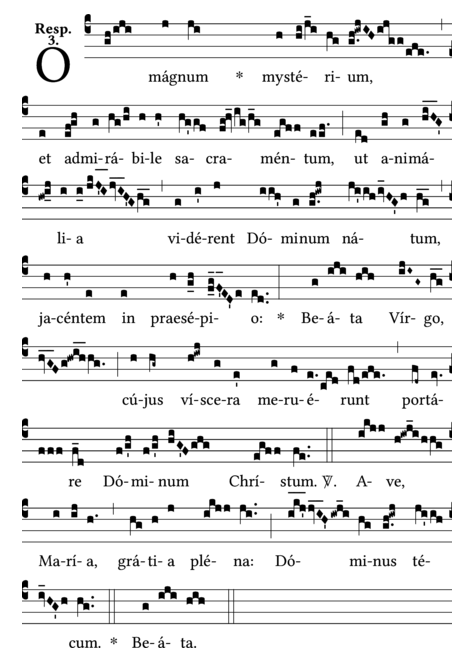
O Magnum Mysterium is a Catholic church chant sung at Christmastime. As part of the Matins (nighttime worship), the text has been around for centuries. While the exact origins are unknown, historians believe the text (and its use in Catholic Mass) has been around since at least the 10th century.
Because the work is so old, there have been many different settings and versions throughout the years. Today I want to share the version composed by Tomás Luis de Victoria (1548-1611), Spain’s most famous 16th-century composer.
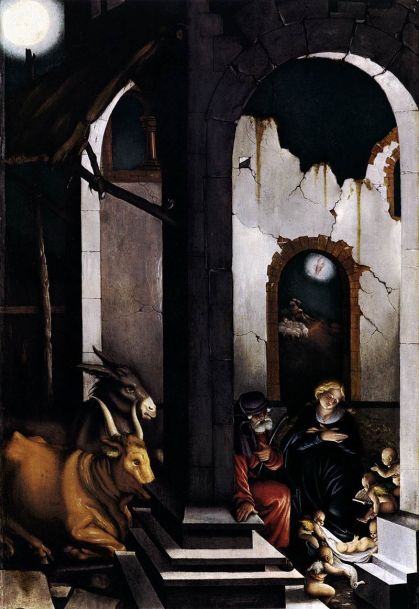
The first half of the chant references the animals present at Jesus’s birth, symbolic of God’s mysterious and lowly life as a mortal. This was a topic of great excitement during the Renaissance; people loved the idea that the animals in the stable recognized the birth of Jesus as an important event. The painting demonstrates this idea.
The second half of the text relates to the words spoken by Elizabeth when she welcomes Mary, the mother of Jesus, into her home:
“And she spake out with a loud voice, and said, Blessed art thou among women, and blessed is the fruit of thy womb.
And whence is this to me, that the mother of my Lord should come to me?” – Luke 1: 42-43
Music theory: Victoria’s use of open 5th intervals perpetuates a sense of awe in the music. In 5th intervals, the third of the chord is missing; this crucial note determines if the harmony is major or minor, so open 5ths don’t have any harmonic indication (which leaves the listener in suspense).
The music changes to a lilting triple meter as the choir sings “Allelujah!” This is an unexpected yet exciting conclusion to the piece, and it reminds me of a chorus of angels proclaiming the birth of Jesus.
About Belle qui
Thoinot Arbeau” is the pen name and an anagram of Jehan Tabourot, a Catholic priest and canon of Langres.
“Belle quit tiens ma vie” was first published in Tabourot’s 1588 dance manuscript “Orchesography”, which today is a major source of information about Renaissance dance.
This piece is a pavane: a stately dance in slow duple time, popular in the 16th and 17th centuries and performed in elaborate clothing.
Belle qui tien ma vie:
Belle qui tiens ma vie
Captive dans tes yeux,
Qui m’as l’ame ravie
D’un souris gracieux,
Viens tot me secourir
Ou me faudra mourir.
Beautiful one who holds my life
Captive in your eyes,
Who has ravished my soul
With a gracious smile.
Come to my aid
Or I must die.
Pourquoi fuis tu, mignarde,
Si je suis pres de toi?
Quand tes yeux je regarde
Je me perds dedans moi,
Car tes perfection
Changent mes actions
Why do you flee, dainty one,
If I am near you?
When I behold your eyes
I am lost inside myself
Because your perfection
[so affects my behaviour].
Tes beautes et ta graces
Et tes divins propos
Ont echauffe la glace
Qui me gelait les os,
Et ont rempli mon coeur
D’une amoureuse ardeur.
Your beauty and your grace
And your divine ways
Have melted the ice
Which was freezing my bones
And have filled my heart
With a loving ardour.
Mon ame voulait etre
Libre de passion,
Mais l’amour s’est fait maitre
De mes affections
Et a mis sous sa loi
Et mon coeur et ma foi.
My soul wanted to be
Free of passion,
But love became master
Of my affections
And put under its law
My heart and my faith.
Approche donc ma belle,
Approche toi mon bien,
Ne me sois plus rebelle
Puisque mon coeur est tien,
Pour mon mal appaiser
Donne moi un baiser.
Come near, my lovely one,
Come near, my [dear one],
Do not resist me further
For my heart is yours,
To relieve my ills
Give me a kiss.
Je meurs, mon Angelette,
Je meurs en te baisant
Ta bouche tant doucette
Va mon bien ravissant
A ce coup mes esprits
Sont tous d’amour epris.
I die, my Little Angel,
I die when kissing
Your mouth so sweet.
My very lovely one,
With that touch my spirits
Are completely lifted in love.
Plutot on verra l’onde
Contremont reculer,
Et plutot l’oeil du monde
Cessera de bruler,
Que l’amour qui m’epoint
Decroisse d’un seul point.
Sooner will waves
Flow backwards
And sooner will the moon
Cease to shine
Before the love which conquered me
Wanes a single iota.
About Ah, Robin:
This is a secular madrigal
a part-song for several voices, especially one of the Renaissance period, typically arranged in elaborate counterpoint and without instrumental accompaniment. Originally used of a genre of 14th-century Italian songs, the term now usually refers to English or Italian songs of the late 16th and early 17th c., in a free style strongly influenced by the text.
Musical Analysis:
As each voice enters the harmonies expand. Interesting enough the opening sonority begins on a G, adds a B-flat with the other ground voice, and finally an octave G in the soloist. This causes one of the significant part of the piece, the entrance of the third voice, to have a G minor harmony without the fifth of the chord.
This piece is still modal despite the use of F naturals, however, the d minor harmony begins to act as a resting point for phrases. The use of a picardy third appears numerous times through the work at the end of phrases, but not at the end as each voice begins to drop out, eventually making the music monophonic.
Ah, Robin, Gentle, Robin
Ah, Robin, gentle, Robin,
Tell me how thy leman doth
and thou shalt know of mine. My lady is unkind I wis, Alack why is she so? She lov’th another better than me, and yet she will say no.
Ah, Robin, gentle, Robin,
Tell me how thy leman doth
and thou shalt know of mine. I cannot think such doubleness for I find women true, In faith my lady lov’th me well she will change for no new.
Ah, Robin, gentle, Robin,
Tell me how thy leman doth
and thou shalt know of mine.
G. Edward Bruner, DMA: “Editions and Analysis of Five Missa Beata Virgine Maria by the Spanish Composers: Morales, Guerreo, Victoria, Vivanco, and Esquivel.” DMA diss., University of Illinois at Urbana-Champaign, 1980.[facsimile: University Microfilms International, Ann Arbor, MI]
Gustave Reese, Music in the Renaissance. New York, W.W. Norton & Co., 1954. ISBN 0-393-09530-4
Apel, Willi. 1988. The History of Keyboard Music to 1700. Bloomington: Indiana University Press. ISBN0-253-32795-4.
Arbeau, Thoinot. 1967. Orchesography, translated by Mary Stewart Evans, with a new introduction and notes by Julia Sutton and a new Labanotation section by Mireille Backer and Julia Sutton. New York: Dover Publications. ISBN0-486-21745-0.
Mimir’s well, year 3 was a resounding success. It was really nice to be able to teach and actually have time to take classes as well as socialize.
About 6 months ago, the Autocrat, Eleanor Grey, had asked me to come teach to make sure there was once again a bardic representation at their lovely event. I agreed. Mountain freehold is a great little shire with great people. Last year, I wrote them a song because they deserved it.
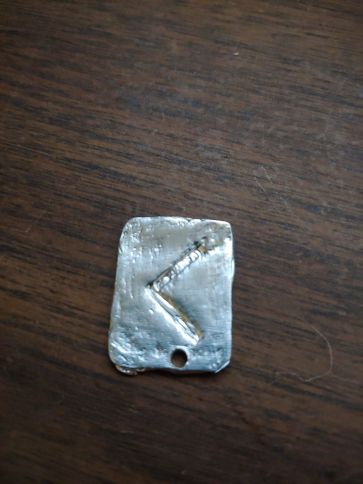
About 1.5 months ago, I was also asked if I could make the site tokens. I happily agreed. Mimir’s well is about wisdom. So, I chose to make tiny wisdom tokens. I sent Aegir the image to 3-d model as I had other work commitments I had to manage and he loves to play in fusion 360 (The 3-d modeling program we use). From there we printed and molded the tokens. She had requested that we make 100 of them. I had also decided that I didn’t want them to look like pristine metal. So, when creating the positive before creating the mold, I covered it in modgepodge and while it was still tacky, took same sandpaper to it to make it appear more stone-like by taking some divits out of the modgepodge.
Here are the final tokens (Though this one has the hole drilled in the wrong side):
From there, off to teach classes! I had a bright eyed and bush tailed class right at 10:00am. I always dread the first class of the day. I feel like no one wants to be there that early and no one is emotionally awake. It’s also the same as first performer stage fright. Always so hard to go on first, however, once the stage is set, everyone is ready to go!
My first class is how to warm up your body to perform. Yes, I taught this class the week before, however it is never the same. Here is the outline of the class so you know more (in a bullet form, what was gone over in the class)
Why do we warm up our bodies?
Athletes
Protection from harm
Emotionally warmed up
Setting the stage
Setting nerves aside
Ready to move
Anatomy of the mouth
Lips, Teeth, Alvular ridge, Hard pallet, Soft pallet
Discussion of how body is connected
Posture- Demonstration
Body stretches and massage
Head/temples
Neck
Head rolls
Arm body crosses
Pliet
Foot stretches
Rag dolls
Group massage
Breathing
Clavicle breathing
Proper way to breath in (order of operations)
Floor breathing
Engaging diaphragm and low back muscles
Breathing exercises
In outs on “Straw”
In outs on “Shhh”
Bubbles
Coughing/laughing
Projection
Talk about notes/polyps/hemorrhaging (Julie Andrews story)
5 locations to send sound in mouth
Discovering the soft pallet
Lollipops/York peppermint paddies
Eyebrows/yawning
Tongue twisters (Diction is done… Mommy made me…)
Finding nasal air flow spot
Tongue position
Dynamic projection (Using soft “stage whispers” to speak across the room)
Body tension
Finding tension in your body
Finding good mouth space
What you can do to loosen up your body
Questions:
From there, I hung out, ate, made some music with friends and enjoyed. I finally got to sing a few filks I had composed to those who had never heard them and saw the glee as disney and queen were attached to their favorite SCA activities. In addition, I got to see Aegir working in the kitchen, which he had a blast with.
My final class was just us singing period rounds. I just finished compiling a book of about 50 all period rounds (Sans “Le coq et mort”… which is a traditional, but hey, everyone likes to sing about dead chickens… plus I added the german. Morbid…dead..german… chickens). However, what makes my book different, besides it being so long, is I wrote up all the translations, IPA (Internation Phoenetic Alphabet) dictions and newspaper diction. I will be adding my written documentation on this shortly as well as the appropriate IPA charts, however, after the class, all 14 of my students were begging me to publish it now. (it was 25 pages, so I was remiss to keep printing more copies out of my pocket). I did, however, sell the 8 copies I made for charity and donated the funds on behalf of my class.
Finally, Aegir and I displayed our molds and casts we’ve been doing over the last few months. We had a BLAST telling everyone about the process. Again, making everything more accessible. We really want to make our arts accessible to people. I find it to be a gateway drug. If you find an easy/cheap way to do it, you most likely will want to explore how it was done. *GASP RESEARCH*
Where to begin with such a gigantic milestone for the East Kingdom. My home. This is the place where it felt safe to sing in public again. What else could I do for the Kingdom I love besides give it back the gift it gave to me?
I decided I would give everything I had to singing this weekend. It was too hot to do anything else. I think the heat this year was as bad as Pennsic 2 years ago where the heat won more bouts than the fighters. I’m glad no one was too seriously injured from heat.
With that being said, although I had transitioned to late period garb, the heat beat me in that battle for the weekend. Saari not Saari. Thats right, I ran around … well, walked around as a proper Indian woman should. It was a new feeling for me as I, in general, don’t show off this much skin. I’m a pretty modest dresser.
I bring this up because it has a lot to do with how I perform. Confidence is key in your performance. If you are not confident, your performance will suffer. Another point being is that when you practice to perform, you should, for all intents and purposes, rehearse in garb and shoes similar to what you will wear in performance. This was not the case for my 3 concerts I did over the weekend.
I was, however, blessed to be surrounded by performers and family of whom I respect immensely as performers.
In the first concert,Bards Ease, I collaborated with my good friends Bird the Bard and Sáerlaith íngean úi Duinnshléibhe (with Guest performances by Mistress Sabine and Mistress Margreatta) We would sing solo, group performances and some off mix of whatever we felt like was a good for the audience. Typically, I’d plan a concert one one genre. However, the 3 of us are so eclectic of performers, I really wanted to showcase that.
The next day we did a showcase of the Sing for the the East CD (which if you purchase this CD to support the East Kingdom Travel Fund, you can hear the track of Ceder San Barefoot and I performing that track. The rest of the concert was the original vocalists performing and the rest of us harmonizing.
The final concert was a sneak preview for the upcoming performance in April, The Decameron. We will be performing a a day of stories and music all from the 14th Century Italian literature. This happy little quartet was again, Myself, Bird, Sáerlaith and Margreatta.
If this wasn’t enough singing, we had our own camp of Bards who withered the night away with song till the wee hours of the morning.
This was my first year at Pennsic. I’m not going to lie. It’s all pretty much a blur right now so I will keep this short and sweet. I sang every night till the wee hours of the morning. I went to a Bardic Circle every night and sometimes multiple in a night.
The only super notable things I did were sing at the VDK Invitational Bardic. I learned a new piece of music (to be) composed by the Queens Bard Geoffrey – MKA-David Yardley (AKA captain Speccy Pants) and then I sang in Drake’s Concert, who opened for Heather Dale. That was pretty cool!
One more thing of note. I did record for the Known World Bardcast. I put up an original composition (Lullaby for the Queen). Anyone who knows me, knows how anxious I am putting my work out into the public.
I often find that GNE has been my event home since I started playing in 2010, but it wasn’t my first even. It is always one that has resonated with me as a war… a true immersion event for me.
This year was no different. I got to get my hands dirty with Bardic from helping to arrange the Bardic space, advertising and even performing myself.
I spent the weeks prior to GNE helping Gregor set up the Bardic space and quire Bardic Talent. I’ll admit, however, I was a bit preoccupied with my own agenda. This was my boyfriend’s first event and I wanted it to be as magical for him as it was for me.
Friday I spent fencing and showing my boyfriend around the range and doing a little bit of shopping. Saturday, I made sure I was there for the other performers as well. Prior to my own performance, a friend of mine was having a difficult time building up her own confidence. I spent time prior to making sure she knew people would be there and the massive amount of skill she possessed. I even requested she sing a song specifically for me.
When it was time to perform, I took the stage. This would be a casual performance. I really feel it’s important to read your venue. I chose not to sing the songs that made me feel like a million bucks, but ones that my audience would enjoy. This concert was not for me. It was for the audience.
The Friday prior, my good friend, now Mistress Christiana Crane had been sent to vigil. I feel like I only truly have one gift I can give and so this is what I made for her.
This was a scroll commissioned of me for Amalia’s von Hoehensee’s Lamp of Apollo
Oh yonder doth sit that little turtle dove, nay nightingale
Whos sweet rhapsody flows through not just music
But weaves and pierces the finest cloth
Each stitch is a note upon the melody of the cloth
Each stanza, a roving of the weave
Dulcet sounds and harmonies nestle into the thread
which is warmed by the heart and hands that are Amalia’s
Like a phoenix in her craft, sets the spirit a glow, a blaze
Pushing forth and reliving, creating each experience
She tests the purity of the cloth with fire
She lights the lamp of apollo which is now granted
By her skill from the hands, her voice
Deemed it so by Baron Dorio of the Oaks
Deemed it so by Baronessa Jocelyn Del Espada
On this day, January 27, A.S. 52 at A Market day at Birka





 This was my first year at Pennsic. I’m not going to lie. It’s all pretty much a blur right now so I will keep this short and sweet. I sang every night till the wee hours of the morning. I went to a Bardic Circle every night and sometimes multiple in a night.
 Meddlings of the Minnesinger