Palio di Stonemarche

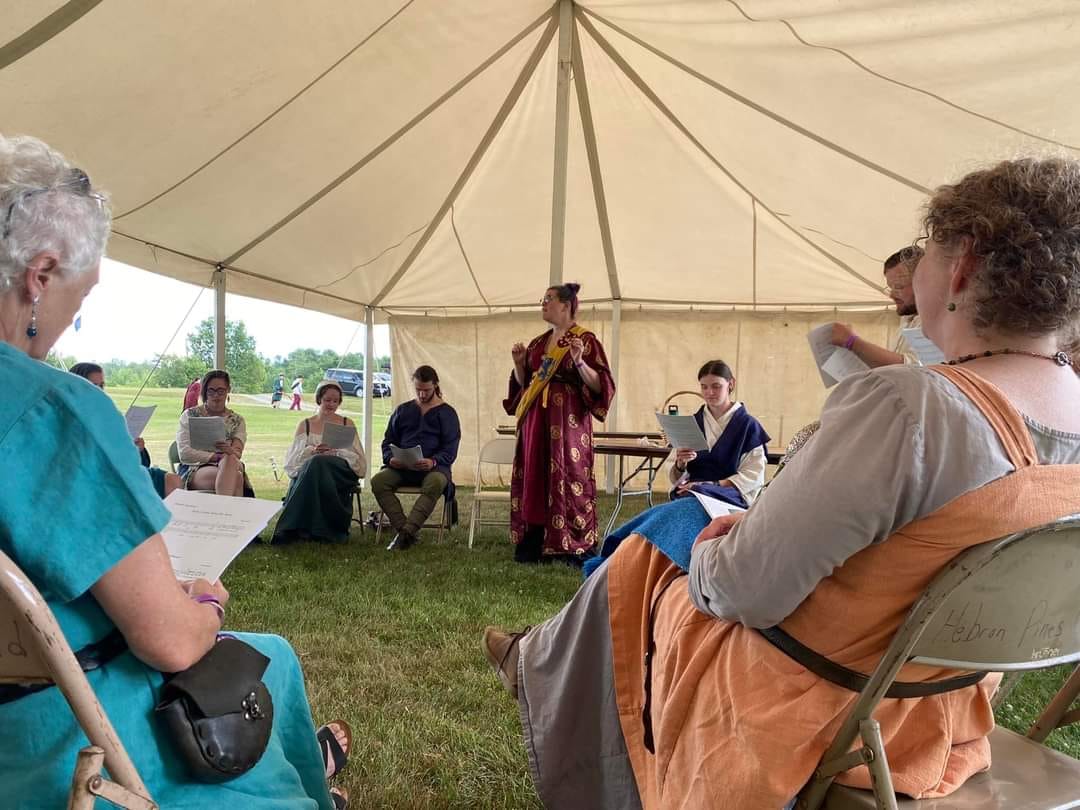
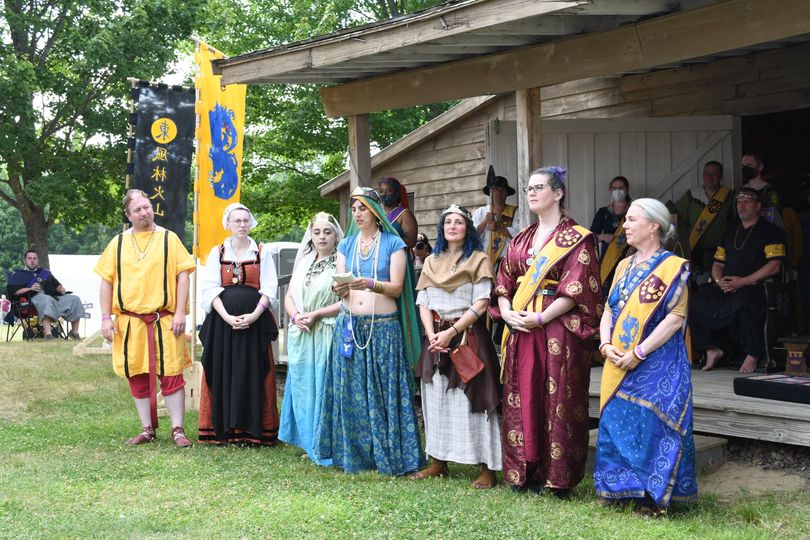
This year Palio was very small compared to previous years. However, considering it was up against fencing champs and another full war event, we still had a decent sized crowd. It was bitterly cold and rainy at night, but that didn’t take away from the run.

I ran the fencing tournament that day, but I was also in charge of the Golden Tongue Bardic competition. This is very near and dear to my heart because it gives folks who were newer performers a chance to shine. The rules are that you can never have won a bardic competition. We had 4 folks competing this year ranging from age 10 to a bit older (We never speak of a ladies age!) These folks do not proclaim themselves Bards. They have had rough experiences and similar to me, had sworn they would never perform again.

They said that -I- inspired them to give it a chance again. I was speechless. I just want folks to have a safe performance space.

When all was done, I chose, not the best or worst performer, I chose someone who moved me. I gifted them the prize and asked them to make me a promise that they would work on their story and tell it to me again sometime within the year.

A More Challenging Assembly

You would think after the 3 prior years of running this event, it would be easy as cake. The problem was that the 3 previous years had all been different. Covid-19 is still raging on and that lends itself to many other challenges.

In the first year of the challenge assembly’s inception, it had a large location in an area that was well accessible by many of the performers in the region. Bringing it up north had it’s own challenges. EKCOP has no money of it’s own, so we would need to find a sponsoring location. Luckily, Stonemarche had some extra money in the coffers and could offer us a sum to run this event. Finding sponsors for the challenges was another item as folks were unsure how their challenges were going to be taken and how they would view them.

This year, I was able to have 18 sponsors of 20 unique challenges. Next, getting folks to travel to New Hampshire and be willing to perform. We still had the requirements of masking indoors and performing outside would pose a challenge as there was a baseball game booked on the same grounds we were using. Can’t really complain considering the site was only charging us 75 dollars for the day. In addition we had to figure out how much food to feed people for day board and how we could encourage folks to teach.

The performance community in Stonemarche is decently sized, however, covid was making this all difficult. All in all, we had 43 attendees and actually made a profit of a little more than a hundred dollars for the day and this with charging folks the least amount we possibly could. We also had 12 amazing classes ranging from singing, story telling, history of stories and insturmental. The videos will be up soon… I hope.

Words for Onana Frizzell- Lamp of Apollo

Words for Onana Frizzell- Lamp of Apollo
By Solveig Bjarnardottir
Inspired by Oedipus

Auspicious Onara Frizzell, stretch the skilled hand
The delicate digits, until they embroider and paint for us
Fine Tapestries and illuminations
Athena, Artist
Make with prism of colors upon the fabric!
Oh, amethyst virtuosa, O fine crafter of brush and needle
O Stonemarchian-Rhapso not be belittled to Nike
Inspire on and share with all you can
Come with outstretched palm as you raise
yourself and others
Baron and Baroness of Stonemarche
Keziah and Deidre, inspired by your skill
Elevate you, an order to join
Apollo, Lamp, golden bright
This Palio, Anno Societatis 57

Words for Spyridon Tou Nkrizou Lykou- Lamp of Apollo

Words for Spyridon Tou Nkrizou Lykou- Lamp of Apollo
By Solveig Bjarnardottir
Inspired by Oedipus

What is Dionysus singing in his profound
Pytho of burgundies and brown
Until now, we were strangers to the taste
As we have been strangers to water
Could we enjoy but the fine tastes that he presents
Without knowing how refined they were
But now, friends
As we are no strangers to this land
Make this proclamation
If any person knows by whose tongue have but tasted
The brews et all
Knows the finery they share
Let it stand as promised to those before him that he too be noticed
Spyridon Tou Nkrizou Lykou, Brewer of fine beverages,
That the Baron and Baroness of Stonemarche
Keziah and Deidre, inspired by your skill
Elevate you, an order to join
Apollo, Lamp, golden bright
This Palio, Anno Societatis 57

Silver Crescent words for Cedric of the Floppy Hat

By Solveig Bjarnardottir MKA Lauren Haywood

Were he to keep a lower profile, he might
Have lived quite unknown in the East Kingdom the rest his life.
The list fields he prowled most every day,
Crossing swords with joy and never delay.
His clothes, most oft his vest and his stripes,
Though his hat alone would identify and suffice
Then, mostly alone save for only a few
To whom he had confided his whole story true.
One afternoon he turned up at the court
And offered his services at their report
To fetch and to carry—any kind of work
No task to small, no trial would shirk
And, to cut short a tale already long,
He strove to study and train and belong
To the rapier marshallate where by and by
He was a cunning fellow who kept a sharp eye
On every fencer and event support staff.
(Which is no small feat alone and by half.)
As Atlas was strong and wise as an ox,
As Apollo was swift and wily as a fox,
With all of these qualities alone, he was good
At teaching and training, as any with such skill should.
He took time to do any job he was asked.
Filling each duty, request, or each task
Helper, mentor, and friend were the names that they called him,
The very notion of abandoning those in need appalled him.
Few folk of the kingdoms were, as all would support,
Were half so beloved as he in the court.
So gentle was his manner, and seen by the crown,
That all of the East Kingdom rang with renown.
So great grew his reputation in time
Both for his helpfulness and service in prime
So for nine years he led life in this way
Through trials and struggles and joys he did stay
And did his job so well, both in peace and in war
That there was no man whom the East valued more.
So we grant Cedric of the Floppyhat, crescents of silver
To show our thanks, we now deliver
Counsels Tindal and Albrecht do bestow in Ethereal Court
This day and forever shall this honor shall be cavort.

Scoll by the incredibly talented Tiffan Fairamay

Check out her other incredible works! https://thornandthread.wordpress.com/

Sweet Nymph, Come to thy lover

Singing! The digital age pt 2! A few days ago, Amalie and I were approached by the Baroness of Stonemarche, who happens to be a performer in I Sebastiani (The greatest comedia troupe in all the known world). They had one of their performers who was supposed to perform in the intermezzo have a health emergency come up. She approached us asking if we could “Do a thing”.

We have both been Bardic Champions of the Barony and long time friends . We agreed to perform a duet. There wasn’t anything in either of our repertoires that really suited what they wanted, so off to learn new rep it was!

Amalie went digging through CPDL and Thomas Morley fell on to our plates. This was Tuesday Night. Wednesday, off to learn a thing!

Thursday, Thursday,…. Thursday. I guess i should record a thing. My friend, George, who is a mundane friend had been getting me into doing some streaming. With this came some awesome and free software. OBS. I was able to make this beautiful half of my recording. It also instantly transfers my files to videos for consumption.

21 takes later this is what I decided to keep. Live performances are fleeting and you cannot dwell on mistakes and imperfections. Videos… those are permanent and scary!

Text:

Sweet nymph come to thy lover,
Lo, here alone our loves we may discover,
Where the sweet Nightingale with wanton glosses,
Hark! her love too discloses.

Sweet Nymph Come to Thy Lover (MorleyThomas). Composition Year, 1595 or before

First Published in 1595 in Canzonets to Two Voices (No.3)

Make sure to check out Amalie and all her other amazing things she does:

https://arsamalie.wordpress.com/

Hamlet, Hamlet!

Hamlet

Although this was not my own production, I was granted a chance to perform with the gifted cast. A few days ago, my Laurel, Sabine, had reached out to me asking if I would be willing to be a part of the live intermission music for Hamlet. This was a live reading so I thought it would also be really cool to be a part of a live performance in any way I could.

I was trying to wrap my head around a way to make this work. Sure, I have some ok recording equipment which make for OK sound equipment when recording. I also don’t really have any period instruments that I play well enough to accompany myself. However, it hit me that I didn’t -need- one. I have a keyboard in my house and music!

This would probably be the only chance I will have in the foreseeable future to be able to play piano and sing without it being too jarring.

Among that challenge, there is the looming of the novel virus COVID-19, which, has put a damper on my performance muse. I won’t even really sing seriously in front of my fiancé.  It’s amazing what isolation will do to your singing spirit.

From there, a small bit of rehearsal and details to iron out.

Day of, everything that could go wrong on the musical side of technology went wrong. After multiple reboots, some sound engineering (Thanks to my fiancé for helping listen for balance checks) and then leveling the volume of the keyboard versus my voice, it was time to go.

Right before I was going to sing, the power supply blew and a quick changing of sockets fixed everything.

Was this my best performance? No. Did I get to be a part of an amazing production? Absolutely.

Thank you again, Sabine for coordinating this and to my fellow performers who made a magical day.

If you have not watched this, please enjoy!

Local Choir strikes again

Choirs are a lot of fun, but they require more than you. That isn’t a bad thing, but finding other like minded folks with the missing parts you need can be difficult to say the least. Once upon a time (4-5 years ago) I ran a vocal group in Malagentia called, “Voce di Sonata”. I ran this choir for about 2 years. However, with real life comes member depletion.  I moved a bunch, people got married and divorced, houses were sold and people have this thing called a job. So, as it were, life doesn’t always work the way it should and I let the group dissolve.

About 2-3 months ago, a conversation struck up with one of my old vocalists from voce. She had expressed wanting to sing and make music. Then, more specifically, she and her husband wanted to work on “O Magnum Mysterium” by Victoria.

If you haven’t heard this piece, take a listen:


NB) More information about this piece below


However, with the 3 of us, we were missing a crucial voice part. The tenor! I was playing the part of Alto, because… why not. (for any of you who know me, I am not an alto, I just play one on TV). We have a local tenor who is also a shoe in and loves to sing, so without fail, he came to the rescue. 2-3 rehearsals in and we have some music going. This is a volunteer group, who meets every 2 weeks, but again, life happens so we’ve maybe met 2-3 times in 3 months, and that’s ok.

This is for fun. (I have to keep telling myself that. I come from a history of professional musicians who come to their first rehearsal with all their music learned if not memorized. Those, who have perfect pitch or at least relative pitch and work without speaking, singing only for 1-2 hours at a time) This is an ongoing learning experience for me. I’m loving every moment of it. It’s absolutely incredible to work with a group of people who’s passion has not been lost. They do this because it’s fun, not work.

O Magnum has been put aside for now so the group can learn some vital things about working together is a very small chamber group. For now, we are working on Belle Qui Tiens Ma Vie ( Thoinot Arbeau 1520-1595) , Ah Robin, Gentle Robin (William Cornish 1465-1523) and  By the Rose (13th century anonymous poem set by Lady Colette la Trouvere).


With permission from the ensemble, here are the super duper rough recordings done on my terrible cell phone. The one thing I can’t show you is the immense joy and pride on all the vocalists faces when they got to hear their recordings for the first time. The plan is, down the road to make a real recording for them to compare themselves to.

Belle qui tien ma vie:

https://drive.google.com/file/d/1MqexQGOtQD0x3adrQyagqbr1FY8Db0sb/view?usp=sharing

Ah robin:

https://drive.google.com/file/d/17mWec-NLl-nhZvJgNfZzfSHQGSzv9eoT/view?usp=sharing


Latin text
O magnum mysterium,
et admirabile sacramentum,
ut animalia viderent Dominum natum,
iacentem in praesepio!
Beata Virgo, cujus viscera
meruerunt portare
Dominum Iesum Christum.
Alleluia!
English translation
O great mystery,
and wonderful sacrament,
that animals should see the newborn Lord,
lying in a manger!
Blessed is the virgin whose womb
was worthy to bear
the Lord, Jesus Christ.Alleluia!
O_magnum_mysterium.png

O Magnum Mysterium is a Catholic church chant sung at Christmastime. As part of the Matins (nighttime worship), the text has been around for centuries. While the exact origins are unknown, historians believe the text (and its use in Catholic Mass) has been around since at least the 10th century.

Because the work is so old, there have been many different settings and versions throughout the years. Today I want to share the version composed by Tomás Luis de Victoria (1548-1611), Spain’s most famous 16th-century composer.

The first half of the chant references the animals present at Jesus’s birth, symbolic of God’s mysterious and lowly life as a mortal. This was a topic of great excitement during the Renaissance; people loved the idea that the animals in the stable recognized the birth of Jesus as an important event. The painting demonstrates this idea.

eb7bb60ff0ee8ce249cc2fd207662371.jpg

The second half of the text relates to the words spoken by Elizabeth when she welcomes Mary, the mother of Jesus, into her home:

“And she spake out with a loud voice, and said, Blessed art thou among women, and blessed is the fruit of thy womb.

And whence is this to me, that the mother of my Lord should come to me?” – Luke 1: 42-43

Music theory: Victoria’s use of open 5th intervals perpetuates a sense of awe in the music. In 5th intervals, the third of the chord is missing; this crucial note determines if the harmony is major or minor, so open 5ths don’t have any harmonic indication (which leaves the listener in suspense).

The music changes to a lilting triple meter as the choir sings “Allelujah!” This is an unexpected yet exciting conclusion to the piece, and it reminds me of a chorus of angels proclaiming the birth of Jesus.


About Belle qui

Thoinot Arbeau” is the pen name and an anagram of Jehan Tabourot, a Catholic priest and canon of Langres.

“Belle quit tiens ma vie” was first published in Tabourot’s 1588 dance manuscript “Orchesography”, which today is a major source of information about Renaissance dance.

This piece is a pavane: a stately dance in slow duple time, popular in the 16th and 17th centuries and performed in elaborate clothing.

Belle qui tien ma vie:

Belle qui tiens ma vie
Captive dans tes yeux,
Qui m’as l’ame ravie
D’un souris gracieux,
Viens tot me secourir
Ou me faudra mourir.
Beautiful one who holds my life
Captive in your eyes,
Who has ravished my soul
With a gracious smile.
Come to my aid
Or I must die.
Pourquoi fuis tu, mignarde,
Si je suis pres de toi?
Quand tes yeux je regarde
Je me perds dedans moi,
Car tes perfection
Changent mes actions
Why do you flee, dainty one,
If I am near you?
When I behold your eyes
I am lost inside myself
Because your perfection
[so affects my behaviour].
Tes beautes et ta graces
Et tes divins propos
Ont echauffe la glace
Qui me gelait les os,
Et ont rempli mon coeur
D’une amoureuse ardeur.
Your beauty and your grace
And your divine ways
Have melted the ice
Which was freezing my bones
And have filled my heart
With a loving ardour.
Mon ame voulait etre
Libre de passion,
Mais l’amour s’est fait maitre
De mes affections
Et a mis sous sa loi
Et mon coeur et ma foi.
My soul wanted to be
Free of passion,
But love became master
Of my affections
And put under its law
My heart and my faith.
Approche donc ma belle,
Approche toi mon bien,
Ne me sois plus rebelle
Puisque mon coeur est tien,
Pour mon mal appaiser
Donne moi un baiser.
Come near, my lovely one,
Come near, my [dear one],
Do not resist me further
For my heart is yours,
To relieve my ills
Give me a kiss.
Je meurs, mon Angelette,
Je meurs en te baisant
Ta bouche tant doucette
Va mon bien ravissant
A ce coup mes esprits
Sont tous d’amour epris.
I die, my Little Angel,
I die when kissing
Your mouth so sweet.
My very lovely one,
With that touch my spirits
Are completely lifted in love.
Plutot on verra l’onde
Contremont reculer,
Et plutot l’oeil du monde
Cessera de bruler,
Que l’amour qui m’epoint
Decroisse d’un seul point.
Sooner will waves
Flow backwards
And sooner will the moon
Cease to shine
Before the love which conquered me
Wanes a single iota.


About Ah, Robin:

This is a secular madrigal

a part-song for several voices, especially one of the Renaissance period, typically arranged in elaborate counterpoint and without instrumental accompaniment. Originally used of a genre of 14th-century Italian songs, the term now usually refers to English or Italian songs of the late 16th and early 17th c., in a free style strongly influenced by the text.

Musical Analysis:

As each voice enters the harmonies expand. Interesting enough the opening sonority begins on a G, adds a B-flat with the other ground voice, and finally an octave G in the soloist. This causes one of the significant part of the piece, the entrance of the third voice, to have a G minor harmony without the fifth of the chord.

This piece is still modal despite the use of F naturals, however, the d minor harmony begins to act as a resting point for phrases. The use of a picardy third appears numerous times through the work at the end of phrases, but not at the end as each voice begins to drop out, eventually making the music monophonic.

Ah, Robin, Gentle, Robin 

Ah, Robin, gentle, Robin,
Tell me how thy leman doth
and thou shalt know of mine.
My lady is unkind I wis,
Alack why is she so?
She lov’th another better than me,
and yet she will say no.
Ah, Robin, gentle, Robin,
Tell me how thy leman doth
and thou shalt know of mine.
I cannot think such doubleness
for I find women true,
In faith my lady lov’th me well
she will change for no new.
Ah, Robin, gentle, Robin,
Tell me how thy leman doth
and thou shalt know of mine.

  • G. Edward Bruner, DMA: “Editions and Analysis of Five Missa Beata Virgine Maria by the Spanish Composers: Morales, Guerreo, Victoria, Vivanco, and Esquivel.” DMA diss., University of Illinois at Urbana-Champaign, 1980.[facsimile: University Microfilms International, Ann Arbor, MI]
  • Gustave Reese, Music in the Renaissance. New York, W.W. Norton & Co., 1954. ISBN 0-393-09530-4
  • Apel, Willi. 1988. The History of Keyboard Music to 1700. Bloomington: Indiana University Press. ISBN 0-253-32795-4.
  • Arbeau, Thoinot. 1967. Orchesography, translated by Mary Stewart Evans, with a new introduction and notes by Julia Sutton and a new Labanotation section by Mireille Backer and Julia Sutton. New York: Dover Publications. ISBN 0-486-21745-0.


Many Much Tokens! And classes!

Mimir’s well, year 3 was a resounding success. It was really nice to be able to teach and actually have time to take classes as well as socialize.

About 6 months ago, the Autocrat, Eleanor Grey, had asked me to come teach to make sure there was once again a bardic representation at their lovely event. I agreed. Mountain freehold is a great little shire with great people. Last year, I wrote them a song because they deserved it.

About 1.5 months ago, I was also asked if I could make the site tokens. I happily agreed. Mimir’s well is about wisdom. So, I chose to make tiny wisdom tokens. I sent Aegir the image to 3-d model as I had other work commitments I had to manage and he loves to play in fusion 360 (The 3-d modeling program we use). From there we printed and molded the tokens. She had requested that we make 100 of them.  I had also decided that I didn’t want them to look like pristine metal. So, when creating the positive before creating the mold, I covered it in modgepodge and while it was still tacky, took same sandpaper to it to make it appear more stone-like by taking some divits out of the modgepodge.

Here are the final tokens (Though this one has the hole drilled in the wrong side):


54514104_2294728344138437_8900480613199380480_n.jpg


From there, off to teach classes! I had a bright eyed and bush tailed class right at 10:00am. I always dread the first class of the day. I feel like no one wants to be there that early and no one is emotionally awake. It’s also the same as first performer stage fright. Always so hard to go on first, however, once the stage is set, everyone is ready to go!

My first class is how to warm up your body to perform. Yes, I taught this class the week before, however it is never the same. Here is the outline of the class so you know more (in a bullet form, what was gone over in the class)

  1. Why do we warm up our bodies?
    1. Athletes
    2. Protection from harm
    3. Emotionally warmed up
    4. Setting the stage
    5. Setting nerves aside
    6. Ready to move
  2. Anatomy of the mouth
    1. Lips, Teeth, Alvular ridge, Hard pallet, Soft pallet
    2. Discussion of how body is connected
    3. Posture- Demonstration
  3. Body stretches and massage
    1. Head/temples
    2. Neck
    3. Head rolls
    4. Arm body crosses
    5. Pliet
    6. Foot stretches
    7. Rag dolls
    8. Group massage
  4. Breathing
    1. Clavicle breathing
    2. Proper way to breath in (order of operations)
    3. Floor breathing
    4. Engaging diaphragm and low back muscles
  5. Breathing exercises
    1. In outs on “Straw”
    2. In outs on “Shhh”
    3. Bubbles
    4. Coughing/laughing
  6. Projection
    1. Talk about notes/polyps/hemorrhaging (Julie Andrews story)
    2. 5 locations to send sound in mouth
    3. Discovering the soft pallet
    4. Lollipops/York peppermint paddies
    5. Eyebrows/yawning
    6. Tongue twisters (Diction is done… Mommy made me…)
    7. Finding nasal air flow spot
    8. Tongue position
    9.  Dynamic projection (Using soft “stage whispers” to speak across the room)
  7. Body tension
    1. Finding tension in your body
    2. Finding good mouth space
    3. What you can do to loosen up your body

Questions:


From there, I hung out, ate, made some music with friends and enjoyed. I finally got to sing a few filks I had composed to those who had never heard them and saw the glee as disney and queen were attached to their favorite SCA activities. In addition, I got to see Aegir working in the kitchen, which he had a blast with.

My final class was just us singing period rounds. I just finished compiling a book of about 50 all period rounds (Sans “Le coq et mort”… which is a traditional, but hey, everyone likes to sing about dead chickens… plus I added the german. Morbid…dead..german… chickens). However, what makes my book different, besides it being so long, is I wrote up all the translations, IPA (Internation Phoenetic Alphabet) dictions and newspaper diction. I will be adding my written documentation on this shortly as well as the appropriate IPA charts, however, after the class, all 14 of my students were begging me to publish it now. (it was 25 pages, so I was remiss to keep printing more copies out of my pocket).  I did, however, sell the 8 copies I made for charity and donated the funds on behalf of my class.

Here is the book, documentation to come!

https://docs.google.com/document/d/1PvID7hHNG2gvJjWctuWdpQiK-OyhmB_GlVLQhHqEcI8/edit?usp=sharing

Finally, Aegir and I displayed our molds and casts we’ve been doing over the last few months. We had a BLAST telling everyone about the process. Again, making everything more accessible. We really want to make our arts accessible to people. I find it to be a gateway drug. If you find an easy/cheap way to do it, you most likely will want to explore how it was done. *GASP RESEARCH*


Getting Medieval with Technology

Recently, there was a call for need of silver level and specialized awards in the East Kingdom. Her Majesty, Vienna, has put out a request and I felt like I could do something to help. My boyfriend, Aegir, and I love to craft and find new ways of making things. So, I put out the idea to him that we should make, or attempt to make, some of these awards.

Without hesitation, we both began to brainstorm. He asked me what were ways of making awards and what was acceptable. I mentioned that it only needed to look period or possibly resemble a period item. We then looked to our 3-d printer and our silicone mold kits and the lights in our heads went off.

Aegir asked me what the awards were and what they meant. I beamed as I got to explain to him the meaning behind the awards and the intricacies that were our tradition and lineage. I bring up lineage due to the fact that a friend of mine, David Poirier de le Loup, was going to be honored at Crown Tournament. I wanted to make him his Silver Wheel. In addition, a good friend of David’s and mine, Anne de Basillion, had mentioned to me that team “Do all the things” was going to pass down her medallion to David. If she did that, she would be without her regalia. That couldn’t be a thing.

So, we worked to get this amended.

EKAWARDS_Silver_Wheel.jpg

1000px-Héraldique_-_meuble_-_Roue.jpg

Aegir taught me how to 3-d model while he worked on the designs for other awards. 3-d modeling is not an extremely difficult process for awards, but it was time consuming. I also had picked a more in-depth design to complete instead of the standard silver wheel award. David is part of the Free Company of the Stella Maris, which is a group of Pi-…. Privateers. So, I chose to make it look more steering wheel like. Anne is also a friend of the company so I would make hers to match.

Here begins the process, 3-D Modeling!

2d model.jpg

3d1.jpg

This modeling was done in a program called Autodesk Fusion 360.

From there, we exported the models into a program called Simplify 3d. This is where the data from the 3d modeling was sent for sizing and printing to be completed.

Here are a few of the models we completed:

Lyre.jpg This is the “Golden Lyre”

Wheel.jpg This is the “Silver Wheel”

Silvertyger.jpg This is the “Silver Tyger”

From there, it was mold making time, baby!

We tried a couple different mold processes in the comfort of our own kitchen. Silicone is not the most beautiful fragrance in the world, so I do recommend proper ventilation. Also, marking a proper container to house the mold during it’s 24 hour cure time is key. Chinese food boxes seem to work well for those who are a bit more frugal.

Here you can see Aegir taking one for the team and handling the fumes.

46426391_280757422575926_8521208380755279872_n.jpg

Here you can see Aegir pouring the mold into our handy dandy takeout box.

46438401_760292231036228_5771233631074779136_n.jpg

While we wait for this mold to cure, we were trying a new gravity fed two part mold… we may or may not have used a salt lick? (It’s a Himalayan salt grilling block thing… it was cheaper than stone)

46436382_1911863125515650_981880629681455104_n.jpg

Here is our finished product (with a little bit of sanding/polishing. Flash happens)

46412036_743937466004667_3255154502457622528_n.jpg