
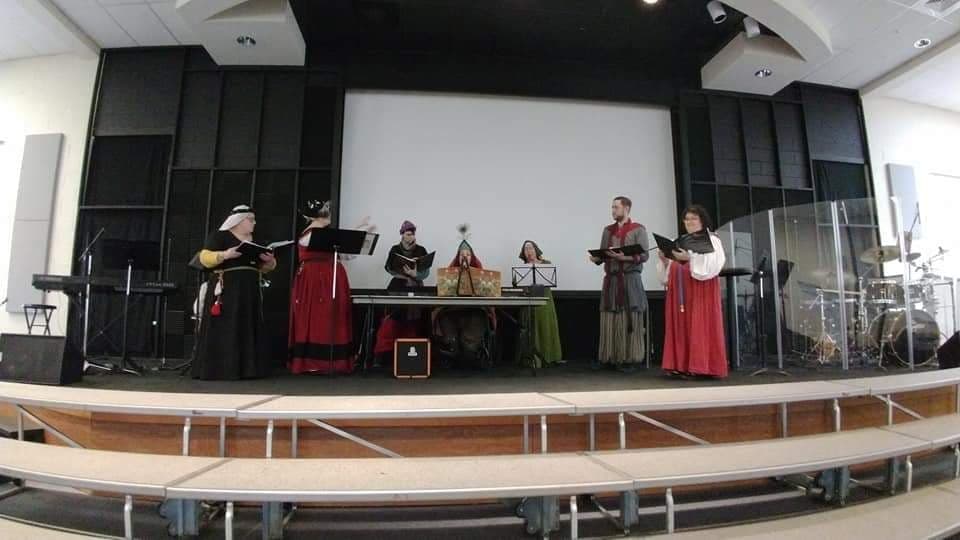
This weekend was the East Kingdom College of Performers Challenge and Schola down in Iron Bog. This was a little bit of a schlep for a day event, but I am so glad I headed down. This is the first time we’ve done something like this in the East Kingdom. It was a day of classes and challenges. You did not have to master anything to be a part of it, but you would have to be willing to step out of your comfort zone.
With that said, it was a challenging, but positive day over all. I started the day right away with running a rehearsal for the newest addition to the East Kingdom College of performers, Opera D’el Est. The day, however, started more frantically than I hoped it would. Our one and only alto wasn’t able to come. So, I guess I’d sing her part and hopefully make it work. Then, 1/2 of the performers, who were traveling in the same vehicle, were about 45 minutes late (however, due to no fault of their own. Between traffic and weather).
Rehearsal did not go as planned, and that’s ok. We were fighting a lot of odds between company distances, time we had to prepare music and we are a new group. This happens. Everyone had agreed to give up part of their lunch time to meet again for additional rehearsal.
I met with some of the other vocalists after for some one on one help. From there, I whirled into some recorder site reading, which I really haven’t picked up a recorder since 2009… when I graduated college. Not only did I remember some things (Which was huge) I got to encourage 2 more of my friends to come join us. We went from 3- 5! So many tooty flutes!
From there, off to run a class. I have taught this class a couple times prior, but I think this iteration was the best version of the class. I am passionate about making sure performers are well warmed up for performance whether is be Singing, story telling or even heralding. If the body -and- mind are not there, then your performance will suffer. This iteration of the class discussed anatomy, posture, breathing, the parts of your body that make the sounds, projection and location of sound. I had 6 folks join my class of varying experience and age. Everyone seemed to get something new from the class and was able to apply it. Once of the gentleman in the class, who I performed with later in the day, said that it was a comprehensive warm up and encouraged others to do so. This was encouraging.
From there, a very abbreviated lunch and round 2 of rehearsing. This time, the section which the group seemed to be struggling with, seemed to lock in. Though, no real way to test it until performance. TO ADVENTURE!
From there, time to do another class! I have been bringing rounds with me to almost every event I teach at. They are a safe singing space for novice to master and bring joy. 8 folks at my rounds class. Everyone had a varying degree of expertise and it was delightful. There was a young lady, who doesn’t sing much, but her boyfriend does, who came to my class. She spoke to me afterwords, advising that she was over the moon since she got to sing. She felt the class was tailored enough that she could join in and not feel like she was slowing progress, but that she got to sing the songs and sing her part independently.
Whooosh! Off to perform (No, I have not sat down today or stopped for water). It was time for Opera D’el Est to make it’s debut. (See documentation, synopsis and translation below #1). The first piece we did was the Prologue from Eurydice. Despite some minor technical difficulties everyone who sang in that piece, rocked it.
We had a solo from our fearless leader and newest Queen’s Bard, Laila.
Then a solo from me! I died. I love dying on stage. I performed Laciate Morire from L’Arianna (See info below #2). I love death arias. I love dying on stage. To lament, there is no greater form of drama. See! Look, I’m dead… on the floor… singing the high stuff!

We had a beautiful duet from Laila and Ethnye (Enya). Finally, the choral piece from doom. A te qual tu ti, Euridice, Jacopo Peri. (Info below #3) It’s not that this piece was hard or anyone was untalented, it was just a perfect storm. This experience however taught me a new skill. I went to school professionally for singing. Everyone had hours to prep their pieces and weeks to learn music. This was not that. I learned that I should be happy with a product, that I had volunteers. I learned that my standard of performance is not a level for everyone. I don’t want this to come off as condescending. What I mean is that in fact, I should be proud of a group who came so far to even get this going. This was a huge success. Even if the music wasn’t perfect. LOOK AT THESE FOLKS! Look what they accomplished in such a short period of time.
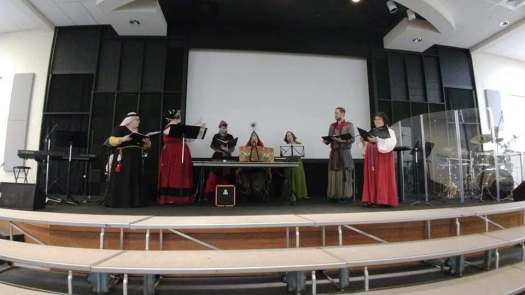
From here, off to the challenges for the day. I stuck myself in a spot just to get out there and do something that I wasn’t necessarily skilled at. I wanted to work on something that wasn’t “Pretty” or necessarily polished. This is a huge fear for me because I was taught to never put anything out there that you weren’t proud of or ready to be recorded for the world. As a Bard, part of my learning is about bringing the news and the stories. They won’t always be perfect, but that is part of the creation and the reality.
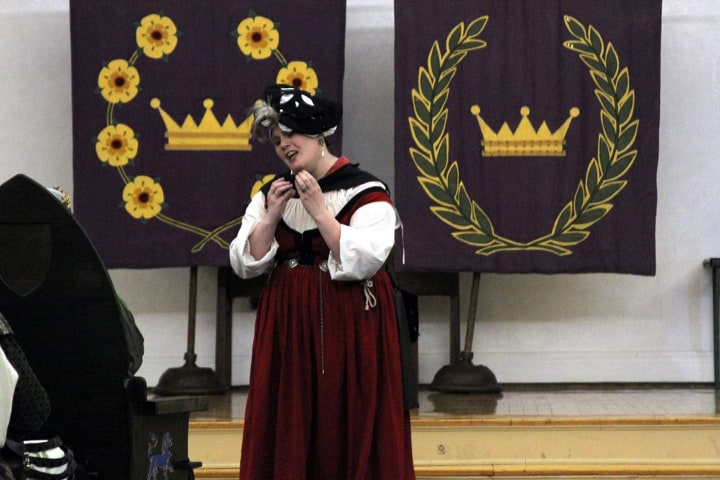
The first piece I performed was “Twa Corbies”. This is a spoof written as a response to Raven’s Croft’s “3 ravens”. (See the lyrics and translation of the low Scottish below).
Second, was a completely non period, but SCA appropriate story. I don’t know it’s title, but I shall call it “How I caught the red dragon”. I’m not really a story teller. I do it to challenge myself. Music is my muse. However, I always want to be able to entertain a room. Pretty singing isn’t for everyone. Sometimes, you just need to tell a cheesy story. So I did. I flubbed up some of the words. I didn’t provide enough gesticulations as I’d like, however, I made my goal. I told another story in front of an audience. I’m getting there.
Last but not least, I had the pleasure of presenting the new East Kingdom College of Performer’s Travel journal during the final court. Just prior to, I had sat down in quiet with one of my fellow performers today. She bled her heart to me. She spoke of her struggles and sorrows with today’s events. She exclaimed that she was embarrassed. I shut the door in the room we were… expelling in. I explained to her that this was a new experience. Nothing wen right for any of us. She did well. Was it perfect, no. However, we will grow from good to better to best. I told her of my struggles with the day. That I was just her with 2 years more experience. I told her after the event we would connect and see how we could grow. It was then, I realized I would present the journal to her. She was my inspiration. She fell, she got back up. She is off running again. I could not be more proud of her.
I presented the journal, I shouted, “I”m free” and from court I left.
1)
Prologo: From Eurydice BY Jacopo Peri, Composed in 1600. The composition is typically considered to be the second work of modern opera, and the first such musical drama to survive to the present day. (The first, Dafne, was written by the same authors in 1597.)
Since both the libretto and score were dedicated to the new Queen of France, Marie de’ Medici, some scholars have recognized a possible parallel between Euridice and Orfeo and the Queen and King of France. While the comparison is readily made, some scholars argue that the traits of King Henry IV are different from Orfeo, especially with respect to Orfeo’s most famous deed. Orfeo loved Euridice so much that he journeyed to Hell and back, quite literally, to unite once more with his beloved wife while King Henry IV wouldn’t travel as far as Florence to retrieve Medici.
Peri’s Euridice tells the story of the musician Orpheus and Euridice from Greek Mythology. According to myth, Orpheus was a great musician who journeyed to the underworld to plead with the gods to revive his wife Euridice after she had been fatally injured.
The opera begins with a Prologue delivered by a singer representing Tragedy. She explains to the audience that she has not come this time to reduce them to tears with stories of sorrow, death and cruelty, but has changed her usual costume in order to awaken much sweeter emotions in the human heart. Future artists may well follow in her footsteps, when the whole world admires what she can do in this changed form: the new queen whose wedding is being celebrated, she says, will be more garlanded with laurels than anyone ever was in ancient Athens or Rome. She herself is going to dress up for the royal wedding, and while France prepares to receive its new queen, the wedding guests can relax and listen to the singing of Orpheus.
- Hill, John Walter (2005). Baroque Music: Music in Western Europe, 1580–1750. Norton. ISBN 0-393-97800-1.
- Oldmeadow, Earnest (1909). Great Musicians. Forgotten Books.
Io, che d’alti sospir vaga e di pianti
spars’or di doglia, or di minacce il volto
fei negl’ampi teatri al popol folto
scolorir di pietà volti, e sembianti.
Non sangue sparso d’innocenti vene
non ciglia spente di tiranno insano,
spettacolo infelice al guardo umano
canto su meste, e lagrimose scene.
Lungi via lungi pur da regi tetti
simolacri funesti, ombre d’affanni,
ecco i mesti coturni, e i foschi panni
cangio, e desto nei cor più dolci affetti.
Or s’avverrà, che le cangiate forme
non senza alto stupor la terra ammiri,
tal ch’ogni alma gentil ch’Apollo inspiri
del mio novo cammin calpesti l’orme.
Vostro regina sia cotanto alloro
qual forse anco non colse Atene, o Roma,
fregio non vil fu l’onorata chioma
fronda febea fra due corone d’oro.
Tal per voi torno, e con sereno aspetto
ne’ reali imenei, m’adorno anch’io,
e su corde più liete il canto mio
tempro al nobile cor dolce diletto.
Mentre Senna real prepara intanto
alto diadema, onde il bel crin si fregi,
e i manti, e seggi degl’antichi regi
del tracio Orfeo date l’orecchia al canto
I, who eager for loud sighs and tears, My face now filled with sorrow, now with threats, Once made the faces of the crowd in great theaters Turn pale with Pity
No longer of blood shed by innocent veins, Nor of eyes put out by the insane Tyrant, Unhappy spectacle to human sight, Do I sing now on a gloomy and tear-filled stage
Away, away from this royal house, Funereal images, shades of sorrow! Behold, I change my gloomy buskins and dark robes to awaken in the heart sweeter emotions
Should it now come to pass that the world admire, with great amazement, these changed forms, So that every gentle spirit that Apollo inspires will treat in the tracks of my new path
Yours, Queen, will be so much laurel, That perhaps not even Athens or Rome gathered more, an ornament worth of those honored tresses A frond of Phoebus between two crowns of gold.
Thus changed, I return; serenely, I, too, adorn myself for the Royal wedding, And temper my song with happier notes, Sweet delight to the noble heart
While the royal Seine prepares A noble crown to decorate the beautiful hair, and the mantle and throne of the ancient Kings, Listen to the singing of Orpheus of Thrace.
2)
This is from Arianna (1608), Arianna’s Lament, the only aria surviving from this opera, with text by Rinuccini. The manuscript survives in two copies: Manuscript Mus. G239, Biblioteca Estense, Modena, Italy and (in the handwriting of composer Luigi Rossi) as British Library Ad. 30491.
Ariadne’s sadness is a prime example of the effects of a man’s false words. In the myth of Theseus, her lover, he promised her a marriage in exchange for her aiding his journey to kill the Minotaur. However, Theseus soon abandons his bride-to-be, leaving her all alone to bathe herself in grief. She then became inspiration to many painters, sculptors, artists and musicians, mainly depicted weeping and in obvious despair.
Lasciatemi morire,
Lasciatemi morire;
E che volete voi che mi conforte
In così dura sorte,
In così gran martire?
Lasciatemi morire.
Let me die,
Let me die;
And what you would think could comfort me
In such a harsh fate,
In such a great martyrdom?
Let me die.
A te qual tu ti, Euridice, Jacopo Peri
A te qual tu ti sia de gl’alti numi
ch’al nobile pastor recasti aita
mentre avran queste membra, e spirto, e vita
canterem lodi ogn’or tra incensi, e fumi.
Se de’ boschi i verdi onori
raggirar su nudi campi
fa stridor d’orrido verno
sorgono anco, e frond’e fiori
appressando i dolci lampi
della luce il carro eterno.
S’al soffiar d’Austro nemboso
crolla in mar gli scogli alteri
l’onda torbida spumante,
dolce increspa il tergo ondoso
sciolti i nembi oscuri, e feri
aura tremula, e vagante.
Al rotar del ciel superno
non pur l’aer, e ‘l foco intorno
ma si volve il tutto in giro,
non è il ben nel pianto eterno.
Come or sorge, or cade il giorno,
regna qui gioia, o martiro.
Poi che dal bel sereno
in queste piagge umil tra noi mortali
scendan li dèi pietosi a’ nostri mali
pria che Febo nasconda a Teti in seno
i rai lucenti, e chiari
al tempio ai sacri altari
andiam devoti, e con celeste zelo
alziam le voci e il cor cantando al cielo.
Aurelio et Ludovico Osanna, Mantua, 1608. Publication of the text included in Federico Follini’s report of the 1608 performance
G. F. Gundulić, Ancona, 1633. Croatian translation, prepared for possible performance in Dubrovnik c. 1620. (5 scenes version)
L’Arianna (English: Ariadne) (SV 291), composed in 1607–1608, was the (now lost) second opera by Italian composer Claudio Monteverdi. One of the earliest operas in general, it was first performed on 28 May 1608, as part of the musical festivities for a royal wedding at the court of Duke Vincenzo Gonzaga in Mantua. All the music is lost apart from the extended recitative known as “Lamento d’Arianna” (“Ariadne’s Lament”). The libretto, which survives complete, was written in eight scenes by Ottavio Rinuccini, who used Ovid’s Heroides and other classical sources to relate the story of Ariadne’s abandonment by Theseus on the island of Naxos and her subsequent elevation as bride to the god Bacchus.
The opera was composed under severe pressure of time; the composer later said that the effort of creating it almost killed him. The initial performance, produced with lavish and innovative special effects, was highly praised, and the work was equally well received in Venice when it was revived under the composer’s direction in 1640 as the inaugural work for the Teatro San Moisè.
Rinuccini’s libretto is available in a number of editions. The music of the “Lamento” survives because it was published by Monteverdi, in several different versions, independently from the opera. This fragment became a highly influential musical work and was widely imitated; the “expressive lament” became an integral feature of Italian opera for much of the 17th century. In recent years the “Lamento” has become popular as a concert and recital piece and has been frequently recorded.
Scene 3
Arcetro recounts that while Orfeo lay weeping, Venus, goddess of love, carries him off in her chariot.
To you, what are you of the high ,
That to the noble pastor recasts
While these members have the spirit and life
Singing praises each between incense and fumes.
If of woods the green honors
Brawl on bare fields
Make gasps of horrid
Battle still, and frond’e flowers
Prepare with sweet flashes
Of light the eternal cart.
Seal and blow of Austro nervously
collapses into the sea, the rocks alter
the murky wave sparkling
Sweetly purse back wave
Melting the dark clouds and wounded
Aura flickers, and rambling.
At the top of the sky excees
Not just the air, and the fire around
But it all turns around
It’s not the way, in the eternal cry
How the day or the day falls
Reigns here joy and martyr.
We raise the voices and the heart singing to Heaven
Here is a copy of the music:




 Meddlings of the Minnesinger