The Spark

You never know where a spark of inspiration will come from. A funny story about the humble beginnings of this song. When Wilhelm and Vienna were on the throne, I had been thumbing through some awards, writing some folks in. I had seen this one award, called the “Gold Lyre” and from that moment I decided I wanted it more than anything. I had this grand plan to compose a song about inspiration and then corner Vienna and sing it for her. This would hopefully spark her to grant me the golden lyre award. Fast forward, I chickened out. However, I still had the humble beginnings of the song.

Fast forward a few years later, I had completely forgotten about this song and it was sitting in the depths of my google drive, never to see the light of day. A friend of mine, Roiberd Mac Neil had just received his writ to join the Order of the Laurel. As part of his “In Case Of Peerage” was to have me make music. He requested that I write a song for the Laurels. He spoke about the knights having “Weight of the Chain” by Aneleda Falconbridge but he wanted something for the artists. Who was I to compose for the peers? I myself simply have AOA level awards. Aneleda is an incredible composer of whom I respect her work immensely. I couldn’t see my work standing up to hers. I, however, would do anything for Roiberd, so I agreed.

I knew what I wanted the subject matter to be, but the words just wouldn’t come out. I sat on this for months before creativity struck. I was digging through my google drive and stumbled upon the above musings. I started to write and rewrite. This went through atleast 9 revisions before I was somewhat happy. Then, the music…. the music just wasn’t flourishing as it should. I spent the next few weeks listening to some of my favorite symphonic metal, folk metal and general Euro metals bands until the melody hit me.

As the melody sank into my soul, it was time to rewrite the words yet again. Below, is the final text:

The Spark– By Solveig Bjarnardottir (MKA Ren Haywood)

All our senses spark the drive
Of A kinship for all to see
A new life blooms, breeds skill to thrive
Which ignite the flames with ease

Passing knowledge, hope all will hear
We press forward, now back to see
The growing paths becoming clearer
All our dreams run wild and free

Each has a muse, a burning fire
Our labors ne’er seems to cease
A moment more drives our desire
The spark that lights the East

We made a path, dragged more along
Surpassing all our wildest dreams
The journey’s harsh, but you’ll grow strong
Your treasured art shines as it gleams

Spent countless hours, late at night
Just to watch each pass our skill
Climbing mountains, reach new heights
A sense of pride, is deep instilled

Each has a muse, a burning fire
Our labors ne’er seems to cease
A moment more drives our desire
The spark that lights the East

Each has a muse, a burning fire
Our labors ne’er seems to cease
A moment more drives our desire
The spark that lights the East

The Recording:

Recording “The Spark”

Returning Home

Gnew has been and likely always will be my favorite event. Yes, it’s hot but you know what? It’s home. This year the plan was to take it easy. I am still re-learning my body as I am going through changes as I continue to lose weight and see how my instrument is working. Minor other health issues but nothing to bring up here.

Since I had earned consorts champ, I have been trying to put up monthly challenges, serve as a mentor and teach. I chose to provide 3 classes at GNEW as I would not be fencing.

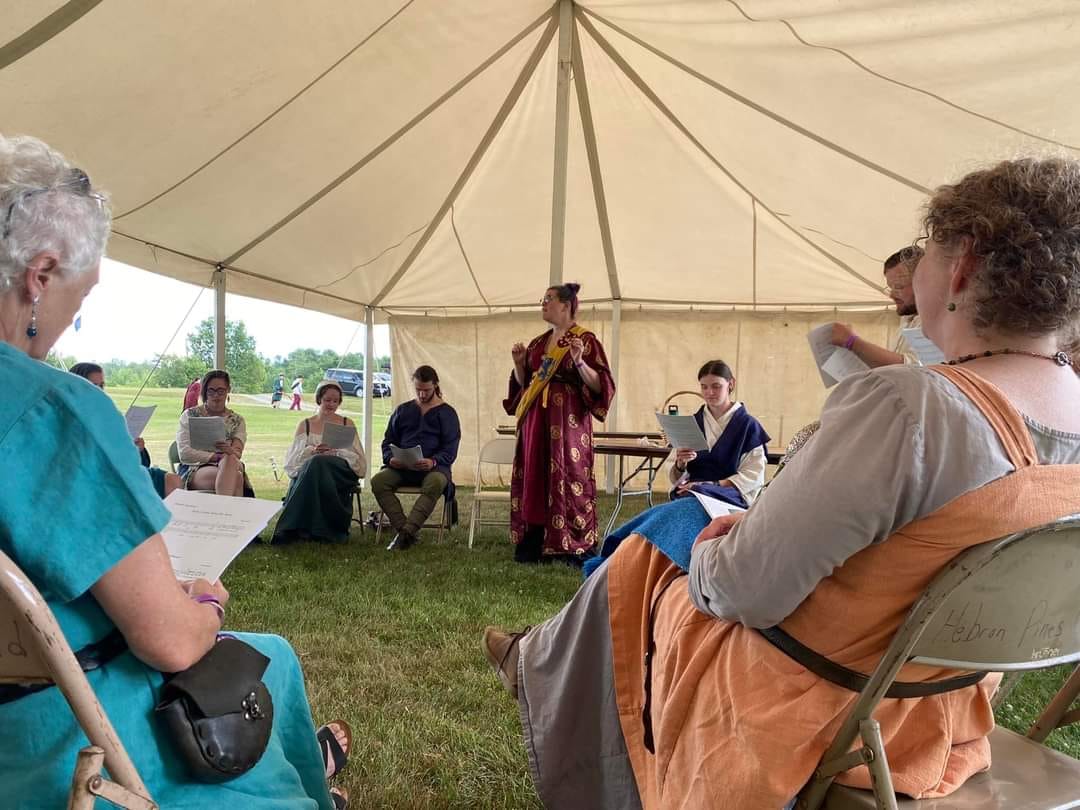
My first class was Friday for 12. I was presenting my ad hoc choir. This was not the best time for this class to be successful, but beggars can’t be choosers. We had a mixed skill level group but not much for vocal variety. Click below to listen to the group perform the piece they learned day of!

Edi be thu, heven queene

Sheet Music-Edi be thu, heven queene

Later in the day, I met with several performers who had an interest in the Bardic Arts. Aalina and I hosted a Bard round table to discuss questions, stories, fears and all in between. We had the full gambit of questions and I feel like the new generation of performers is strong and ready to flourish.

From there it was off to teach my son about the joys of service in the SCA. He is 9.5 so doing for others if somewhat foreign to him still. I ran off to retain with Their excellencies Stonemarche. I was given a plate of delicious items to share with the Deed gallery. There was nor formal gallery this year so tasty treats for all!

Saturday I started my day in morning court, seeing folks celebrated and then off to my final class. I did my rounds class. This class had originally been inspired by Aneleda Falconbridge. I had taken it over when she was elevated to Laurel. It had started as her labor of love and I have been continuing it. Inspired by this I have been putting together a book of all period rounds. It is a work in processes, but I hope it will continue to be a tool that folks will use to keep singing in a safe space.

Rounds Book compiled by Solveig Bjarnardottir

Here is a small recording of the folks singing in my group. This song is originally in German, but I am using the English translation with my students.

Music Alone Shall Live

The rest of the time in between was a blur until court. Previously, I had been asked if I would serve as an alternate on the A and S team. This was an absolute honor. I didn’t put much thought into it, but it has really kick started my desire to go into further documentation with my pieces. However, look at this group of amazing folks!!!! I am so excited to do this. Look out Pennsic. More to come on that post Pennsic.

Last but not least, for Saturday, my love was to be recognized in court and become a Lord. Wolfgang was to receive his silver brooch. I have a mold of the silver brooches I had made before. if you look back in past posts, you can see what they look like. However, this time, to make his special, I enameled it for him so it represents the heraldic picture of the award. That night, my house mate was being being apprenticed and I had the joy of heralding him and wandering camps to sing and do Bardy things. Just a good ol’ shennaniganless night. Irish coffee without the irish and songs for old and new friends.

Sunday was pack up day. The saddest day of all. Sure, it was hot and gross all weekend, but this is where my heart lies. As I was packing up, some old friends from Malagentia asked if I would mind mentoring their child in Bardic Performance. I was honored and moved. I have watched this amazingly warm human grow and nothing would give me greater honor. I cried back in camp. This… this was my passion, my joy. To bring bardic to the world, be safe and be a teacher. I cried for joy. We drove home…. washed off the GNEW tan and that was the end of this tale.

This year was different….

This year was different. I just couldn’t get out of my own way. 2 years of virtual performance just aren’t the same. I hadn’t been focusing on my music as much as I should have and the passion for competition didn’t light the flame underneath me. This was the first year I just didn’t feel like competing, but I knew it was good for me. So, I continued on. I had originally picked my repertoire, believing that this year would be like the last 5 where I would have to do 1 piece that was SCA appropriate, 1 piece that was period and the final round would be the crowns whim.

It was announced 6 weeks prior to crown bardic that there would be a theme. “War”. War was not really something that was comfortably in my repertoire. Sure, I like to make people sad like anyone else, but the war in the Ukraine had really put a damper on my soul. I needed to rework my plans for competition this year.

My head had tossed and turned about my first round piece. I wanted to tell a story. Folks don’t really know me for my story telling skills. They mostly know me as a singer. I had originally thought about telling the story of beginning the great unification of Japan. Our King, Ryou, based his persona off of Oda Nobunaga, who was one of the 3 unifiers of Japan. I thought that may be really neat. However, my addled brain just couldn’t bear to add new repertoire to it. Also, finding the right way to keep Oda Nobunaga in a positive light was evading me. So, I chose to tell a humorous tale. It wasn’t period, but it was SCA appropriate. I told the story of “How I caught the red dragon”. It was a strong way to start/finish round 1 and vastly different than anything my other competitors would be doing.

I chose for round 2 to do a completely persona accurate piece. I found a landsknecht piece called “Unser Liebe fraue”. My persona is a Trossfrau who would have traveled with the soldiers as they marched off to mercenary jobs.

The final round would be up to the crown.

The weeks passed and every day I asked my husband if I should still compete. It would put a damper on our house remodeling and also would limit my ability to care for our son at events. Every day he encouraged me to continue on. So, I did.

The bardic community is tight here in the East. We are all friends and there is no ill will towards anyone. We spoke often and I would see who would be joining me at Roses. The numbers were low. It was tough hearing the numbers that low. Daily they ranged from 3-7. Would it feel awful if I didn’t win? Would I feel awful if I did win? Did I deserve it? It’s so many feelings rushing through.

Day of came.

I had my community behind me. Again, nothing seemed like it was as it should be. I donned my German, which was my armor and off I went. My husband was trying to MIT for archery so I went alone.

I saw familiar faces. We hugged. We chatted. I found a new face. I welcomed her as I had never even met her before. She was one of us today. I don’t care what her skill level is. She would be one of us.

The day started with Anne de Basillion heralding us in. It was so cool to feel special. To feel like our championship, though small as it was, mattered.

Round 1 went off with out a hitch. A minor hiccup, but nothing I would call a mistake. I was pleased with my story. It’s not for everyone, but I made folks smile.

Round 2… thats another story. I had forgotten half of the words. I didn’t stop. I made them up as I went. This was a skill I picked up in college. Fake it till you make it. No one seemed to notice. Not even the judges who I had presented a copy of the text and translations to. WHEW.

The finals. We all went to the finals since there were only 5 of us. TRM picked my Ladino piece. I got to geek out and talk about my deep knowledge of ladino, a dead language and sing a beautiful piece of love and loss. I got to chit chat about batties and the macabre. I got to feel a bit more whole about my love.

The day was long, but over. I missed my Bardic family. I missed Agnes who was home with Covid. I missed the hugs and camaraderie that is our community. It was small, but we protected one another during each round. We were family.

We were each gifted a favor from HrRM and Agnes sent us all bracelets. I did not receive one from my sister. She only sent 4 and there were 5 of us. I was gifted a special one from Aneleda Falconbridge. This had a history.

Then… court happened. Sovereigns champion was named as Leyli Shirazi. This was the new to me bard. New to our community. She was magic and it was an absolute delight seeing her called up.

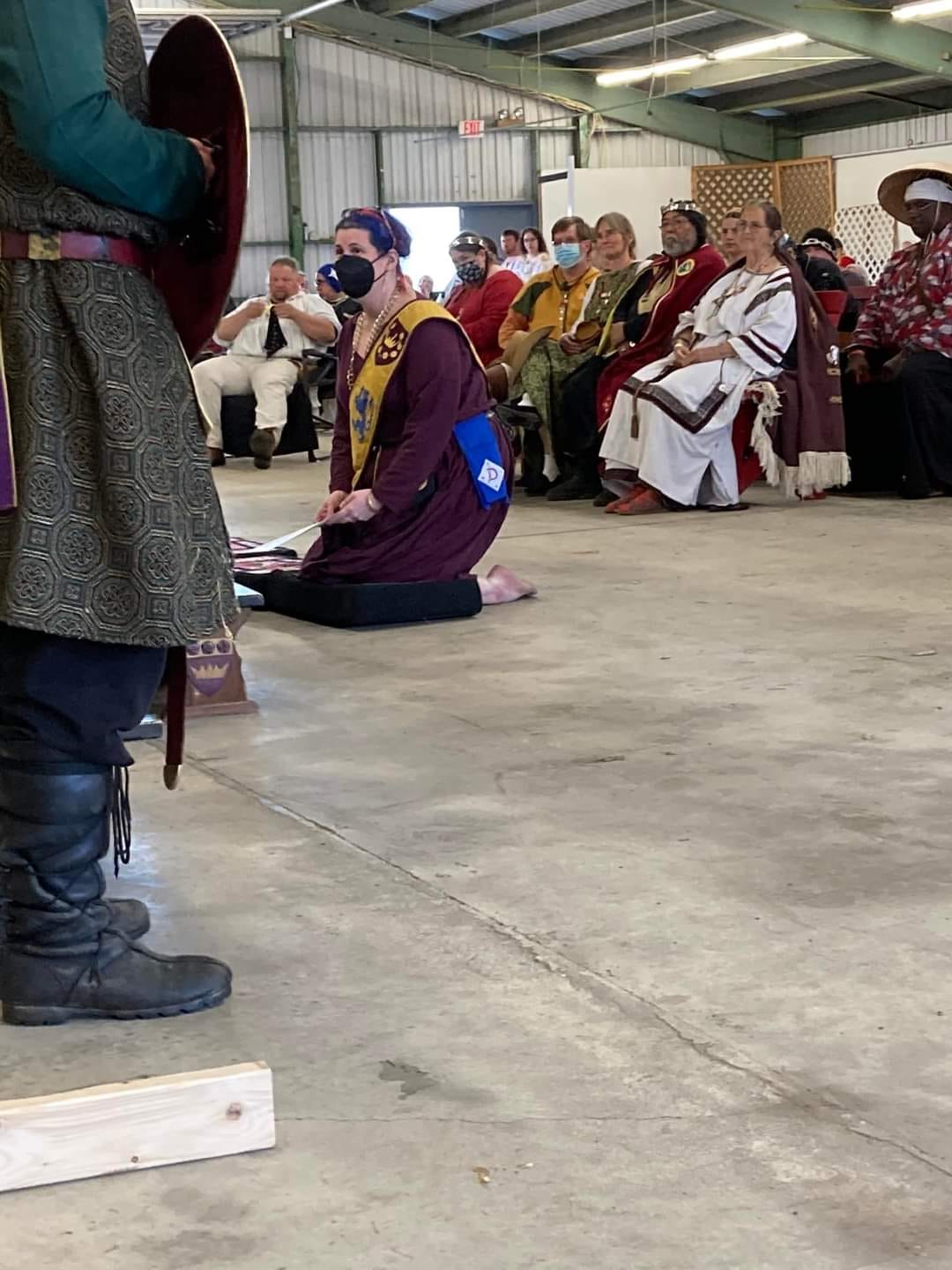
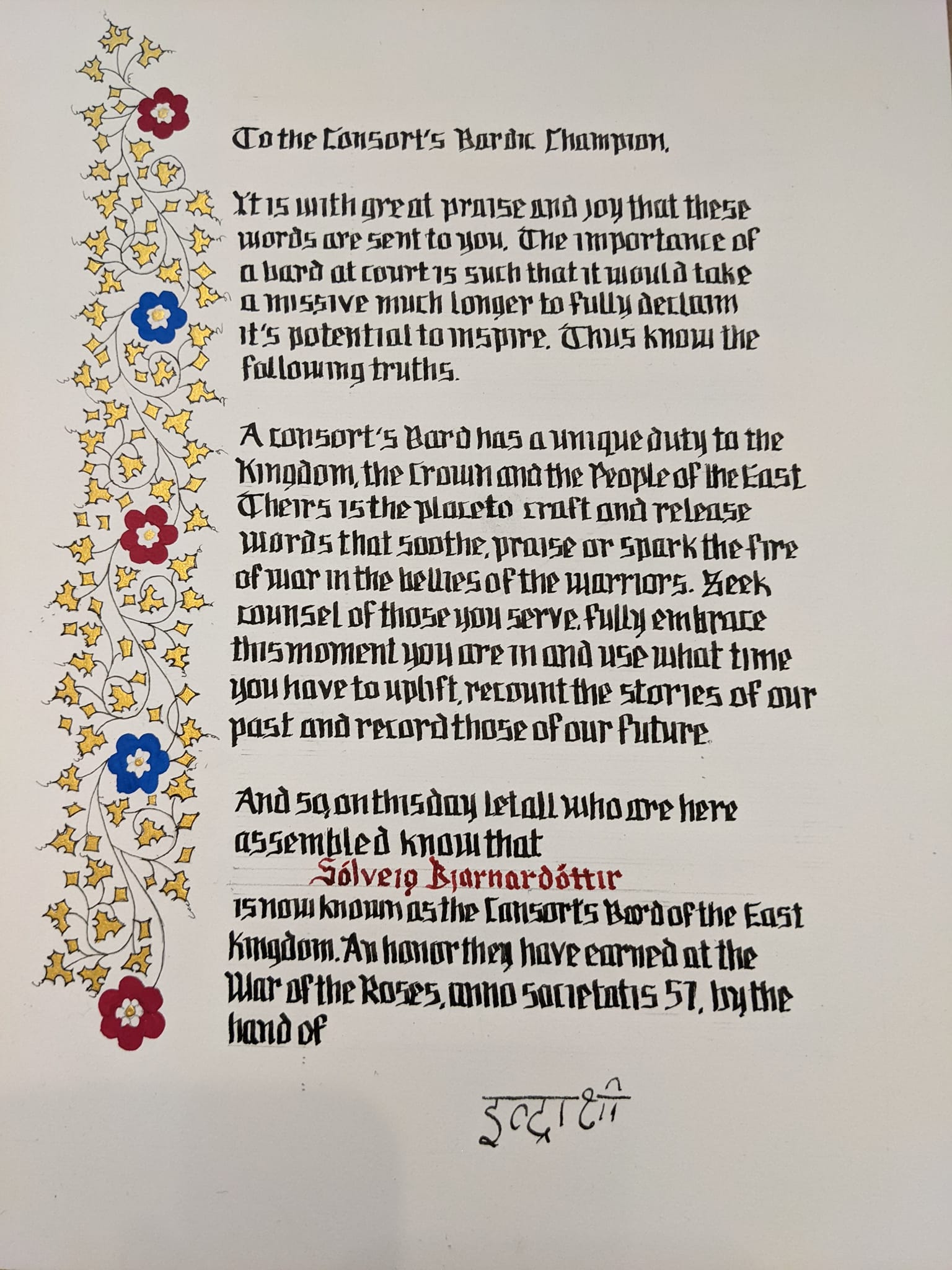
Then, this happened:

After my name was called, I stood there, dumbfounded and hid behind the court banners for the rest of the night. This was something I had been working towards since 2015. It finally happened.

A More Challenging Assembly

You would think after the 3 prior years of running this event, it would be easy as cake. The problem was that the 3 previous years had all been different. Covid-19 is still raging on and that lends itself to many other challenges.

In the first year of the challenge assembly’s inception, it had a large location in an area that was well accessible by many of the performers in the region. Bringing it up north had it’s own challenges. EKCOP has no money of it’s own, so we would need to find a sponsoring location. Luckily, Stonemarche had some extra money in the coffers and could offer us a sum to run this event. Finding sponsors for the challenges was another item as folks were unsure how their challenges were going to be taken and how they would view them.

This year, I was able to have 18 sponsors of 20 unique challenges. Next, getting folks to travel to New Hampshire and be willing to perform. We still had the requirements of masking indoors and performing outside would pose a challenge as there was a baseball game booked on the same grounds we were using. Can’t really complain considering the site was only charging us 75 dollars for the day. In addition we had to figure out how much food to feed people for day board and how we could encourage folks to teach.

The performance community in Stonemarche is decently sized, however, covid was making this all difficult. All in all, we had 43 attendees and actually made a profit of a little more than a hundred dollars for the day and this with charging folks the least amount we possibly could. We also had 12 amazing classes ranging from singing, story telling, history of stories and insturmental. The videos will be up soon… I hope.

Know World Courtesans Performance

Digital performance is still new grounds for me. I don’t have much space in my living zone right now. Covid has made it worse and using a web cam with a nice microphone is weird. Ideally, I’d have a backdrop or be outside. This is a performance where I am comfy sitting in a chair in my garb. There are ways that I am able to provide good timber, but the lack of a live audience really changes the mood.  I don’t have too many thoughts on this at the moment, but i wanted to share that digital art can still exist.


Crown Bardic

Delaware is far! I live in Maine, currently. In order for me to get to Delaware alone I need to fly. I don’t really feel like driving 7-8 hours *without stopping* alone so an airplane it is! Shoot, this is school vacation week as well… Cheapest plane ticket round trip is $300 (still cheaper than driving based on gas, tolls, oil change, wear and tear on tires etc). Oh well. Worth it. Usually tickets are around $150 round trip. Oh man! It’s also my Birthday. Welp, what a better way to spend your Birthday than around friends making music. NAILED IT.
I flew down to spend some time with my Laurel 2 nights before. Her advice and mentorship are always invaluable.
I had spent most of the day when I had silence in the house rehearsing my pieces. It was a luxury to have high ceilings versus my small apartment where I can’t even sing out due to this thing called neighbors. I also hadn’t had much time to practice in front of peers except for at 12th night. I ended up skyping with a few of my trusted friends and fellow performers for feedback. Not only on the performance itself but on my intros. Performance is not just the piece itself; it’s about setting the scene. You want everything to flow and be connected.
The night prior to competition I was surrounded by fellow competitors… no.. friends. That is a better word. Sure, we were in competition with one another, but one of the best things I love about my community is the love and support we share for one another. We all possess several special talents and none of us are the same. It’s a gift that we have such a variety of folks to learn from.

mlady
Day of. Up and at em! A hearty breakfast of nothing but protein to make sure nothing would go awry in my stomach. I made to hydrate well. You should always begin hydrating the night before or you will be playing catch up all day. Your bladder may also decide it needs tango lessons. I was greeted by familiar and nervous faces. Stage fright/competition fright never goes away. It’s something we all still cope with from time to time. It’s not even that we are afraid. It’s that we want something immensely and if something doesn’t go perfectly, you may be upset with yourself. I do try to point out to anyone that art should not be perfect. It should never be the same each time. It should never feel the same each time. I always try to find something new in a piece every time I perform it as well.
Anyways, Birthday wishes rolled in and it was time to begin. My first piece I chose was brand new repertoire to me. No one except for those I rehearsed in front of had every heard me sing it. IN fact, although it was a late period piece, most people had never heard of it.
Here is round 1:

Francis Pilkington (ca. 1570–1638) (The First Book of Songs or Ayres of Four Parts, 1605). This was originally set as a Madrigal. Each verse of text consists of the entire musical work, which then repeats back to the beginning with each consecutive stanza. Internal repetition starts with the nonsense syllables “Lulla, lullaby” to create an unbalanced binary (ABB) form. As such, the rhyme scheme, ababcddc, is divided at the “fa-la chorus,” splitting each octave into two quartets. Pilkington also altered meter between these quartets to create melodic and rhythmic variation

https://drive.google.com/open?id=1PhNWh6t2eObdYBc9C2S-TxtNp3VoG3sH
Rest, sweet nymphs, let golden sleep
charm thy star brighter eyes
Whilst my lute the watch doth keep
in pleasing sympathies.
Lulla lullabye, lulla lullabye,
Sleep sweetly, sleep sweetly,
let nothing afright ye,
in calm contentments lie.
Dream, fair virgins, of delight
and blest Elysian groves
while the wandering shades of night
resemble your true loves.
Lulla lullabye, lulla lullabye,
Your kisses, your blisses
send them by your wishes
although they be not nigh.
Thus, dear damsels, I do give goodnight,
and so am gone;
With your hearts’ desires long live,
Still joy, and never mourn.
Lulla lullabye, lulla lullabye,
Hath pleased you and eased you,
and sweet slumber seized you —
And now to bed I hie.
Lulla lullabye, lulla lullabye,
Sleep sweetly, sleep sweetly,
let nothing afright ye,
in calm contentments lie.

Brief biographical sketch of Francis Pilkington in the Grove Concise Dictionary of Music, 1994, Oxford University Press.


I never expect anything regarding moving on. You never know what the judges and the royalty are looking for in their champions. Everyone has a different taste to what they like and they don’t like. The first round was over and I swallowed hard waiting to find out if I had made it to round 2. I did in fact make it to round 2.
I chose a new strategy this. I chose pieces that made me happy and highlighted what I liked to sing. I chose a Dowland piece. If you know anything about me, I love to sing dark pieces. I like to make people feel. I chose Flow, my tears.

Here is round 2:
Flow, my tears” is a lute song (specifically, an “ayre”) by the accomplished lutenist and composer John Dowland (1563–1626). Originally composed as an instrumental under the name “Lachrimae pavane” in 1596, it is Dowland’s most famous ayre,[1] and became his signature song, literally as well as metaphorically: he would occasionally sign his name “Jo. Dolandi de Lachrimae”.Like others of Dowland’s lute songs, the piece’s musical form and style are based on a dance, in this case the pavan. It was first published in The Second Booke of Songs or Ayres of 2, 4 and 5 parts.

https://drive.google.com/open?id=1PfSHXUg3tdK9qSFg_paP3opxdZHmDlYl

Flow, my tears, fall from your springs!
Exiled for ever, let me mourn;
Where night’s black bird her sad infamy sings,
There let me live forlorn.

Down vain lights, shine you no more!
No nights are dark enough for those
That in despair their last fortunes deplore.
Light doth but shame disclose.

Never may my woes be relieved,
Since pity is fled;
And tears and sighs and groans my weary days, my weary days
Of all joys have deprived.

From the highest spire of contentment
My fortune is thrown;
And fear and grief and pain for my deserts, for my deserts
Are my hopes, since hope is gone.

Hark! you shadows that in darkness dwell,
Learn to contemn light
Happy, happy they that in hell
Feel not the world’s despite.

Boden, Anthony. Thomas Tomkins: The Last Elizabethan. Ashgate Publishing Limited, Aldershot, England, 2005. ISBN 0-7546-5118-5

Deep

Round 2 had finished. I had made it to the finals the year prior so it was possible I could do it again. I was very blessed to be surrounds by folks around me who were able to hold my hand and support me. Then, I heard it. My name was called? MY NAME WAS CALLED. Oh man… I’m so glad I always have my Bard book on me as a quick reference.
What would the challenge be? What would they have me do? Then, I heard it. “Bring your best”. I quickly ran to my Laurel looking for sagely wisdom. We talked through options. What would make me feel best? What can I emote that shows me off the best? I know I have talked about this piece immensely ad nauseum, but it is never too late to bring out an oldy but a goody. I brought out Amarilli, Mia Bella by Giulio Caccini ( 1551-1618). I also made the specific choice to perform all period acceptable pieces. Although the SCA typically cuts off at 1600, music, due to documentation has been accepted as extended through 1650. I gave my heart to the world as I was the first competitor. I sat and listened to my friends do their things.

Finalist
Here is round 3:

https://video-lga3-1.xx.fbcdn.net/v/t42.9040-2/87452238_1017316311985156_1025122008230264832_n.mp4?_nc_cat=110&_nc_sid=985c63&efg=eyJ2ZW5jb2RlX3RhZyI6ImxlZ2FjeV9zZCJ9&_nc_ohc=KK8jo3K1gzIAX-WSQc3&_nc_ht=video-lga3-1.xx&oh=570b8b2703a3400853f6cdfca12eec45&oe=5E9A28FD

Again, I was not one of the victors, however, in my heart I won. I learned new pieces, I got to see friends grow, meet new performers and I would say this was the best birthday of my life.

It was the best of times; it was the 12 night of times….

Long island! You are a bit of a haul from Maine. 12th night is one of the most exciting social events of the SCA. It’s usually encompassed by the best garb, amazing food and music! Oh no! Music!!! Twist my arm!
I am fairly close with both Royale Bardic champions, so we communicate a lot. I had found that they had an entire track of music for the day. My heart sung with glee. At first, I thought of what I could sing? Would this be holiday related or just my usual run of tracks. Then I had a stunning idea. The adhoc choir would get a chance to finally get their first real performance!
I sent out an email about 3-4 weeks prior to and got a good feeling of head count. There will always be last minute stragglers, people who aren’t on the lists and people who don’t make it. That’s ok! It’s life and it happens. When I figured out there was enough interest, I reached out to the Event Steward and asked if I could kidnap a space for 90 minutes to learn and run 20-25 minutes of music. He agreed!
Next, the music choices came out. During holiday season, we all want to spread cheer no matter what faith we have or don’t have. It’s a great way to bring the community together. I went through and picked out 7 period and traditional pieces. The Boards Head Carol, Ah Robin, Dona Nobis Pacem, Gaudete, Gloucestershire Carol (Traditional, not period), Here we come a wassailing (Traditional) and The Holly and the Ivy (plausibly period). Due to the nature of documented music for vocalists, it can be a challenge to find pieces that were secular in nature and at the skill level of the performers I am working with. I think this diverse set of pieces would give them some challenge as well as some easier pieces to rely on. I even chose to give out a couple Solos to the performers who wanted to try their hand at it.

Choir
I didn’t hold auditions for various reasons, but the primary reason is opportunity. When you are a full-time performer, you tend to get more opportunities to perform as a soloist. The more skill you had, the greater the chance. Most of these folks are all volunteers who just liked to sing or sang in chorus in high school and that was their last real opportunity to sing. Some don’t even read music. That is just fine. Everyone gets a chance if they want it with me.
After rehearsing the pieces, couple of soloists asked for additional help. One expressed concern on rhythm/notes and the other with the language itself. I worked with each for an additional 20 minutes and by the end, they both felt very confident and ready to perform.
About 1:00 it was their time to shine. Each of them stood proudly in our vocal horseshoe, ready to do a thing. They sang their hearts out with joy. Not even one of them seemed nervous. After about 25 minutes of performance and several pictures being taken, we were approached by a couple of patrons. The one comment that really stuck with me was this: “You made me feel like I was truly immersed in a 12th night feast. The music, the madrigals… I was there. Thank you” and she handed each one of my performers a token of gratitude. Were the pieces perfect? No. Were they enjoyed by all? Yes. Both singer and bystander. My heart flowed for each and every one.


Choir 2
I had my own set later. I used this time to work some of my Crown Bardic pieces to get them in front of an audience, because they were new. One of the pieces of advice I give to all of my performers I have every worked with both solo and group is to make sure you get to perform a piece in front of as many people as you can before you go for the gold. My middle schoolers would have an assembly in front of their peers before they sang for their parents that night. What this does is prepare people ahead of time and make it old hat instead of new and shiny. This is also done with professional performers as well. They have full runs and open dress rehearsals to get feedback from the audience. So, this is done by all skill levels.

Solo
The rest of the night was food and merriment as well as serving my amazing queen. In my free time I have been retaining whenever possible. I helped pack up for the night and home I went. I even got to participate as a mummer in my dear friend’s performance during open bardic performances.

Mummers

The Boar’s Head Carol was first published in English during the 1520’s in a book entitled Christmase Carolles Newly Emprynted at London in the flete street, which was written by Jan van Wynken de Worde.
“Boar’s Head Carol”. Christmas-Carols.org.uk. Archived from the original on December 28, 2009. Retrieved December 8, 2009.
William Cornysh (1468-1523)

Cornish. William. Ah Robin, Gentle Robin. Edited by Alberto Gomez Gomez: 2012.
Encyclopædia Britannica Online, s. v. “William Cornysh,” accessed February 10, 2014, http://www.britannica.com/EBchecked/topic/138138/William-Cornysh.
“Dona nobis pacem” (Ecclesiastical Latin: [ˈdona ˈnobis ˈpatʃem] “Grant us peace”) is a song with Latin text, often sung as a canon or round (where each section starts with a new voice). It is the invocation to the Lamb of God to have mercy and grant peace to the worshipers. It is said to have been introduced into the Mass by Pope Sergius I in 687,

Gaudete ( “rejoice [ye]” in Latin) is a sacred Christmas carol, thought to have been composed in the 16th century. It was published in Piae Cantiones, a collection of Finnish/Swedish sacred songs published in 1581. No music is given for the verses, but the standard tune comes from older liturgical books.

The Holly and the Ivy was first published in a broadside dated 1710 and have have originated somewhere in the Cotswolds.
The Holly & Ivy; Twelve Articles. Birmingham: D. Wrighton. n.d.

A whole new world!

Pennsic is a home for many people who may not be as active in the SCA as they’d like to be. For those who are ridden with anxiety, even this town of 12,000 humans who inhabit here for up to two weeks can be a safe haven. For some, it can also be a place where dreams come true and things you would never have done can be realities… so also, dreams coming true.
This was Pennsic #2 for me. Riding solo but still having a group to camp with has been amazing. Mermaid’s song is a group of Bards and Fencers and yes, there is crossover. I arrive and set up my tent hastily. I made a new friend as we had new camp mates. Atilla was kind and welcoming and helped me set up my tent, hastily as, in true Solveig fashion, I have overbooked myself and I don’t really know how to say “no” yet. I’m working on it. With that, I was off to my first Pennsic experience for the year.
Hastily dressed I ran up the hill (Yes, that hill. I live in the bog) to the amphitheater. There was a non-English concert set up to happen. Sadly, there were no spectators, but I think that it made it less of a concert and more of a song sharing session. There were familiar faces and new faces. One face I had seen at this gathering was Heather Dale. For those of you who don’t know Heather, she is an SCA super star and professional touring artist with 20 CD’s available for purchase. It’s like meeting Robert Downey Jr. or any large Hollywood legend. I had met her previously the year before as I was part of Drake Oranwood’s concert which opened for Heather. I didn’t expect her to know or remember me as it was just a glance meeting, but low and behold, like a normal person, she greeted me, said hello and *gasp* remembered my name. I’m terrible with names. Clearly, she was not. I tried to withhold my awestruck words and tried to treat her as a normal person. I -believe- I succeeded. It was eventually my turn and I chose not to sing my best pieces. This was a chance to show languages. I pulled out an old piece I really should memorize.

by Ludwig Senfl (1534, German)
Es Warb Ein Schöner Jüngling
Es warb ein schöner Jüngling
über ein breiten See.
um eines Königes Tochter,
nach leid geschach ihm Weh.

Ach Elselein liebes Elselein mein,
wie gern wär ich bei dir!
So sein zwei tiefe Wasser
wohl zwischen dir und mir.”

“Das bringt mir grossen Schmerzen,
herzallerliebster Gsell.
Redich von ganzem Herzen
Habs für gross Ungefäll.”

Hoff, Zeit werd es wohl enden,
hoff, Glück werd kummen drein
sich in alls Guets verwenden,
herzliebstes Elselein!”
Once there was a handsome young man
from across a wide sea.
Pursuit of a king’s daughter
led him to great sorrow.

“Oh Elselein, my dear Elselein,
how I long to be with you!
But there are two deep waters
between you and me.”

“That brings me great pain, my
dear friend.
I say wholeheartedly this is
great misfortune.”

“Have hope that time will end this.
Have hope that fortune will change.
Have hope that all else will fall into
place, beloved Elselein!”

The rest of the first evening was pretty low key afterwards. Bird the Bard and I spent the rest of the night singing into the hours.

Day 2! Saturday! Low key day as well. Several months prior to I had been asked if I would sing at the East Kingdom/Midrealm invitational Bardic. This was -HUGE-. This is a display of the best/up and coming Bards the kingdoms had to offer. There was no competition involved, just performance. It was certainly quite the show. I had chose to do Amarilli, mia Bella. This piece has a lot of emotional attachment to me as it’s a piece of music I have been doing long before the SCA.

Amarilli, mia bella,                 Amaryllis, my beloved,
Non credi, o del mio cor,       Do you not believe
dolce desio,                           Sweet desired one,
D’esser tu l’amor mio?           That you are my love?
Credilo pur:                            Believe only this:
e se timor t’assale,                 And if fear assails you,
Prendi questo mie strale        Take one of my arrows
Aprimi il petto.                        Open my breast
e vedrai scritto in core:           And see written in my heart,
Amarilli, Amarilli, Amarilli        Amaryllis, Amaryllis, Amaryllis
è il mio amore.                       Is my beloved.

Guilio Caccini (1551-1618). Composed in 1602 and the text was by Alessandro Guarini . Written before the development of the pianoforte (which was invented in 1700), “Amarilli, mia bella” was meant to be accompanied by the lute, which lends it a particularly intimate and hauntingly beautiful atmosphere. Even the words evoke an earlier time—the line, “Prendi questo mie strale” (take one of my arrows) evokes images of bows and arrows. Any performer of “Amarilli, mia bella” will want to sing with a hushed sotto voce (soft singing) throughout with exquisite legato phrasing.
Who decided that waking up prior to 12 on a Sunday was a good idea!? Oh wait… it was the best time for people to meet. ***SIIIGHHHH**** It was time for the EKCOP annual Pennsic meeting. Honestly, I think it was a really constructive meeting. I’ve been the deputy Chatelaine for almost a year now and It was really nice to see how our work has been going and what people had to comment on it. At this meeting I was nominated for Chancellor. I, however, was floored seeing the unanimous vote for my nomination. I know I really care about this group and making performance a safe and tangible place for others, but I never thought my work had gone this noticed. The rest of the day was spent celebrating other delightful musicians such as Cedar Barefoot and the Queen’s Bard, Laila (celebrating her birthday).

Monday was spend rehearsing for our concert on Wednesday and Pirate debauchery at night. Bird has spent many years as a Shantyman. I have always enjoyed a good shanty, but have never thought much about singing them. I was a bel canto singer. We sing pretty. Shanties are for the rough and tough pirates and seaman!!! (Get your head out of the gutter). However, I felt like getting out of my comfort zone. Roll the Old Chariot Along was my song of choice and belting was my game. Mind you, belting is -not- my forte, but the belting muses hit me in the face like a sack of flour. WHOA where did that sound come from!!!!??? I was elated that my voice was continuing to mature. For those of you who don’t know, you go through several vocal puberties during your life. The bigger and darker your voice is, the longer it takes to mature. Mine, according to my voice teachers from college, would be done around age 35. Joy! I digress.

Tuesday was more laid back… I think. Around 11 or so, Bird and I climbed up the brewer’s road hill, filing everyone’s favorite past time song, “Baby Shark”, to motivate us in the intense sun. We eventually made it to our family gathering where the Bard Yard could just relax and enjoy each other’s company. My Laurel and all connections to her, have become some of the most supportive and people in my SCA life. I’ve talked about brain weasels before. They continue to persist. Having a family like this as a performer is essential for building that skin up. I wouldn’t change anyone in this group for the world. Later that night, Bird and I had donated a concert to the royal travel fund. We made our way into the camp of the winners. It was a very “dry” setting despite the alcohol freely flowing. Everything from period pieces to ruckus was performed for an hour. I’m not sure how I felt about this, but I was later told that it was enjoyed. Sometimes, it’s nice to just perform and not peacock. Getting to sing/perform your non forte pieces is a relief sometime.

Wednesday! Oh man. This. This is what you’ve all been waiting for! This would be the day when we would strut all our stuff. I say we, because Bird and I were inseparable this whole war. It started with a very prestigious performance. We had been invited to perform at queen’s tea. That is the big time. Only the “right” performers got to do that. It’s a very specific setting where you are background, not the center of attention. To be invited to perform for this meant you knew how to be unobtrusive, appropriate and a good performer. Bird and I also used this as a warmup for our concert…. Which was 2 hours after. The pieces performed will be discussed after. We were presented a few tokens from attending queens and thanked for our service. It was super magical. It really felt like I was a hired performer in ye olde times… despite some of the modern accouterments. From there, off we went to present, for the first time ever “Song Byrds”. Originally this was supposed to include Collete la Trouvere, however, life happened, and it was just Bird and I. We spent a good amount of time trying to break the concert in to 3 sections that would compliment one another. The first was all period pieces, the second was SCA appropriate/Filks and finally original compositions.

Below is the concert in it’s entirety. Enjoy!

This was the best week of my life, filled with so much song. I regret not being able to perform at the Opera dell’est concert as my voice was shot from the war, but I do not regret having all the opportunities to sing. This only fire up my need to perform more, but I made more connections and started digging for more repetoir!
On an unrelated note, I did meet up with a super amazing lutenist and got to jam to some Dowland with her.

Everyone loves a challenge, even EKCoP!


This weekend was the East Kingdom College of Performers Challenge and Schola down in Iron Bog. This was a little bit of a schlep for a day event, but I am so glad I headed down. This is the first time we’ve done something like this in the East Kingdom. It was a day of classes and challenges. You did not have to master anything to be a part of it, but you would have to be willing to step out of your comfort zone.

With that said, it was a challenging, but positive day over all. I started the day right away with running a rehearsal for the newest addition to the East Kingdom College of performers, Opera D’el Est. The day, however, started more frantically than I hoped it would. Our one and only alto wasn’t able to come. So, I guess I’d sing her part and hopefully make it work. Then, 1/2 of the performers, who were traveling in the same vehicle, were about 45 minutes late (however, due to no fault of their own. Between traffic and weather).

Rehearsal did not go as planned, and that’s ok. We were fighting a lot of odds between company distances, time we had to prepare music and we are a new group. This happens. Everyone had agreed to give up part of their lunch time to meet again for additional rehearsal.

I met with some of the other vocalists after for some one on one help. From there, I whirled into some recorder site reading, which I really haven’t picked up a recorder since 2009… when I graduated college.  Not only did I remember some things (Which was huge) I got to encourage 2 more of my friends to come join us. We went from 3- 5! So many tooty flutes!

From there, off to run a class. I have taught this class a couple times prior, but I think this iteration was the best version of the class. I am passionate about making sure performers are well warmed up for performance whether is be Singing, story telling or even heralding.  If the body -and- mind are not there, then your performance will suffer. This iteration of the class discussed anatomy, posture, breathing, the parts of your body that make the sounds, projection and location of sound. I had 6 folks join my class of varying experience and age. Everyone seemed to get something new from the class and was able to apply it. Once of the gentleman in the class, who I performed with later in the day, said that it was a comprehensive warm up and encouraged others to do so. This was encouraging.

From there, a very abbreviated lunch and round 2 of rehearsing. This time, the section which the group seemed to be struggling with, seemed to lock in. Though, no real way to test it until performance.  TO ADVENTURE!

From there, time to do another class! I have been bringing rounds with me to almost every event I teach at. They are a safe singing space for novice to master and bring joy. 8 folks at my rounds class. Everyone had a varying degree of expertise and it was delightful. There was a young lady, who doesn’t sing much, but her boyfriend does, who came to my class. She spoke to me afterwords, advising that she was over the moon since she got to sing. She felt the class was tailored enough that she could join in and not feel like she was slowing progress, but that she got to sing the songs and sing her part independently.

Whooosh! Off to perform (No, I have not sat down today or stopped for water). It was time for Opera D’el Est to make it’s debut. (See documentation, synopsis and translation below #1). The first piece we did was the Prologue from Eurydice. Despite some minor technical difficulties everyone who sang in that piece, rocked it.

We had a solo from our fearless leader and newest Queen’s Bard, Laila.

Then a solo from me! I died. I love dying on stage. I performed Laciate Morire from L’Arianna (See info below #2). I love death arias. I love dying on stage. To lament, there is no greater form of drama. See! Look, I’m dead… on the floor… singing the high stuff!

ded.jpg


We had a beautiful duet from Laila and Ethnye (Enya). Finally, the choral piece from doom.  A te qual tu ti, Euridice, Jacopo Peri. (Info below #3) It’s not that this piece was hard or anyone was untalented, it was just a perfect storm. This experience however taught me a new skill. I went to school professionally for singing. Everyone had hours to prep their pieces and weeks to learn music. This was not that. I learned that I should be happy with a product, that I had volunteers. I learned that my standard of performance is not a level for everyone. I don’t want this to come off as condescending. What I mean is that in fact, I should be proud of a group who came so far to even get this going. This was a huge success. Even if the music wasn’t perfect. LOOK AT THESE FOLKS! Look what they accomplished in such a short period of time.

Choir.jpg

From here, off to the challenges for the day. I stuck myself in a spot just to get out there and do something that I wasn’t necessarily skilled at. I wanted to work on something that wasn’t “Pretty” or necessarily polished. This is a huge fear for me because I was taught to never put anything out there that you weren’t proud of or ready to be recorded for the world. As a Bard, part of my learning is about bringing the news and the stories. They won’t always be perfect, but that is part of the creation and the reality.

The first piece I performed was “Twa Corbies”. This is a spoof written as a response to Raven’s Croft’s “3 ravens”.  (See the lyrics and translation of the low Scottish below).

Second, was a completely non period, but SCA appropriate story. I don’t know it’s title, but I shall call it “How I caught the red dragon”. I’m not really a story teller. I do it to challenge myself. Music is my muse. However, I always want to be able to entertain a room. Pretty singing isn’t for everyone. Sometimes, you just need to tell a cheesy story. So I did. I flubbed up some of the words. I didn’t provide enough gesticulations as I’d like, however, I made my goal. I told another story in front of an audience. I’m getting there.

Last but not least, I had the pleasure of presenting the new East Kingdom College of Performer’s Travel journal during the final court. Just prior to, I had sat down in quiet with one of my fellow performers today. She bled her heart to me. She spoke of her struggles and sorrows with today’s events. She exclaimed that she was embarrassed.  I shut the door in the room we were… expelling in. I explained to her that this was a new experience. Nothing wen right for any of us. She did well. Was it perfect, no. However, we will grow from good to better to best. I told her of my struggles with the day. That I was just her with 2 years more experience. I told her after the event we would connect and see how we could grow. It was then, I realized I would present the journal to her. She was my inspiration. She fell, she got back up. She is off running again. I could not be more proud of her.

I presented the journal, I shouted, “I”m free” and from court I left.

1)

Prologo: From  Eurydice BY Jacopo Peri, Composed in 1600. The composition is typically considered to be the second work of modern opera, and the first such musical drama to survive to the present day. (The first, Dafne, was written by the same authors in 1597.)

Since both the libretto and score were dedicated to the new Queen of France, Marie de’ Medici, some scholars have recognized a possible parallel between Euridice and Orfeo and the Queen and King of France. While the comparison is readily made, some scholars argue that the traits of King Henry IV are different from Orfeo, especially with respect to Orfeo’s most famous deed. Orfeo loved Euridice so much that he journeyed to Hell and back, quite literally, to unite once more with his beloved wife while King Henry IV wouldn’t travel as far as Florence to retrieve Medici.

Peri’s Euridice tells the story of the musician Orpheus and Euridice from Greek Mythology. According to myth, Orpheus was a great musician who journeyed to the underworld to plead with the gods to revive his wife Euridice after she had been fatally injured.

The opera begins with a Prologue delivered by a singer representing Tragedy.  She explains to the audience that she has not come this time to reduce them to tears with stories of sorrow, death and cruelty, but has changed her usual costume in order to awaken much sweeter emotions in the human heart.  Future artists may well follow in her footsteps, when the whole world admires what she can do in this changed form: the new queen whose wedding is being celebrated, she says, will be more garlanded with laurels than anyone ever was in ancient Athens or Rome.  She herself is going to dress up for the royal wedding, and while France prepares to receive its new queen, the wedding guests can relax and listen to the singing of Orpheus.

  • Hill, John Walter (2005). Baroque Music: Music in Western Europe, 1580–1750. Norton. ISBN 0-393-97800-1.
  • Oldmeadow, Earnest (1909). Great Musicians. Forgotten Books.

Io, che d’alti sospir vaga e di pianti
spars’or di doglia, or di minacce il volto
fei negl’ampi teatri al popol folto
scolorir di pietà volti, e sembianti.
Non sangue sparso d’innocenti vene
non ciglia spente di tiranno insano,
spettacolo infelice al guardo umano
canto su meste, e lagrimose scene.
Lungi via lungi pur da regi tetti
simolacri funesti, ombre d’affanni,
ecco i mesti coturni, e i foschi panni
cangio, e desto nei cor più dolci affetti.
Or s’avverrà, che le cangiate forme
non senza alto stupor la terra ammiri,
tal ch’ogni alma gentil ch’Apollo inspiri
del mio novo cammin calpesti l’orme.
Vostro regina sia cotanto alloro
qual forse anco non colse Atene, o Roma,
fregio non vil fu l’onorata chioma
fronda febea fra due corone d’oro.
Tal per voi torno, e con sereno aspetto
ne’ reali imenei, m’adorno anch’io,
e su corde più liete il canto mio
tempro al nobile cor dolce diletto.
Mentre Senna real prepara intanto
alto diadema, onde il bel crin si fregi,
e i manti, e seggi degl’antichi regi
del tracio Orfeo date l’orecchia al canto


I, who eager for loud sighs and tears, My face now filled with sorrow, now with threats, Once made the faces of the crowd in great theaters Turn pale with Pity

No longer of blood shed by innocent veins, Nor of eyes put out by the insane Tyrant, Unhappy spectacle to human sight, Do I sing now on a gloomy and tear-filled stage

Away, away from this royal house, Funereal images, shades of sorrow! Behold, I change my gloomy buskins and dark robes to awaken in the heart sweeter emotions

Should it now come to pass that the world admire, with great amazement, these changed forms, So that every gentle spirit that Apollo inspires will treat in the tracks of my new path

Yours, Queen, will be so much laurel, That perhaps not even Athens or Rome gathered more, an ornament worth of those honored tresses A frond of Phoebus between two crowns of gold.

Thus changed, I return; serenely, I, too, adorn myself for the Royal wedding, And temper my song with happier notes, Sweet delight to the noble heart

While the royal Seine prepares A noble crown to decorate the beautiful hair, and the mantle and throne of the ancient Kings, Listen to the singing of Orpheus of Thrace.


2)

This is from Arianna (1608), Arianna’s Lament, the only aria surviving from this opera, with text by Rinuccini. The manuscript survives in two copies: Manuscript Mus. G239, Biblioteca Estense, Modena, Italy and (in the handwriting of composer Luigi Rossi) as British Library Ad. 30491.

Ariadne’s sadness is a prime example of the effects of a man’s false words. In the myth of Theseus, her lover, he promised her a marriage in exchange for her aiding his journey to kill the Minotaur. However, Theseus soon abandons his bride-to-be, leaving her all alone to bathe herself in grief. She then became inspiration to many painters, sculptors, artists and musicians, mainly depicted weeping and in obvious despair.

Lasciatemi morire,
Lasciatemi morire;
E che volete voi che mi conforte
In così dura sorte,
In così gran martire?
Lasciatemi morire.

Let me die,
Let me die;
And what you would think could comfort me
In such a harsh fate,
In such a great martyrdom?
Let me die.

A te qual tu ti, Euridice, Jacopo Peri

A te qual tu ti sia de gl’alti numi
ch’al nobile pastor recasti aita
mentre avran queste membra, e spirto, e vita
canterem lodi ogn’or tra incensi, e fumi.

Se de’ boschi i verdi onori
raggirar su nudi campi
fa stridor d’orrido verno
sorgono anco, e frond’e fiori
appressando i dolci lampi
della luce il carro eterno.
S’al soffiar d’Austro nemboso
crolla in mar gli scogli alteri
l’onda torbida spumante,
dolce increspa il tergo ondoso
sciolti i nembi oscuri, e feri
aura tremula, e vagante.
Al rotar del ciel superno
non pur l’aer, e ‘l foco intorno
ma si volve il tutto in giro,
non è il ben nel pianto eterno.
Come or sorge, or cade il giorno,
regna qui gioia, o martiro.

Poi che dal bel sereno
in queste piagge umil tra noi mortali
scendan li dèi pietosi a’ nostri mali
pria che Febo nasconda a Teti in seno
i rai lucenti, e chiari
al tempio ai sacri altari
andiam devoti, e con celeste zelo
alziam le voci e il cor cantando al cielo.

Aurelio et Ludovico Osanna, Mantua, 1608. Publication of the text included in Federico Follini’s report of the 1608 performance

G. F. Gundulić, Ancona, 1633. Croatian translation, prepared for possible performance in Dubrovnik c. 1620. (5 scenes version)


L’Arianna (English: Ariadne) (SV 291), composed in 1607–1608, was the (now lost) second opera by Italian composer Claudio Monteverdi. One of the earliest operas in general, it was first performed on 28 May 1608, as part of the musical festivities for a royal wedding at the court of Duke Vincenzo Gonzaga in Mantua. All the music is lost apart from the extended recitative known as “Lamento d’Arianna” (“Ariadne’s Lament”). The libretto, which survives complete, was written in eight scenes by Ottavio Rinuccini, who used Ovid’s Heroides and other classical sources to relate the story of Ariadne’s abandonment by Theseus on the island of Naxos and her subsequent elevation as bride to the god Bacchus.

The opera was composed under severe pressure of time; the composer later said that the effort of creating it almost killed him. The initial performance, produced with lavish and innovative special effects, was highly praised, and the work was equally well received in Venice when it was revived under the composer’s direction in 1640 as the inaugural work for the Teatro San Moisè.

Rinuccini’s libretto is available in a number of editions. The music of the “Lamento” survives because it was published by Monteverdi, in several different versions, independently from the opera. This fragment became a highly influential musical work and was widely imitated; the “expressive lament” became an integral feature of Italian opera for much of the 17th century. In recent years the “Lamento” has become popular as a concert and recital piece and has been frequently recorded.

Scene 3

Arcetro recounts that while Orfeo lay weeping, Venus, goddess of love, carries him off in her chariot.

To you, what are you of the high ,
That to the noble pastor recasts
While these members have the spirit and life
Singing praises each between incense and fumes.

If of woods the green honors
Brawl on bare fields
Make gasps of horrid
Battle still, and frond’e flowers
Prepare with sweet flashes
Of light the eternal cart.

Seal and blow of Austro nervously
collapses into the sea, the rocks alter
the murky wave sparkling
Sweetly purse back wave
Melting the dark clouds and wounded
Aura flickers, and rambling.

At the top of the sky excees
Not just the air, and the fire around
But it all turns around
It’s not the way, in the eternal cry
How the day or the day falls
Reigns here joy and martyr.

We raise the voices and the heart singing to Heaven


Here is a copy of the music:

Click to access asc001b.pdf

Prologo – Euridice

A te qual tu ti