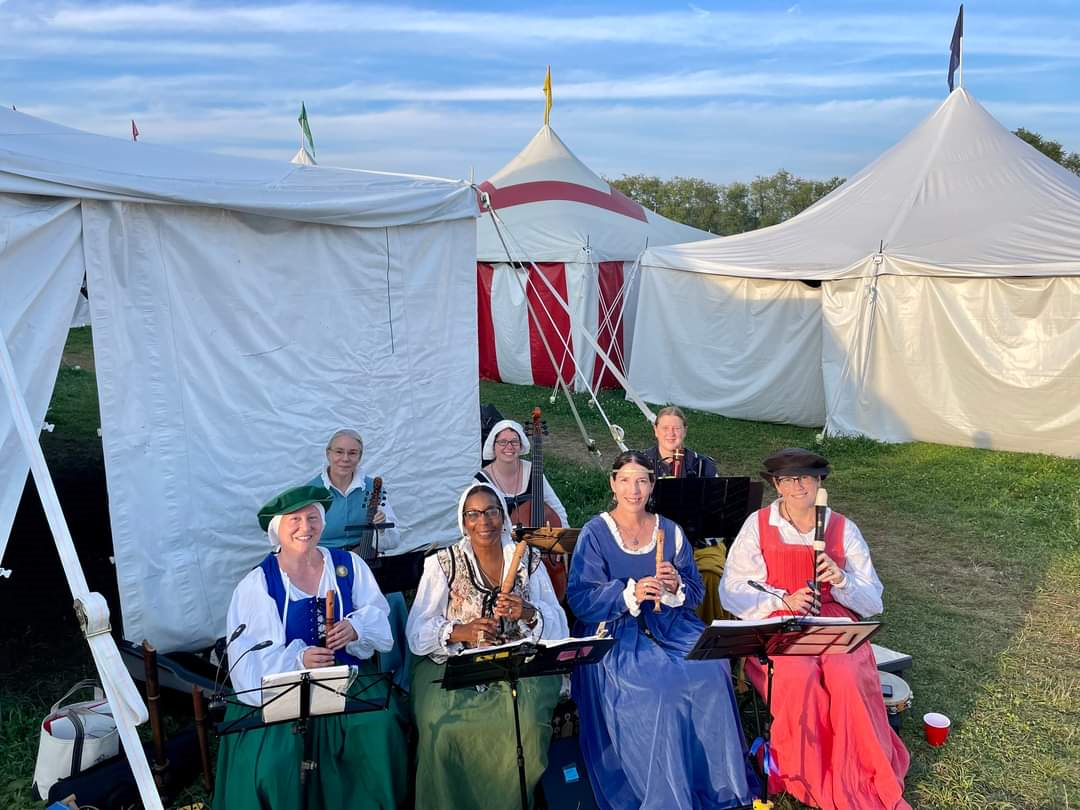
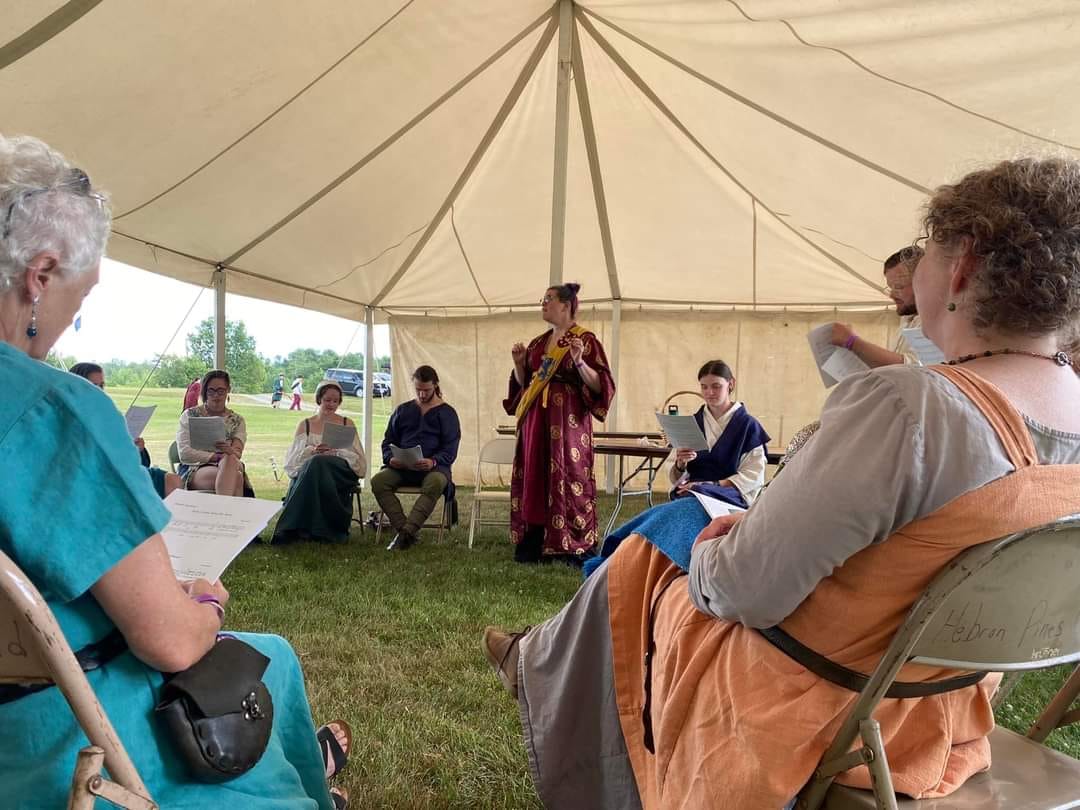
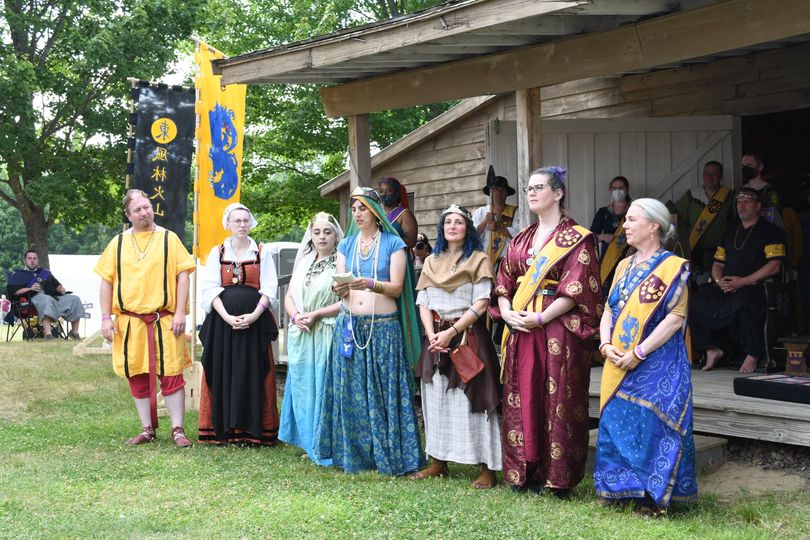
Heading home…back from the longest town run.

Pensic 50. I DREADED it. I’m not huge into parties, covid is rearing it’s head again and I just don’t want to make the 10.5 hour car ride there and 12.5 back (I make a detour to visit the cutest kiddos and favorite middle sister on the way back). We have done a lot of work on our house and I was just a bit traveled out, but my husband wanted to go, so I made sure to head to Pensic.

Friday am arrival. Fastest gate I have ever processed through. I waited maybe 10 minutes in line total before we were seen and out completely. Then, rolling down to the Bog. HOME. MERMAIDS SONG. Like the name sounds, we are all Bards or some type. The best part of our Bardic Mayhem group is that none of us specialize in the same artform. We have a magician as “Camp Dad”, A harpist, a shanty-man, a vocalist who specializes in period works, a story teller and the rest provide us with libations and support. Friday night was just a night in camp to enjoy friend’s and reconnect. It would not be Pensic without random bursts of music and such to which we did.

Saturday came around quickly, but not the worst for timing. I once again decided to join my comrades from ACROSS the kingdom for another Song Byrds Concert. I believe we hailed from 6-7 Kingdoms between us and only 2 lived in the same kingdom and they were partners (so that made sense). Bird, Aibihilin, Colette, Geoffrey, Robbin, Leaf and Mathias and of course me. This set list was almost entirely new to me. The only piece I had some inkling of was Ecco La Primavera. However, every piece we performed was period. It was so much fun to do an immersive period concert since that is my focus. 5 completely new pieces to me and 1 I knew and 1 which I had conducted but never sang (and I ended up learning Soprano and Alto for different performances)

Set List:

Now Wolde Y Fayne, Mors Sui, Se Je NE Vous Vois, Je Ne Cuit Pas, Ecco La Primavera, Doulz Viaire Gracieus, The World an Illusion , Il Est Bel Et Bon.

In between each of the pieces we each had a chance to perform a solo. I chose to do my Landskneckt piece which has only been performed for an audience once before, a year ago. It’s a persona accurate piece for me and a joy to do in persona garb. This performance comes later in the week but rehearsals needed to happen. We had folks shifting parts as well as participating because of illness and commitments. This group was incredibly flexible in their abilities to switch parts at the drop of a hat. I am 1 of 2 professionally trained musician’s in the group and the rest just have an overabundance of passion for performance and they are all absolute joys to work with.

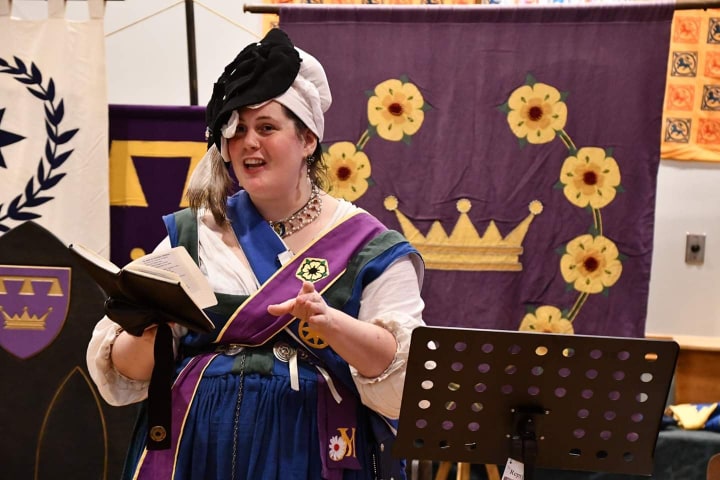
Later that evening I had been cordially invited to perform at Duchess Caoilfhionn’s Bardic. This is an invite only performance set. This Bardic is special to me because VDK is a fighting household and to see that their warrior queen supports the arts, performs herself and child performs, is very near and dear to my heart. I used to fight armored combat for a period of 6 years but my body decided it wasn’t right for it but typically you fight or art. It’s nothing more than a time dedication. People who focus on more than 1 activity can struggle to keep up with both or will burn out. I chose to sing about love and loss. This year has been such a full of those I could think of no better subject than that. My ladino piece was bitter sweet, La Prima Vez. The rest of the night was full of other incredible performers, old and new to me. oh! Another point to note, I am a huge advocate of “Clothing changes how you move/perform”. I chose to wear male presenting clothing because I’m still having difficulty knowing how to gauge my body temperature changes. La prima Vez felt new and almost foreign. I interacted in new ways than I historically do. It was so interesting to feel the drastic change.

Sunday… the doom day. I had promised my Pelican that I would not overbook myself. Originally when I had booked my schedule it was only 2-3 things a day…. here we are 5 commitments. Heck. Welp! I started the day bright and early in rehearsal to play in the pit of Romeo and Juliet. This is the first time I have played in any form of a pit since 2004. I’ve been a long time recorder player, but not my main focus. It was like falling off a wobbly bike. I got back on but still wobbled. It was joyous though. My soul -needed- this. I have been dying to be part of an ensemble instead of the solo performer or conductor. I got to play with varying levels of skills and make music. I got to play -harmony-. I NEVER get to do harmony. It made me so happy. Also, my super amazing awesome Laurel, Sabine was our concert mistress which always makes for a supportive and awesome good time.

Shortly after this rehearsal I was speaking to one of the fellow instrumentalists. We we sharing our backgrounds and she had admitted that she was going to be auditioning for one of the Pensic choirs. She seemed nervous. I asked her if she’d like me to find a place for her to sing it to me to get her jitters out. She happily accepted and off we went to an empty A and S tent. As we got there, I asked her what kind of feedback she wanted. I asked “Do you want to hear THATS GREAT or GOOD” or did she want “That was flat” or did she want fixes. I find it’s really important to asked for feedback consent. You can really destroy someone if they aren’t in the right headspace or ready Sometimes folx don’t want feedback at all. Sometimes folx want to hear if it was “good enough” and sometimes they want you to rip them apart as long as you can tell them how to fix it. I was lucky enough that she did want feedback and how to fix it. I was pleasantly surprised by her timbre and skills she came in with. An absolute delight to listen to. I had her sing the piece through and then I gave her 1 piece of feedback each time she sang it for me as not to overwhelm here or give her too much information to process at once. I think we did it 3 times through. She exclaimed that she felt more confident and more ready for this audition. She was thankful and we enjoyed the rest of our Pensic times together.

From there I hustled over to Geoffrey of Exeter’s class. He was teaching basic vocal technique and using this class to teach his piece “The World an Illusion” so I could support him, but also I would be conducting this piece for his procession as he was to be elevated to the Order of the Laurel in court on Tuesday. I wanted to scope out what additional voices we might have and figure out if they would need more Sopranos or Altos (Any other voice part would be out of my very Soprano range).
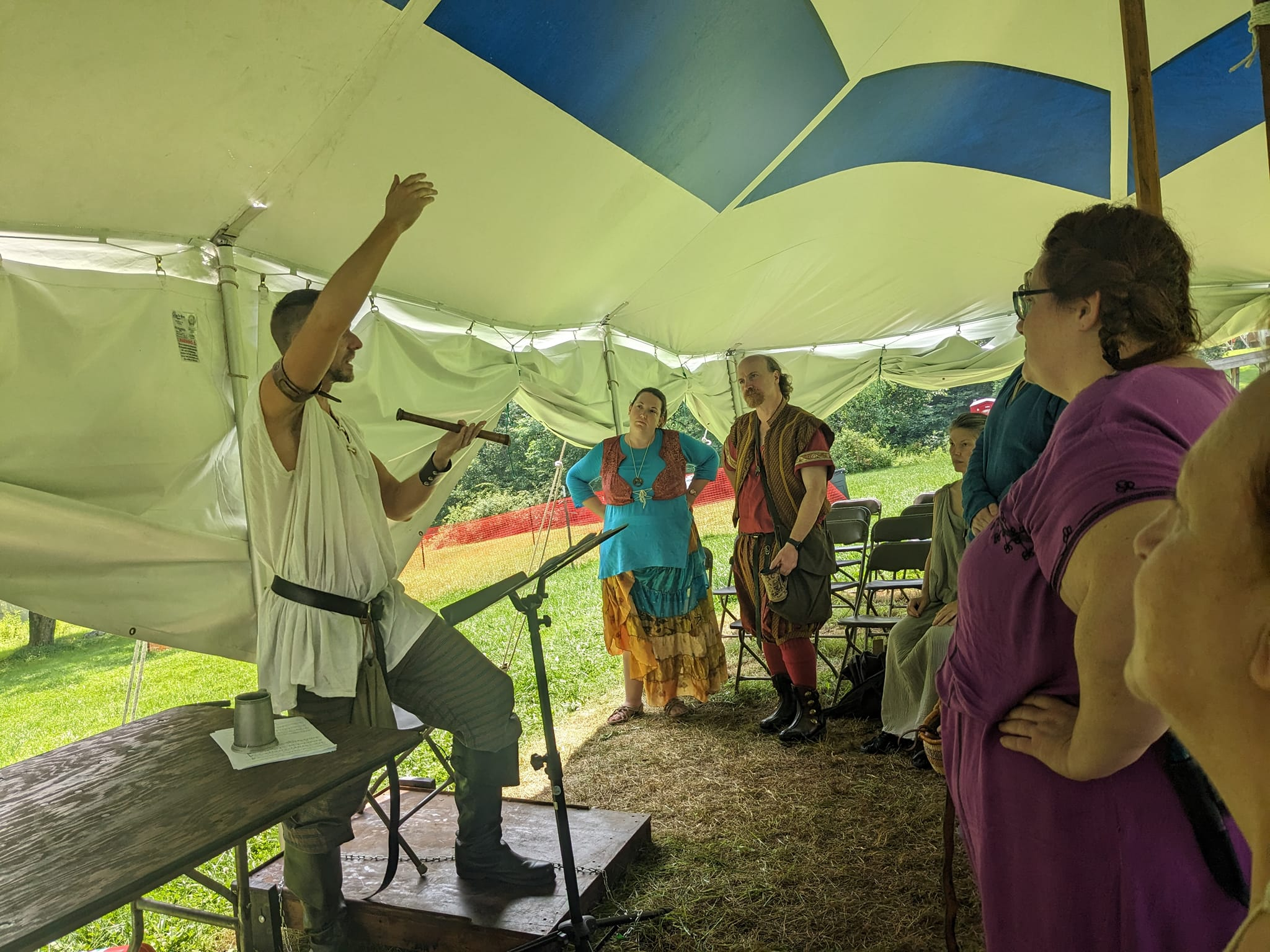
From there I immediately hustled back to EK Royale as I was running the East Kingdom College of performers meeting. I decided we should be able to include folks from home as it’s not fair that folks who cannot afford or physically make it to Pensic could not have their voices heard. I made a hybrid meeting where we had 2 people remote in and 6 in person. Not bad for a Pensic meeting. They are always hard and there is -never- a good time.

I had a few hours in between there and went to camp where it then began to POUR. I’m sweet but not made of sugar so the rain never bothered me anyways. As the rain let up, Husband and I hauled our way up “The Hill”tm to go speak to our speccy boy, the vigilant. It is my goal, when I speak to vigilants, that besides to present them with a gift (which is usually a composition for them) is to speak from the heart and make them cry. Poor now, Master Speccy Pants, there were tears I tell you.

The final stop for the night was Bhakail Boardgames and Bardic. A glass of “Nerds Wine”… made from freshly squeezed nerds, singing and more camaraderie happened. Bhakail is a second home to me. My Laurel is Bhakaili and my Pelican used to be/still really is Bhakali. Nothing much to note besides heading home for Bog shenanigans.

Monday was more Romeo and Juliet rehearsal for several hours. I then head down to the Casa where my apprentice “Niece/cousin/somehow SCA related because weird things” where we jammed out for a little bit on her brand new citole. Her other one met its demise earlier in the week so this was as good of an excuse as any.

Tuesday was another Song Byrds rehearsal and full run through where we ironed out the details, set list order and set everything for day of. Then, EK court. As I had mentioned earlier, I was concert mistress for Geoffrey’s elevation as he processed. I herded everyone to our performance spot, recruited another singer a few minutes before. We were set… except the court order changed so HERE WE GO. Rapid singing. Not only was I conducting, I was jumping between singing both parts and coordinating the Harpists (who were fab, btw). I am unsure if anyone recorded the performers and if any of you readers find one, let me know so I can add it to here. Geoffrey, amongst all of his emotion said it could be heard from the back of court and was exactly what he envisioned. I’ll take it

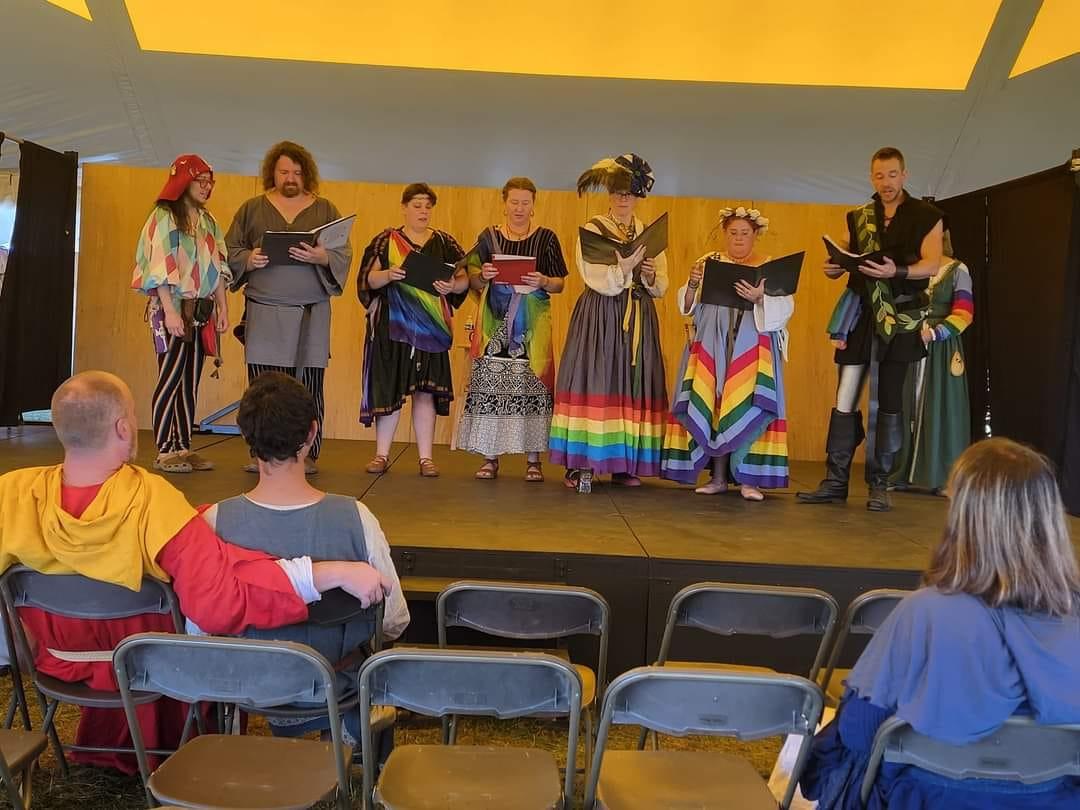
Wednesday was the Song Byrds concert. Most everything went off without a hitch. One piece was moved and we added a piece last second because we under scheduled ourselves (which is better than last year in which we had to cut things. Such is life. However, I do want to make another point about our amazing and diverse set of vocalists were all LGBTQIA. So, in a world that is so scary right now for us, we wanted to make a statement. I requested that we all wear some form of a rainbow for our performance uniform. Check out these speccy duds!!!! (Also, Period appropriate hoes/stockings…. just saying)
Thursday was a new adventure for me. I had been asked to serve as a judge for the Pensic A and S. Typically there is a war point involved, but this year, for the safety of all, there were no war points. So, this took some of the pressure off of me as a first time judge. The coordinators/generals provided training on the rubrics and we were given documentation ahead of time to review so we could formulate and ask intelligent questions about the projects. I was given 2 physical items to review. If you have never had a chance to judge an A and S competition, you absolutely should. You get the pleasure of hearing the passion, the process and the whole scope of some ones project in a way you don’t get from a display. I got 40 minutes to hear a shpiel about some ones work for 20 minutes, ask 20 minutes of questions and then feverishly try to score someone. Although this can feel like a pressure chamber, I genuinely got to ask the artist so many questions about their art that I wouldn’t have ever thought to ask. I didn’t ask anything regarding why they didn’t do a thing. I tried to ask questions with genuine intent to learn and clarify items in documentation and creation that I may have missed. All in all 10/10 would do again.

After my brain was fried from new artforms, back to my camp, in the bog to teach my rounds class. This class serves 2 purposes. 1) To sing period music 2) To make a safe space for new and old singers. This is a judgment free zone that should, in theory, allow folks to have a safe learning environment in which they can explore a period topic. I teach this class similarly to when I was teaching youth. Depending on the duration or language of the piece I would do the following process: 1) Sing the entire song for people to hear. 2) If the piece was short enough I would sing it, ad nauseum, until they felt comfortable enough to jump in 3) When the majority started singing I would “chase” them to give them an idea of how the round sounds with it while creating some minor part independence. The only change of process is if the song was longer or in a foreign language I would break the son into smaller chunks. Id do one phrase at a time then connect 2. then the next one and repeat until the song was whole. In this particular session I had a HUGE variety of skill levels and confidence. I had someone who hadn’t sang since high school and never sings in public, I had someone who appeared to have some musical background and finally a music teacher who is going deaf. My assorted camp mates came in and out to sing with us as well which is always a joy.

After my class, the individual who had not sang since high school and never in public approached me. They advised that this was an amazing class. They said they felt safe and secure and that it was a good place for them to make music. They appreciated my corrections being subtle, non aggressive and not pointing them out at all. My heart was overjoyed to hear this. Not to mention that they have a beautiful singing timbre as well.

If you are interested in downloading my book, here it is. Just please credit me for use. With this link you will get updates to my book as I add them.

https://docs.google.com/document/d/1PvID7hHNG2gvJjWctuWdpQiK-OyhmB_GlVLQhHqEcI8/edit?usp=sharing

Friday was the last day. Usually I am leaving on Friday so I can have a nice leisurely drive home for visits with the family. This year I was staying behind to play in the pit of Romeo and Juliet. This was going to be a super unique situation as we were playing “Under The stars”. What this means is a change in light availability as well as sound reverberation (or lack there of). Tent walls are hard and provide additional bounce. Bodies eat bounce and the sky is a nebulous black hole. We were a small but mighty group and we could do it. We got to play through at least the stage warming music. No more than 30 minutes in did the sky open up and we needed to move inside. This again changed dynamics but we made it work. I had forgot to mention earlier all the music I learned for R and J was new to me as well and all period music. We played Heart’s Ease, Amoroso, La Doune Cella, The Hunts Up, Chi Passa Per Strada and Where Griping Grief. Where Griping Grief comes from the original score of R and J and I actually got to sing that instead of play it. I did with Chi Passa Per Strada as well.

All in all, Pensic filled my heart in ways that I wasn’t sure it could this year. I had a leisurely drive home after which included the cutest 11 year old and 4 year old you’ve ever seen, my ever patient Pelican, friends for lunch at the best Jewish Style deli in CT and washing off the Pensic tan.

Returning Home

Gnew has been and likely always will be my favorite event. Yes, it’s hot but you know what? It’s home. This year the plan was to take it easy. I am still re-learning my body as I am going through changes as I continue to lose weight and see how my instrument is working. Minor other health issues but nothing to bring up here.

Since I had earned consorts champ, I have been trying to put up monthly challenges, serve as a mentor and teach. I chose to provide 3 classes at GNEW as I would not be fencing.

My first class was Friday for 12. I was presenting my ad hoc choir. This was not the best time for this class to be successful, but beggars can’t be choosers. We had a mixed skill level group but not much for vocal variety. Click below to listen to the group perform the piece they learned day of!

Edi be thu, heven queene

Sheet Music-Edi be thu, heven queene

Later in the day, I met with several performers who had an interest in the Bardic Arts. Aalina and I hosted a Bard round table to discuss questions, stories, fears and all in between. We had the full gambit of questions and I feel like the new generation of performers is strong and ready to flourish.

From there it was off to teach my son about the joys of service in the SCA. He is 9.5 so doing for others if somewhat foreign to him still. I ran off to retain with Their excellencies Stonemarche. I was given a plate of delicious items to share with the Deed gallery. There was nor formal gallery this year so tasty treats for all!

Saturday I started my day in morning court, seeing folks celebrated and then off to my final class. I did my rounds class. This class had originally been inspired by Aneleda Falconbridge. I had taken it over when she was elevated to Laurel. It had started as her labor of love and I have been continuing it. Inspired by this I have been putting together a book of all period rounds. It is a work in processes, but I hope it will continue to be a tool that folks will use to keep singing in a safe space.

Rounds Book compiled by Solveig Bjarnardottir

Here is a small recording of the folks singing in my group. This song is originally in German, but I am using the English translation with my students.

Music Alone Shall Live

The rest of the time in between was a blur until court. Previously, I had been asked if I would serve as an alternate on the A and S team. This was an absolute honor. I didn’t put much thought into it, but it has really kick started my desire to go into further documentation with my pieces. However, look at this group of amazing folks!!!! I am so excited to do this. Look out Pennsic. More to come on that post Pennsic.

Last but not least, for Saturday, my love was to be recognized in court and become a Lord. Wolfgang was to receive his silver brooch. I have a mold of the silver brooches I had made before. if you look back in past posts, you can see what they look like. However, this time, to make his special, I enameled it for him so it represents the heraldic picture of the award. That night, my house mate was being being apprenticed and I had the joy of heralding him and wandering camps to sing and do Bardy things. Just a good ol’ shennaniganless night. Irish coffee without the irish and songs for old and new friends.

Sunday was pack up day. The saddest day of all. Sure, it was hot and gross all weekend, but this is where my heart lies. As I was packing up, some old friends from Malagentia asked if I would mind mentoring their child in Bardic Performance. I was honored and moved. I have watched this amazingly warm human grow and nothing would give me greater honor. I cried back in camp. This… this was my passion, my joy. To bring bardic to the world, be safe and be a teacher. I cried for joy. We drove home…. washed off the GNEW tan and that was the end of this tale.

Well, well, well… What do we have here?

Vermont! Here I come. One of the smaller, but favorite events I get to teach at is Mimir’s well. This is a Viking descriptive event which is all about classes and an A and S display and contest (some years). I tend to offer up on the Bardic track because there are a lot of folks who enjoy performance but not a ton who teach. That’s ok. Not everyone teaches, but I love doing it. In addition, I was asked to teach a class on pewter casting. I have been making tokens for the last year or so as well as award medallions. The Event Stewards wanted to get more folks into doing it since it was as far spread in this part of the Northern Region. I happily agreed.
I had decided to challenge myself. I have a really big fear of putting my own work for the general public. Not only that, I never feel like my polyphonic works are good enough. I was inspired by their Royale Highnesses to compose them a processional. His Royal Highness crown winner has an early roman persona. I pulled from the texts of Augustus. I used a small portion of the texts that I felt would represent our Royalty

Bella terra et mari civilia externaque tóto in orbe terrarum suscepi3  victorque omnibus veniam petentibus4 cívibus pepercí. Externas  gentés, quibus túto ignosci potuit, conserváre quam excídere malui. Míllia civium Rómanorum adacta sacrámento meo fuerunt circiter quingen ta.
Wars, both civil and foreign, I undertook throughout the world, on sea and land, and when victorious I spared all citizens who sued for pardon. The foreign nations which could with safety be pardoned I preferred to save rather than to destroy.

Choir

Below, find  the MP3 and the recording I made during rehearsal. Sheet music to follow. I chose to teach this during the ad hoc choir that I run. It was a dream group because I had a pretty good balance on all voice parts. Everyone learned it quickly and took direction well. Again, everyone was excited to perform this during court while THR processed. TRH were banished from the room while we rehearsed because I wanted this to be a big surprise.

https://drive.google.com/open?id=1xSn0BGTbBZfLUvubdQLD7hwQkYXfbw8J
Pewter casting came later. I went through all the different forms of casting materials from clay, cuttlefish bone, soap stone and sand. We went over the materials I use in my anachronistic process (which you can see in my post for making the tokens for Ozurr and Fortune) and then, everyone who gave a donation could bring their own piece home. I had made two molds, one a Mjolnir and one a Viking brooch replica. I wanted to keep with the mood of the event. Also, this is the first time I’ve ever let anyone use my supplies or cast in front of me. I made sure to bring safety equipment to make sure everyone was safe and was ready to have my first vict-.. first student attempt this as HRH walks in. I of course offered him the chance to cast and he took it. A perfect pour! It wasn’t the first time I’ve ever had royalty attend my class, but it was the first time they were ever actively a part of it.

Everyone had gone home with their own, personally casted piece. There were no injuries. Only a few broken rubber bands and my mantra (NO PAPERWORK) seemed to work.Casts

If you’re curious about the site tokens I made (all 200 of them) here is a picture of the completed tokens.

Site tokens

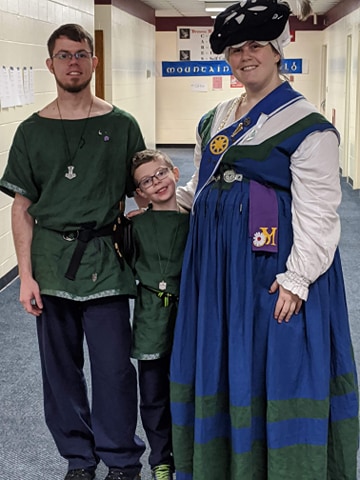
The rest of the day I got to enjoy classes. I had my Partner with me and his son, in matching garb (which was cute as heck!). It was also his son’s first event. He got to calligraph, make an LED lantern, chainmail and even got a token from TRH. You could see the magic in his eyes as he entered our little village and made new friends. He felt right at home. This is a huge deal because he doesn’t have a lot of friends. They say he’s weird (Honestly, he’s a normal kid who really enjoys Pokémon and telling you about it. Also, wicked smart at math). If you have been part of our village, these are qualities we all share.Family
The end of the day was here. Court! My partner loves court and he’s only been to one. It’s not the gift he got (both times) but the celebration of people and the pomp and circumstance that goes with it. I got to explain the awards people were getting, the vocabulary we were using and what was what and who was who.
It was my turn in court. I am one of the officers for EKCoP (east Kingdom College of Performers). I serve as Chancellor as well as Deputy Chatelaine for the Northern Region. I had been given the Travel journal to pass on since the recipient was sick (with the world being like it is right now, we don’t want any of your flu/COVID-19 crud). I asked if I could present it in court. It’s a cheesy way to get the college some recognition and make the recipient feel more special. As I was about to sit down, their royal highnesses told me to hold on.Journal
What had I done? Did they hate my song? Wha I being Banished because I’m an obnoxious and loud Bard? No.. they were doing a thing.

I was inducted into the Order of the Silver Wheel. This is an armigerous level award for those who do community service. I never expect to get awards for what I do. Sure, I dream about them like anyone else, but I do what I do because I enjoy it and want others to enjoy. I was literally dive tackled by 2 of my peers in the order… who also happen to be in the Free Company of the Stella Maris. With teers and joy I entered the order.
Please see this BEAUTIFUL scroll done by the hand of Kenneric Aubrey. Text is based off of L’homme Arme (The Armed Man)

Here is a copy of the sheet music for the processional:

Patronus


Here is an MP3 of it, at a fast tempo, This should be performed at a  marching tempo and militantly timed.

https://drive.google.com/file/d/1hvby7YD2y9oJRj0biix5tQtXn3OoN_Fh/view?usp=sharing

It was the best of times; it was the 12 night of times….

Long island! You are a bit of a haul from Maine. 12th night is one of the most exciting social events of the SCA. It’s usually encompassed by the best garb, amazing food and music! Oh no! Music!!! Twist my arm!
I am fairly close with both Royale Bardic champions, so we communicate a lot. I had found that they had an entire track of music for the day. My heart sung with glee. At first, I thought of what I could sing? Would this be holiday related or just my usual run of tracks. Then I had a stunning idea. The adhoc choir would get a chance to finally get their first real performance!
I sent out an email about 3-4 weeks prior to and got a good feeling of head count. There will always be last minute stragglers, people who aren’t on the lists and people who don’t make it. That’s ok! It’s life and it happens. When I figured out there was enough interest, I reached out to the Event Steward and asked if I could kidnap a space for 90 minutes to learn and run 20-25 minutes of music. He agreed!
Next, the music choices came out. During holiday season, we all want to spread cheer no matter what faith we have or don’t have. It’s a great way to bring the community together. I went through and picked out 7 period and traditional pieces. The Boards Head Carol, Ah Robin, Dona Nobis Pacem, Gaudete, Gloucestershire Carol (Traditional, not period), Here we come a wassailing (Traditional) and The Holly and the Ivy (plausibly period). Due to the nature of documented music for vocalists, it can be a challenge to find pieces that were secular in nature and at the skill level of the performers I am working with. I think this diverse set of pieces would give them some challenge as well as some easier pieces to rely on. I even chose to give out a couple Solos to the performers who wanted to try their hand at it.

Choir
I didn’t hold auditions for various reasons, but the primary reason is opportunity. When you are a full-time performer, you tend to get more opportunities to perform as a soloist. The more skill you had, the greater the chance. Most of these folks are all volunteers who just liked to sing or sang in chorus in high school and that was their last real opportunity to sing. Some don’t even read music. That is just fine. Everyone gets a chance if they want it with me.
After rehearsing the pieces, couple of soloists asked for additional help. One expressed concern on rhythm/notes and the other with the language itself. I worked with each for an additional 20 minutes and by the end, they both felt very confident and ready to perform.
About 1:00 it was their time to shine. Each of them stood proudly in our vocal horseshoe, ready to do a thing. They sang their hearts out with joy. Not even one of them seemed nervous. After about 25 minutes of performance and several pictures being taken, we were approached by a couple of patrons. The one comment that really stuck with me was this: “You made me feel like I was truly immersed in a 12th night feast. The music, the madrigals… I was there. Thank you” and she handed each one of my performers a token of gratitude. Were the pieces perfect? No. Were they enjoyed by all? Yes. Both singer and bystander. My heart flowed for each and every one.


Choir 2
I had my own set later. I used this time to work some of my Crown Bardic pieces to get them in front of an audience, because they were new. One of the pieces of advice I give to all of my performers I have every worked with both solo and group is to make sure you get to perform a piece in front of as many people as you can before you go for the gold. My middle schoolers would have an assembly in front of their peers before they sang for their parents that night. What this does is prepare people ahead of time and make it old hat instead of new and shiny. This is also done with professional performers as well. They have full runs and open dress rehearsals to get feedback from the audience. So, this is done by all skill levels.

Solo
The rest of the night was food and merriment as well as serving my amazing queen. In my free time I have been retaining whenever possible. I helped pack up for the night and home I went. I even got to participate as a mummer in my dear friend’s performance during open bardic performances.

Mummers

The Boar’s Head Carol was first published in English during the 1520’s in a book entitled Christmase Carolles Newly Emprynted at London in the flete street, which was written by Jan van Wynken de Worde.
“Boar’s Head Carol”. Christmas-Carols.org.uk. Archived from the original on December 28, 2009. Retrieved December 8, 2009.
William Cornysh (1468-1523)

Cornish. William. Ah Robin, Gentle Robin. Edited by Alberto Gomez Gomez: 2012.
Encyclopædia Britannica Online, s. v. “William Cornysh,” accessed February 10, 2014, http://www.britannica.com/EBchecked/topic/138138/William-Cornysh.
“Dona nobis pacem” (Ecclesiastical Latin: [ˈdona ˈnobis ˈpatʃem] “Grant us peace”) is a song with Latin text, often sung as a canon or round (where each section starts with a new voice). It is the invocation to the Lamb of God to have mercy and grant peace to the worshipers. It is said to have been introduced into the Mass by Pope Sergius I in 687,

Gaudete ( “rejoice [ye]” in Latin) is a sacred Christmas carol, thought to have been composed in the 16th century. It was published in Piae Cantiones, a collection of Finnish/Swedish sacred songs published in 1581. No music is given for the verses, but the standard tune comes from older liturgical books.

The Holly and the Ivy was first published in a broadside dated 1710 and have have originated somewhere in the Cotswolds.
The Holly & Ivy; Twelve Articles. Birmingham: D. Wrighton. n.d.

Harper’s Retreat!- The “Still not enough Harps” edition

This is one of my favorite events in the year. It is closer to home than most of the events I travel and is in the Barony that in my heart is my Barony. This one, however, was much tougher for me emotionally. Not to bring my personal life in to this, but I had gone through a very devastating event about 2 months prior and still had not resolved all my emotions over it. On top of that, the instigator of the event was scheduled to be present. I was lucky, however, to be camping with several of my SCA families, who would keep me safe. I brought a plethora of instruments with me to bring to the instrument petting zoo, including my harp. This was the first time I was going to get to play it in public. There was a harp ensemble present. I learned quickly of the pains harps have in heat/stage lights regarding tuning. This was not something I encountered practicing in the comforts of my mildly lit and frigid apartment. I got to spend an hour playing with other harpists of varying skill level. It was heaven!
From there, I would twiddle on my recorders outside with an impromptu recorder jam. Everything from chaotic melodies, to soothing waltzes. I met new folks, got to try new instruments with no pressure.

That night, at feast, I was once again honored to be part of the feast entertainment. I had been asked by the current baronial bard to perform. I performed my first ever originally composed story about how the children of the east changed Ozurr, storm bringer. It discussed the several events he had been to, inclusive of the crown tournament where the rains fell, the Estrella where it flooded and Pennsic, raining out the Eastern Court. From there, I sang some of my newer repertoire and enjoyed the feast.

Following court would be the Bardic championship. This year, I decided I would try something new. It’s really important to me to show newer performers that I wasn’t born with all skill. I wanted to show them that I was working on new skills. There theme was fortune and misfortune. I had the idea of performing 3 Ravens first and then Twa Corbies with a guitar accompaniment. I was newer at the guitar and this would only be my second time playing it public. I knew Twa Corbies was also not my strongest vocal piece, but I wanted to try something new. I was pleased enough with my performance and called it a night. Where I was not chosen as the new Baronial Bard, I did win populace choice. I’ll take it.

The lyrics to “The Three Ravens” are here transcribed using 1611 orthography.
“The Three Ravens” (Child 26, Roud 5) is an English folk ballad, printed in the song book Melismata compiled by Thomas Ravenscroft and published in 1611, but it is perhaps older than that.

There were three rauens sat on a tree,
downe a downe, hay downe, hay downe,
There were three rauens sat on a tree,
with a downe,
There were three rauens sat on a tree,
They were as blacke as they might be.
With a downe, derrie, derrie, derrie, downe, downe.
The one of them said to his mate,
Where shall we our breakfast take?
Downe in yonder greene field,
There lies a Knight slain under his shield,
His hounds they lie downe at his feete,
So well they can their Master keepe,
His Hawkes they flie so eagerly,
There’s no fowle dare him come nie
Downe there comes a fallow Doe,
As great with yong as she might goe,
She lift up his bloudy head,
And kist his wounds that were so red,
She got him up upon her backe,
And carried him to earthen lake,
She buried him before the prime
She was dead her self ere euen-song time.
God send euery gentleman,
Such haukes, such hounds, and such a Leman.

Written heavily in the Scots language, “The Twa Corbies” probably dates from the 18th century and was first published in Walter Scott’s Minstrelsy in 1812. Child (I, 253) quotes a letter from Charles Kirkpatrick Sharpe to Walter Scott (August 8, 1802): “The song of ‘The Twa Corbies’ was given to me by Miss Erskine of Alva (now Mrs Kerr), who, I think, said that she had written it down from the recitation of an old woman at Alva.”.

Twa Corbies

As I was walking all alane,
I heard twa corbies making a mane;
The tane unto the t’other say,
‘Where sall we gang and dine to-day?’
‘In behint yon auld fail dyke,
I wot there lies a new slain knight;
And naebody kens that he lies there,
But his hawk, his hound, and lady fair.
‘His hound is to the hunting gane,
His hawk to fetch the wild-fowl hame,
His lady’s taen another mate,
So we may mak our dinner sweet.
‘Ye’ll sit on his white hause-bane,
And I’ll pike out his bonny blue een;
Wi ae lock o his gowden hair
We’ll theek our nest when it grows bare.
‘Mony a one for him makes mane,
But nane sall ken where he is gane;
Oer] his white banes, when they are bare,
The wind sall blaw for evermair.


Meaning of unusual words:
twa=two
corbies=crows (or ravens)
fail dyke=wall of turf
wot=know
kens=knows
hause-bane=neck bone
een=eye
theek=thatch

The Beginning of a new era!

Panteria was my first camping event in 2010 and has always been a special event to me (Even though a bunch of my friends tried to coax me into go to Roses instead). This year would be no different. Well, I mean, it will be because the event has grown and changed over the years.

With this development of the event, I decided to develop myself farther. I had started a similar idea before, but this will be an ongoing contingency group. I started a travel ad hoc choir in which we would learn some music and then after a few events or so, would get the chance to perform it.

The plan for this one would be to introduce everyone, get a gauge of their skill level and then do a thing! My first meeting has 10 vocalists as I gave out all copies of my music. we had 1 bass, 1 tenor, 4 altos and 4 sopranos. What made this group even more interesting was the addition of a youth (sub 18).  I handed out pieces in various languages. She seemed very concerned that they would potentially contain a swear word. Even after I reassured her several times there we no swears, I even had a native speaker of the language to also confirm that.

It was a challenge to have a youth there as I haven’t been a youth instructor since 2008. So, a few years. She stuck around for about a half hour. With permission, just after she left, I made a recording of the group performing and a second one as well.

By the end of our 2 hour sessions, a complete piece of music was learned as well the groups excitement level was near explosion. They asked over and over again if they could perform that night at Bardic. I had been planning to wait a few rehearsals, but they people have spoken.

Additionally, I had brought my new rounds book which I created. This would be the second event it is making it’s debut at. I am really proud of what I gathered. Now I have a few finishing touches to add to it. However, people are eager to purchase or have a copy of it in general.

Here are a couple recordings of the rehearsal process:

Take 1:

https://drive.google.com/open?id=1-8hj3AmqyfbUb17JhhYOor3FWT3vwzJr


Take 2:

https://drive.google.com/open?id=1-7n480C7IACotD2tIAFFNsL3TeV7ICc6


You can definitely hear the improvement between takes. There is maybe a 20 minute difference between them.  By performance that night they were spot on. I am still hunting down that recording.


During rehearsal I did refrain from singing with the group so they could focus on themselves. However, by performance, we had lost a couple folks and needed to shift around and I ended up singing with them.

NB) This was not taken at tempo for rehearsal reasons.

About the piece:


It was included in Dowland’s First Booke of Songes or Ayres, which appeared in 1597. The piece is often performed as a lute song by soloist and lute, but, like other songs in the First Booke, it is printed in a format that can also be performed as a madrigal by a small vocal group (typically SATB).

This lute song is largely famous for the lovely melody and the striking repetition of rising fourths in the penultimate line of each verse. This is especially effective in the first and second verses, where the text and the music are a perfect fit.

In the first verse, the singer urges the beloved to come to him again, so they can enjoy together the pleasures of love, “to see, to hear, to touch, to kiss, to die, ” in the second he sings of his sorrow, “I sit, I sigh, I weep, I faint, I die, ” and in the somewhat less graceful third verse, he claims that nothing can move her heart, “By sighs, and tears, more hot than are thy shafts/ Did tempt, while she for triumph laughs.”

Come again!
Sweet love doth now invite
Thy graces that refrain
To do me due delight,
To see, to hear, to touch, to kiss, to die,
With thee again in sweetest sympathy.

Come again!
That I may cease to mourn
Through thy unkind disdain;
For now left and forlorn
I sit, I sigh, I weep, I faint, I die
In deadly pain and endless misery.

All the day
The sun that lends me shine
By frowns do cause me pine
And feeds me with delay;
Her smiles, my springs that makes my joys to grow,
Her frowns the Winters of my woe.

All the night
My sleeps are full of dreams,
My eyes are full of streams.
My heart takes no delight
To see the fruits and joys that some do find
And mark the storms are me assign’d.

Out alas,
My faith is ever true,
Yet will she never rue
Nor yield me any grace;
Her eyes of fire, her heart of flint is made,
Whom tears nor truth may once invade.

Gentle Love,
Draw forth thy wounding dart,
Thou canst not pierce her heart;
For I, that do approve
By sighs and tears more hot than are thy shafts
Did tempt while she for triumph laughs.

Local Choir strikes again

Choirs are a lot of fun, but they require more than you. That isn’t a bad thing, but finding other like minded folks with the missing parts you need can be difficult to say the least. Once upon a time (4-5 years ago) I ran a vocal group in Malagentia called, “Voce di Sonata”. I ran this choir for about 2 years. However, with real life comes member depletion.  I moved a bunch, people got married and divorced, houses were sold and people have this thing called a job. So, as it were, life doesn’t always work the way it should and I let the group dissolve.

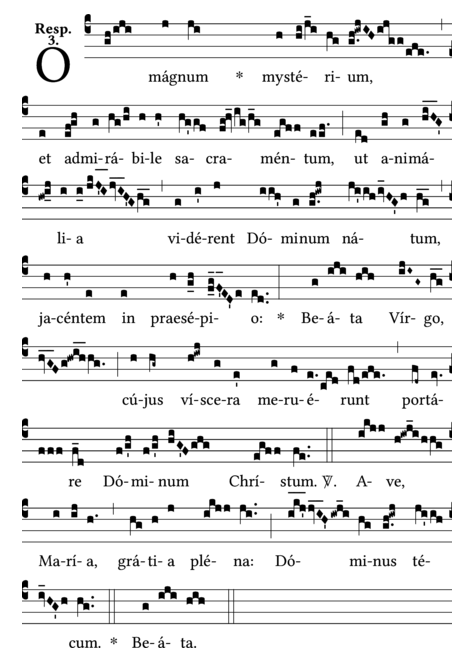
About 2-3 months ago, a conversation struck up with one of my old vocalists from voce. She had expressed wanting to sing and make music. Then, more specifically, she and her husband wanted to work on “O Magnum Mysterium” by Victoria.

If you haven’t heard this piece, take a listen:


NB) More information about this piece below


However, with the 3 of us, we were missing a crucial voice part. The tenor! I was playing the part of Alto, because… why not. (for any of you who know me, I am not an alto, I just play one on TV). We have a local tenor who is also a shoe in and loves to sing, so without fail, he came to the rescue. 2-3 rehearsals in and we have some music going. This is a volunteer group, who meets every 2 weeks, but again, life happens so we’ve maybe met 2-3 times in 3 months, and that’s ok.

This is for fun. (I have to keep telling myself that. I come from a history of professional musicians who come to their first rehearsal with all their music learned if not memorized. Those, who have perfect pitch or at least relative pitch and work without speaking, singing only for 1-2 hours at a time) This is an ongoing learning experience for me. I’m loving every moment of it. It’s absolutely incredible to work with a group of people who’s passion has not been lost. They do this because it’s fun, not work.

O Magnum has been put aside for now so the group can learn some vital things about working together is a very small chamber group. For now, we are working on Belle Qui Tiens Ma Vie ( Thoinot Arbeau 1520-1595) , Ah Robin, Gentle Robin (William Cornish 1465-1523) and  By the Rose (13th century anonymous poem set by Lady Colette la Trouvere).


With permission from the ensemble, here are the super duper rough recordings done on my terrible cell phone. The one thing I can’t show you is the immense joy and pride on all the vocalists faces when they got to hear their recordings for the first time. The plan is, down the road to make a real recording for them to compare themselves to.

Belle qui tien ma vie:

https://drive.google.com/file/d/1MqexQGOtQD0x3adrQyagqbr1FY8Db0sb/view?usp=sharing

Ah robin:

https://drive.google.com/file/d/17mWec-NLl-nhZvJgNfZzfSHQGSzv9eoT/view?usp=sharing


Latin text
O magnum mysterium,
et admirabile sacramentum,
ut animalia viderent Dominum natum,
iacentem in praesepio!
Beata Virgo, cujus viscera
meruerunt portare
Dominum Iesum Christum.
Alleluia!
English translation
O great mystery,
and wonderful sacrament,
that animals should see the newborn Lord,
lying in a manger!
Blessed is the virgin whose womb
was worthy to bear
the Lord, Jesus Christ.Alleluia!
O_magnum_mysterium.png

O Magnum Mysterium is a Catholic church chant sung at Christmastime. As part of the Matins (nighttime worship), the text has been around for centuries. While the exact origins are unknown, historians believe the text (and its use in Catholic Mass) has been around since at least the 10th century.

Because the work is so old, there have been many different settings and versions throughout the years. Today I want to share the version composed by Tomás Luis de Victoria (1548-1611), Spain’s most famous 16th-century composer.

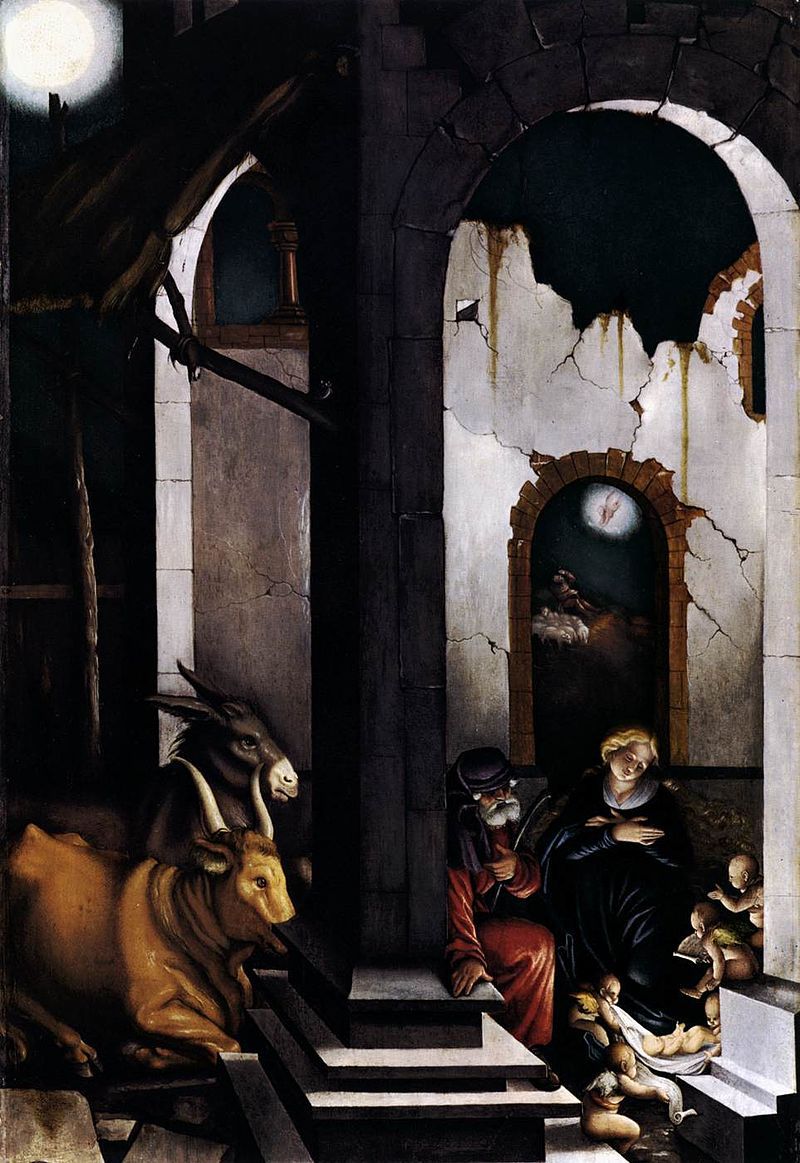
The first half of the chant references the animals present at Jesus’s birth, symbolic of God’s mysterious and lowly life as a mortal. This was a topic of great excitement during the Renaissance; people loved the idea that the animals in the stable recognized the birth of Jesus as an important event. The painting demonstrates this idea.

eb7bb60ff0ee8ce249cc2fd207662371.jpg

The second half of the text relates to the words spoken by Elizabeth when she welcomes Mary, the mother of Jesus, into her home:

“And she spake out with a loud voice, and said, Blessed art thou among women, and blessed is the fruit of thy womb.

And whence is this to me, that the mother of my Lord should come to me?” – Luke 1: 42-43

Music theory: Victoria’s use of open 5th intervals perpetuates a sense of awe in the music. In 5th intervals, the third of the chord is missing; this crucial note determines if the harmony is major or minor, so open 5ths don’t have any harmonic indication (which leaves the listener in suspense).

The music changes to a lilting triple meter as the choir sings “Allelujah!” This is an unexpected yet exciting conclusion to the piece, and it reminds me of a chorus of angels proclaiming the birth of Jesus.


About Belle qui

Thoinot Arbeau” is the pen name and an anagram of Jehan Tabourot, a Catholic priest and canon of Langres.

“Belle quit tiens ma vie” was first published in Tabourot’s 1588 dance manuscript “Orchesography”, which today is a major source of information about Renaissance dance.

This piece is a pavane: a stately dance in slow duple time, popular in the 16th and 17th centuries and performed in elaborate clothing.

Belle qui tien ma vie:

Belle qui tiens ma vie
Captive dans tes yeux,
Qui m’as l’ame ravie
D’un souris gracieux,
Viens tot me secourir
Ou me faudra mourir.
Beautiful one who holds my life
Captive in your eyes,
Who has ravished my soul
With a gracious smile.
Come to my aid
Or I must die.
Pourquoi fuis tu, mignarde,
Si je suis pres de toi?
Quand tes yeux je regarde
Je me perds dedans moi,
Car tes perfection
Changent mes actions
Why do you flee, dainty one,
If I am near you?
When I behold your eyes
I am lost inside myself
Because your perfection
[so affects my behaviour].
Tes beautes et ta graces
Et tes divins propos
Ont echauffe la glace
Qui me gelait les os,
Et ont rempli mon coeur
D’une amoureuse ardeur.
Your beauty and your grace
And your divine ways
Have melted the ice
Which was freezing my bones
And have filled my heart
With a loving ardour.
Mon ame voulait etre
Libre de passion,
Mais l’amour s’est fait maitre
De mes affections
Et a mis sous sa loi
Et mon coeur et ma foi.
My soul wanted to be
Free of passion,
But love became master
Of my affections
And put under its law
My heart and my faith.
Approche donc ma belle,
Approche toi mon bien,
Ne me sois plus rebelle
Puisque mon coeur est tien,
Pour mon mal appaiser
Donne moi un baiser.
Come near, my lovely one,
Come near, my [dear one],
Do not resist me further
For my heart is yours,
To relieve my ills
Give me a kiss.
Je meurs, mon Angelette,
Je meurs en te baisant
Ta bouche tant doucette
Va mon bien ravissant
A ce coup mes esprits
Sont tous d’amour epris.
I die, my Little Angel,
I die when kissing
Your mouth so sweet.
My very lovely one,
With that touch my spirits
Are completely lifted in love.
Plutot on verra l’onde
Contremont reculer,
Et plutot l’oeil du monde
Cessera de bruler,
Que l’amour qui m’epoint
Decroisse d’un seul point.
Sooner will waves
Flow backwards
And sooner will the moon
Cease to shine
Before the love which conquered me
Wanes a single iota.


About Ah, Robin:

This is a secular madrigal

a part-song for several voices, especially one of the Renaissance period, typically arranged in elaborate counterpoint and without instrumental accompaniment. Originally used of a genre of 14th-century Italian songs, the term now usually refers to English or Italian songs of the late 16th and early 17th c., in a free style strongly influenced by the text.

Musical Analysis:

As each voice enters the harmonies expand. Interesting enough the opening sonority begins on a G, adds a B-flat with the other ground voice, and finally an octave G in the soloist. This causes one of the significant part of the piece, the entrance of the third voice, to have a G minor harmony without the fifth of the chord.

This piece is still modal despite the use of F naturals, however, the d minor harmony begins to act as a resting point for phrases. The use of a picardy third appears numerous times through the work at the end of phrases, but not at the end as each voice begins to drop out, eventually making the music monophonic.

Ah, Robin, Gentle, Robin 

Ah, Robin, gentle, Robin,
Tell me how thy leman doth
and thou shalt know of mine.
My lady is unkind I wis,
Alack why is she so?
She lov’th another better than me,
and yet she will say no.
Ah, Robin, gentle, Robin,
Tell me how thy leman doth
and thou shalt know of mine.
I cannot think such doubleness
for I find women true,
In faith my lady lov’th me well
she will change for no new.
Ah, Robin, gentle, Robin,
Tell me how thy leman doth
and thou shalt know of mine.

  • G. Edward Bruner, DMA: “Editions and Analysis of Five Missa Beata Virgine Maria by the Spanish Composers: Morales, Guerreo, Victoria, Vivanco, and Esquivel.” DMA diss., University of Illinois at Urbana-Champaign, 1980.[facsimile: University Microfilms International, Ann Arbor, MI]
  • Gustave Reese, Music in the Renaissance. New York, W.W. Norton & Co., 1954. ISBN 0-393-09530-4
  • Apel, Willi. 1988. The History of Keyboard Music to 1700. Bloomington: Indiana University Press. ISBN 0-253-32795-4.
  • Arbeau, Thoinot. 1967. Orchesography, translated by Mary Stewart Evans, with a new introduction and notes by Julia Sutton and a new Labanotation section by Mireille Backer and Julia Sutton. New York: Dover Publications. ISBN 0-486-21745-0.


Many Much Tokens! And classes!

Mimir’s well, year 3 was a resounding success. It was really nice to be able to teach and actually have time to take classes as well as socialize.

About 6 months ago, the Autocrat, Eleanor Grey, had asked me to come teach to make sure there was once again a bardic representation at their lovely event. I agreed. Mountain freehold is a great little shire with great people. Last year, I wrote them a song because they deserved it.

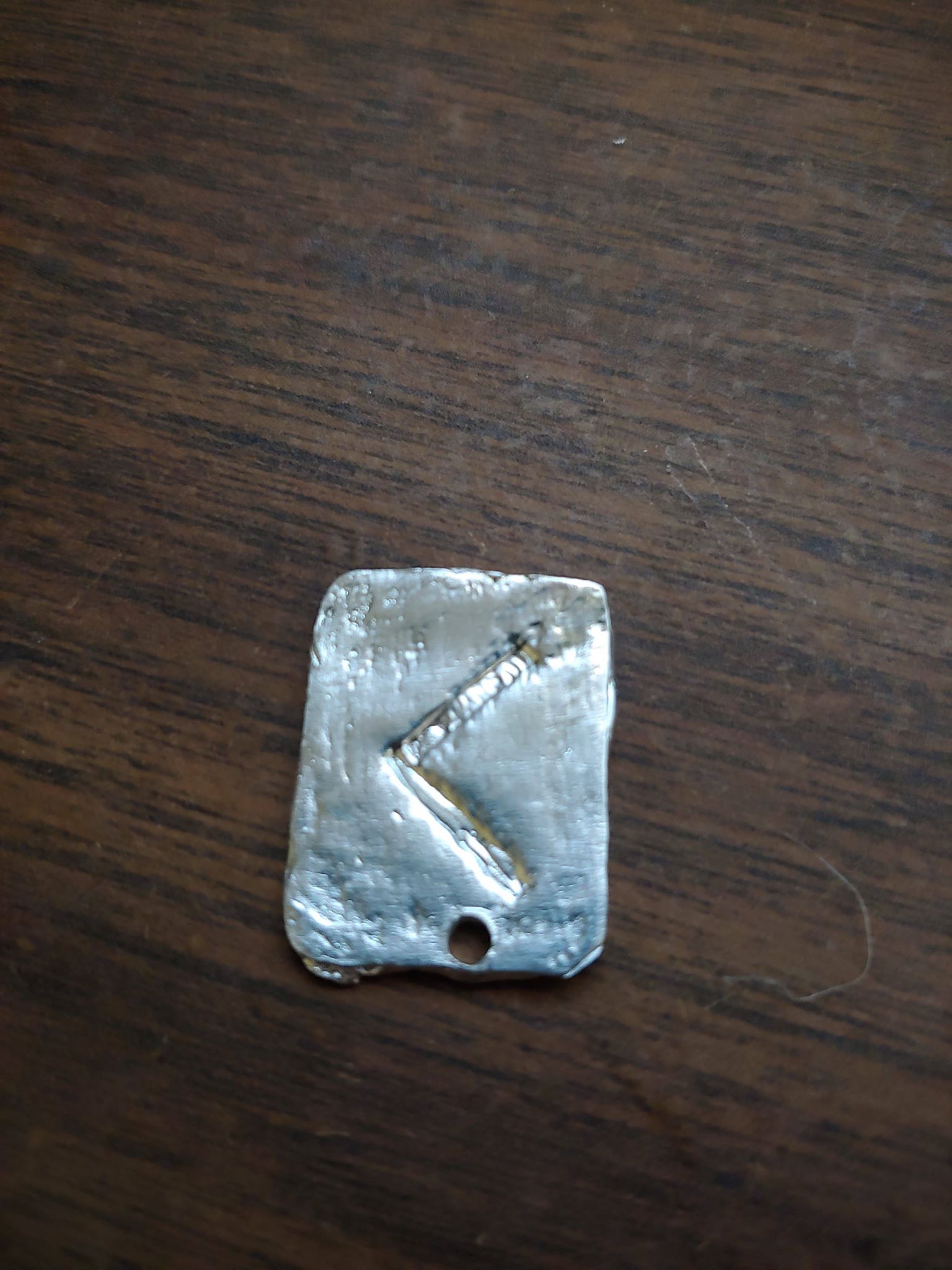
About 1.5 months ago, I was also asked if I could make the site tokens. I happily agreed. Mimir’s well is about wisdom. So, I chose to make tiny wisdom tokens. I sent Aegir the image to 3-d model as I had other work commitments I had to manage and he loves to play in fusion 360 (The 3-d modeling program we use). From there we printed and molded the tokens. She had requested that we make 100 of them.  I had also decided that I didn’t want them to look like pristine metal. So, when creating the positive before creating the mold, I covered it in modgepodge and while it was still tacky, took same sandpaper to it to make it appear more stone-like by taking some divits out of the modgepodge.

Here are the final tokens (Though this one has the hole drilled in the wrong side):


54514104_2294728344138437_8900480613199380480_n.jpg


From there, off to teach classes! I had a bright eyed and bush tailed class right at 10:00am. I always dread the first class of the day. I feel like no one wants to be there that early and no one is emotionally awake. It’s also the same as first performer stage fright. Always so hard to go on first, however, once the stage is set, everyone is ready to go!

My first class is how to warm up your body to perform. Yes, I taught this class the week before, however it is never the same. Here is the outline of the class so you know more (in a bullet form, what was gone over in the class)

  1. Why do we warm up our bodies?
    1. Athletes
    2. Protection from harm
    3. Emotionally warmed up
    4. Setting the stage
    5. Setting nerves aside
    6. Ready to move
  2. Anatomy of the mouth
    1. Lips, Teeth, Alvular ridge, Hard pallet, Soft pallet
    2. Discussion of how body is connected
    3. Posture- Demonstration
  3. Body stretches and massage
    1. Head/temples
    2. Neck
    3. Head rolls
    4. Arm body crosses
    5. Pliet
    6. Foot stretches
    7. Rag dolls
    8. Group massage
  4. Breathing
    1. Clavicle breathing
    2. Proper way to breath in (order of operations)
    3. Floor breathing
    4. Engaging diaphragm and low back muscles
  5. Breathing exercises
    1. In outs on “Straw”
    2. In outs on “Shhh”
    3. Bubbles
    4. Coughing/laughing
  6. Projection
    1. Talk about notes/polyps/hemorrhaging (Julie Andrews story)
    2. 5 locations to send sound in mouth
    3. Discovering the soft pallet
    4. Lollipops/York peppermint paddies
    5. Eyebrows/yawning
    6. Tongue twisters (Diction is done… Mommy made me…)
    7. Finding nasal air flow spot
    8. Tongue position
    9.  Dynamic projection (Using soft “stage whispers” to speak across the room)
  7. Body tension
    1. Finding tension in your body
    2. Finding good mouth space
    3. What you can do to loosen up your body

Questions:


From there, I hung out, ate, made some music with friends and enjoyed. I finally got to sing a few filks I had composed to those who had never heard them and saw the glee as disney and queen were attached to their favorite SCA activities. In addition, I got to see Aegir working in the kitchen, which he had a blast with.

My final class was just us singing period rounds. I just finished compiling a book of about 50 all period rounds (Sans “Le coq et mort”… which is a traditional, but hey, everyone likes to sing about dead chickens… plus I added the german. Morbid…dead..german… chickens). However, what makes my book different, besides it being so long, is I wrote up all the translations, IPA (Internation Phoenetic Alphabet) dictions and newspaper diction. I will be adding my written documentation on this shortly as well as the appropriate IPA charts, however, after the class, all 14 of my students were begging me to publish it now. (it was 25 pages, so I was remiss to keep printing more copies out of my pocket).  I did, however, sell the 8 copies I made for charity and donated the funds on behalf of my class.

Here is the book, documentation to come!

https://docs.google.com/document/d/1PvID7hHNG2gvJjWctuWdpQiK-OyhmB_GlVLQhHqEcI8/edit?usp=sharing

Finally, Aegir and I displayed our molds and casts we’ve been doing over the last few months. We had a BLAST telling everyone about the process. Again, making everything more accessible. We really want to make our arts accessible to people. I find it to be a gateway drug. If you find an easy/cheap way to do it, you most likely will want to explore how it was done. *GASP RESEARCH*