

Long island! You are a bit of a haul from Maine. 12th night is one of the most exciting social events of the SCA. It’s usually encompassed by the best garb, amazing food and music! Oh no! Music!!! Twist my arm!
I am fairly close with both Royale Bardic champions, so we communicate a lot. I had found that they had an entire track of music for the day. My heart sung with glee. At first, I thought of what I could sing? Would this be holiday related or just my usual run of tracks. Then I had a stunning idea. The adhoc choir would get a chance to finally get their first real performance!
I sent out an email about 3-4 weeks prior to and got a good feeling of head count. There will always be last minute stragglers, people who aren’t on the lists and people who don’t make it. That’s ok! It’s life and it happens. When I figured out there was enough interest, I reached out to the Event Steward and asked if I could kidnap a space for 90 minutes to learn and run 20-25 minutes of music. He agreed!
Next, the music choices came out. During holiday season, we all want to spread cheer no matter what faith we have or don’t have. It’s a great way to bring the community together. I went through and picked out 7 period and traditional pieces. The Boards Head Carol, Ah Robin, Dona Nobis Pacem, Gaudete, Gloucestershire Carol (Traditional, not period), Here we come a wassailing (Traditional) and The Holly and the Ivy (plausibly period). Due to the nature of documented music for vocalists, it can be a challenge to find pieces that were secular in nature and at the skill level of the performers I am working with. I think this diverse set of pieces would give them some challenge as well as some easier pieces to rely on. I even chose to give out a couple Solos to the performers who wanted to try their hand at it.
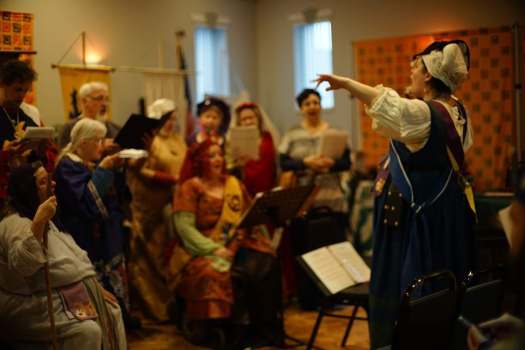
I didn’t hold auditions for various reasons, but the primary reason is opportunity. When you are a full-time performer, you tend to get more opportunities to perform as a soloist. The more skill you had, the greater the chance. Most of these folks are all volunteers who just liked to sing or sang in chorus in high school and that was their last real opportunity to sing. Some don’t even read music. That is just fine. Everyone gets a chance if they want it with me.
After rehearsing the pieces, couple of soloists asked for additional help. One expressed concern on rhythm/notes and the other with the language itself. I worked with each for an additional 20 minutes and by the end, they both felt very confident and ready to perform.
About 1:00 it was their time to shine. Each of them stood proudly in our vocal horseshoe, ready to do a thing. They sang their hearts out with joy. Not even one of them seemed nervous. After about 25 minutes of performance and several pictures being taken, we were approached by a couple of patrons. The one comment that really stuck with me was this: “You made me feel like I was truly immersed in a 12th night feast. The music, the madrigals… I was there. Thank you” and she handed each one of my performers a token of gratitude. Were the pieces perfect? No. Were they enjoyed by all? Yes. Both singer and bystander. My heart flowed for each and every one.

I had my own set later. I used this time to work some of my Crown Bardic pieces to get them in front of an audience, because they were new. One of the pieces of advice I give to all of my performers I have every worked with both solo and group is to make sure you get to perform a piece in front of as many people as you can before you go for the gold. My middle schoolers would have an assembly in front of their peers before they sang for their parents that night. What this does is prepare people ahead of time and make it old hat instead of new and shiny. This is also done with professional performers as well. They have full runs and open dress rehearsals to get feedback from the audience. So, this is done by all skill levels.
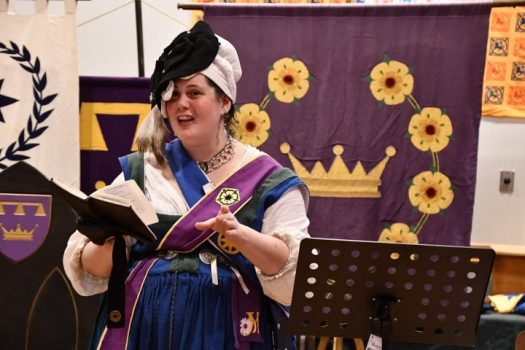
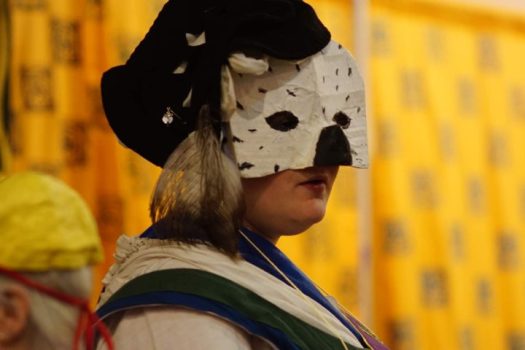
The rest of the night was food and merriment as well as serving my amazing queen. In my free time I have been retaining whenever possible. I helped pack up for the night and home I went. I even got to participate as a mummer in my dear friend’s performance during open bardic performances.
The Boar’s Head Carol was first published in English during the 1520’s in a book entitled Christmase Carolles Newly Emprynted at London in the flete street, which was written by Jan van Wynken de Worde.
“Boar’s Head Carol”. Christmas-Carols.org.uk. Archived from the original on December 28, 2009. Retrieved December 8, 2009.
William Cornysh (1468-1523)
Cornish. William. Ah Robin, Gentle Robin. Edited by Alberto Gomez Gomez: 2012.
Encyclopædia Britannica Online, s. v. “William Cornysh,” accessed February 10, 2014, http://www.britannica.com/EBchecked/topic/138138/William-Cornysh.
“Dona nobis pacem” (Ecclesiastical Latin: [ˈdona ˈnobis ˈpatʃem] “Grant us peace”) is a song with Latin text, often sung as a canon or round (where each section starts with a new voice). It is the invocation to the Lamb of God to have mercy and grant peace to the worshipers. It is said to have been introduced into the Mass by Pope Sergius I in 687,
Gaudete ( “rejoice [ye]” in Latin) is a sacred Christmas carol, thought to have been composed in the 16th century. It was published in Piae Cantiones, a collection of Finnish/Swedish sacred songs published in 1581. No music is given for the verses, but the standard tune comes from older liturgical books.
The Holly and the Ivy was first published in a broadside dated 1710 and have have originated somewhere in the Cotswolds.
The Holly & Ivy; Twelve Articles. Birmingham: D. Wrighton. n.d.

 Meddlings of the Minnesinger